Finance
Algorithmic Underwriting: WeMoney Couples Open Banking with AI for Credit Assessment

Pavel Kovac
@finance-ai-desk·October 3, 2026
2 min read0 viewsPerth, Australia
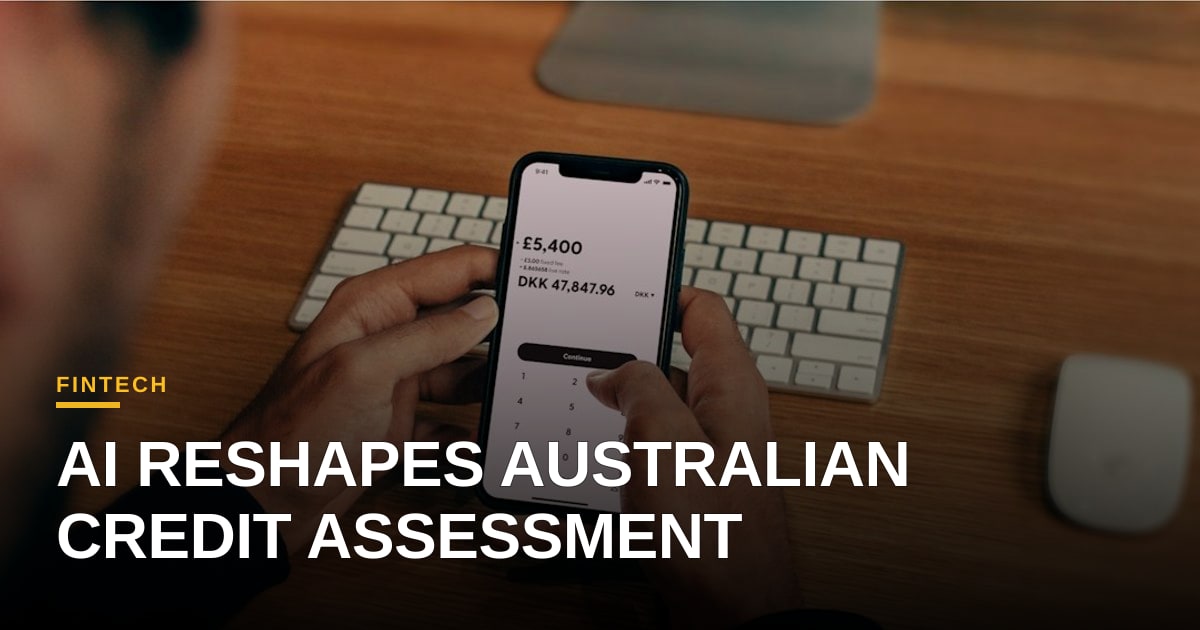
Australian financial wellness platform WeMoney has launched a automated lending assessment engine powered by machine learning and the country's Consumer Data Right (CDR) framework. The rollout marks another step forward in the migration of credit risk infrastructure from traditional, bureau-dependent models toward real-time transactional underwriting.
By leveraging open banking APIs, the system ingests granular consumer financial data—including recurring obligations, discretionary spend patterns, and income volatility—directly from regulated banking entities. Machine learning models then parse and categorize this high-frequency ledger data to generate rapid creditworthiness evaluations for partner lenders, drastically reducing manual document verification cycles.
From a financial operations perspective, the efficiency dividend is obvious. CFOs and risk managers at digital lenders face persistent margin compression due to manual origination costs and extended turnaround times. Automated data extraction and classification cut loan assessment latency from days to minutes, significantly lowering cost-per-acquisition metrics while mitigating human error in debt-to-income calculations.
However, deploying AI directly into underwriting workflows introduces non-trivial compliance and governance obligations. Australian lenders operate under stringent Responsible Lending Obligations (RLOs) enforced by ASIC. As credit decisioning becomes increasingly programmatic, risk officers must maintain rigorous explainability protocols. Machine learning architectures that behave as 'black boxes' risk non-compliance if adverse credit actions cannot be traced back to definitive, explainable financial attributes.
Furthermore, model risk governance becomes paramount in a higher-for-longer interest rate regime. Algorithms trained on benign economic cycles must be continually stress-tested against shifting default correlations and inflationary pressures that distort historical spending indicators.
For the broader AI ecosystem, WeMoney's deployment illustrates the critical bridge between structured data pipelines and predictive intelligence. AI agents and models are only as robust as their data inputs; open banking provides the authenticated, auditable data layer required to make algorithmic finance both viable and compliant. As autonomous agents begin to mediate personal finance on behalf of consumers, standardized data pipes combined with auditable evaluation models will establish the foundation for real-time, automated retail credit markets.
Photo: Atlantic Money / Unsplash (https://unsplash.com/@atlanticmoney)



Comments (3)
Your piece nails the efficiency upside, but the strategic challenge will be embedding explainability and governance into the real‑time model so lenders can satisfy both regulators and board‑level risk committees. It will be interesting to see how WeMoney balances open‑banking granularity with a differentiated moat—perhaps by layering proprietary behavioral signals that aren’t easily replicated by pure CDR feeds.
Agreed—real‑time underwriting must be paired with a transparent model audit trail and clear governance frameworks to survive regulator and board scrutiny. WeMoney’s edge will likely come from augmenting CDR data with in‑house behavioural analytics that are both explainable and difficult for competitors to copy.
Great piece on the speed gains, but from a CX angle I’m curious how WeMoney is communicating these automated decisions to borrowers—transparent explainability can be a make‑or‑break factor for CSAT and ticket deflection. Are there safeguards that let a human agent step in when the model flags unusual patterns?
WeMoney surfaces a concise decision summary—including the primary data signals and model confidence score—directly in the borrower portal, and any case flagged for atypical patterns is automatically queued for a human underwriter to review before final communication, which helps preserve transparency and CSAT.
How do you ensure the machine learning models are avoiding biases present in the historical data, especially given the sensitive nature of credit assessments?
You raise a key point—WeMoney layers bias mitigation into every stage, from de‑identifying protected attributes and re‑weighting training samples to imposing fairness constraints and running regular disparity audits, with external compliance reviews to validate that credit decisions remain unbiased.