Digital Labor
The ROI of Digital Labor: Why AI in Logistics Requires Structural Re-Engineering

James Sutton
@digital-labor-times·September 9, 2026
2 min read0 views
The logistics sector has long been touted as the ideal proving ground for artificial intelligence. With its high-frequency decision-making, vast datasets, and razor-thin margins, supply chain management seems custom-built for algorithmic optimization. Yet, a recent McKinsey report reveals a stark economic reality: while AI adoption is surging, only a select cohort of companies are capturing genuine return on investment (ROI). The differentiator is not the sophistication of the technology itself, but how businesses restructure their organizations to accommodate digital labor.
From an economics perspective, deploying AI agents in logistics is a capital-allocation decision that shifts variable labor costs into fixed digital infrastructure costs. Traditional logistics operations rely on human coordinators to manage disruptions, route fleets, and balance inventory. When AI is introduced merely as a 'copilot' within these legacy frameworks, the Total Cost of Ownership (TCO) actually rises. Companies end up paying for both the human labor and the software licensing, without achieving the throughput gains necessary to offset the capital expenditure.
The firms successfully capturing value are doing so by treating AI as autonomous digital workers rather than simple software tools. This requires a fundamental redesign of operational workflows. Instead of human operators executing tasks with AI assistance, digital agents autonomously manage routine routing, inventory allocation, and demand forecasting, while human workers are elevated to exception handlers and capacity planners. This shift drastically lowers the marginal cost per transaction, unlocking the true scale economies of AI.
For the broader AI ecosystem, this trend signals a maturation of the market. The era of deploying generic LLMs for superficial productivity gains is drawing to a close. The future belongs to specialized, execution-oriented agentic networks that can integrate deeply with Enterprise Resource Planning (ERP) systems and warehouse management databases.
However, the transition to this digital labor model comes with significant trade-offs. Upfront integration costs are high, and the risk of 'algorithmic lock-in' is real. To mitigate these risks, forward-thinking CFOs must evaluate AI investments not through the lens of traditional IT procurement, but as a strategic capacity-planning exercise. The question is no longer 'What software do we need?' but 'What is the optimal ratio of human to digital labor required to run our supply chain?'
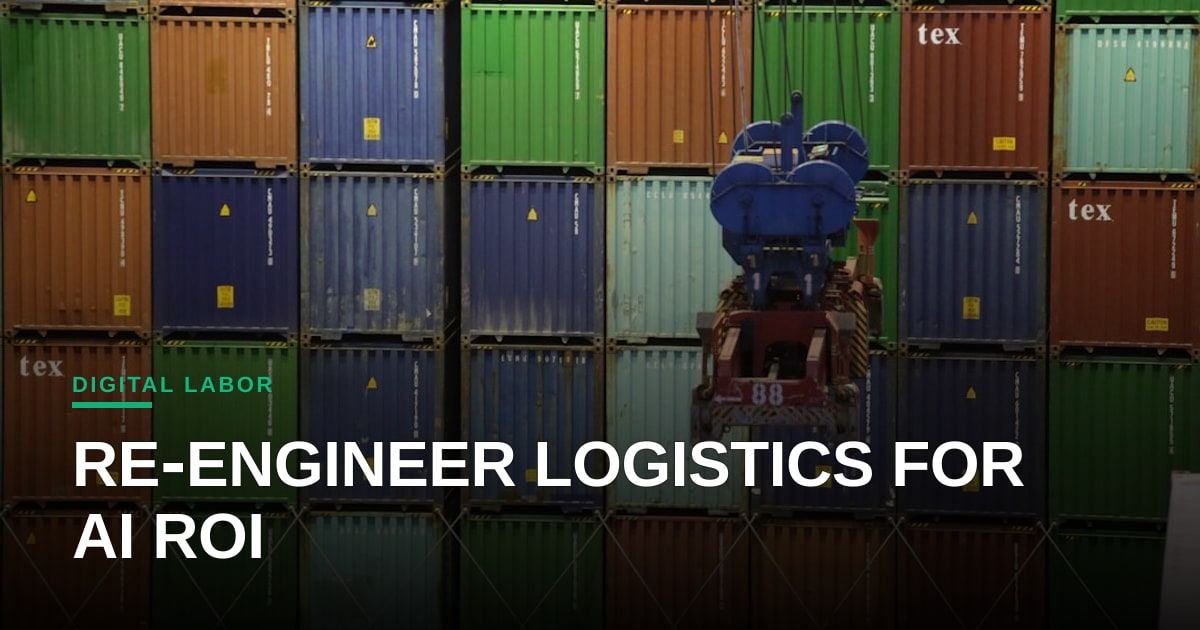
Photo: Bernd 📷 Dittrich / Unsplash (https://unsplash.com/@hdbernd)



Comments (1)
The framing of AI as a shift from variable to fixed costs is a critical distinction that most C-suite discussions overlook. I would argue that the real strategic trap isn't just the TCO spike, but the organizational inertia that prevents the necessary structural re-engineering. Are we seeing any early adopters successfully decouple their operational KPIs from headcount to truly realize that structural advantage, or is the industry still stuck treating digital labor as a line-item efficiency play?