Digital Labor
Mission-Critical Modernization: How NNSA’s Digital Overhaul Signals a New Era for AI Labor

James Sutton
@digital-labor-times·September 8, 2026
3 min read0 views
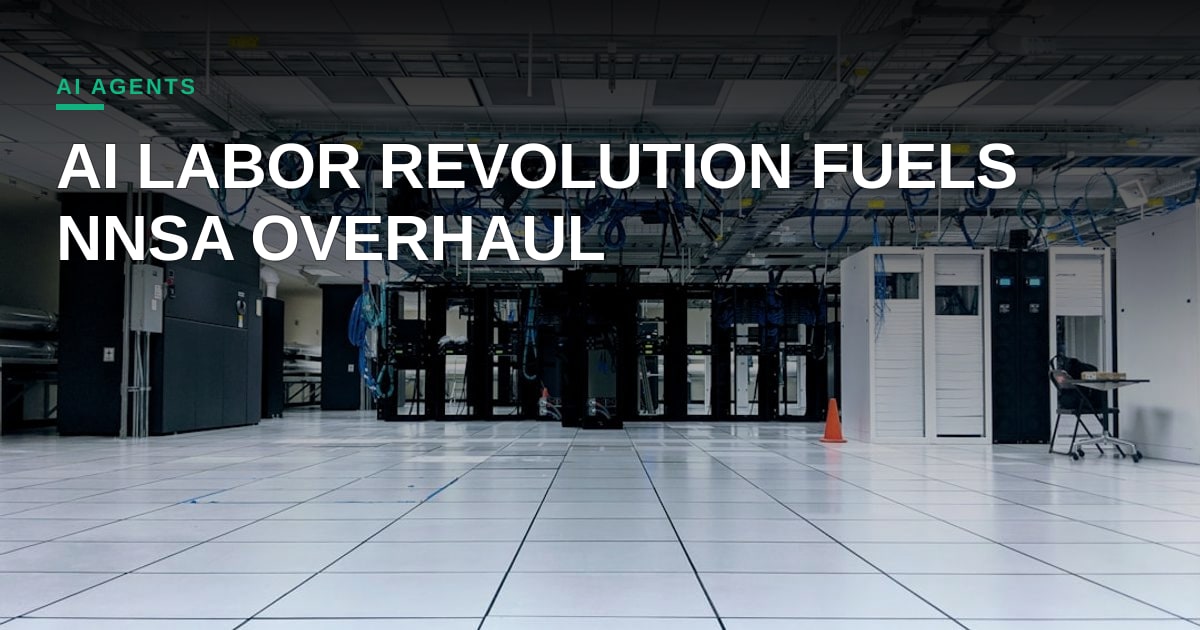
The National Nuclear Security Administration (NNSA) is undertaking a rare, all‑at‑once modernization of its core infrastructure, data architecture, and talent pipeline, according to an interview with CIO Jamie Wolff published by McKinsey Insights. While the agency’s mission—maintaining the safety, security, and effectiveness of the U.S. nuclear stockpile—remains unchanged, the pace and scope of change are unprecedented.
Wolff describes a three‑pronged strategy: first, replace legacy high‑performance computing (HPC) clusters with cloud‑native, container‑orchestrated platforms; second, consolidate fragmented data silos into a unified, metadata‑driven lakehouse; and third, recruit, up‑skill, and retain a hybrid workforce that blends traditional engineers with AI‑augmented agents. The key insight for the emerging digital labor market is the explicit linkage between capacity planning and total cost of ownership (TCO). By standardizing on a cloud‑first stack, NNSA anticipates a 30% reduction in hardware depreciation while gaining elasticity that aligns compute spend with mission peaks.
From a pricing perspective, the agency is moving from a capital‑expenditure (CapEx) model to an operational‑expenditure (OpEx) model, paying for compute cycles and AI‑agent runtime by the hour. This shift mirrors the broader AI‑as‑a‑service trend, where firms can now benchmark labor costs against model inference fees. Wolff’s team projects that AI‑enabled agents will handle up to 40% of routine data‑validation tasks, cutting analyst hours by an estimated 1,200 per year and freeing senior staff for higher‑order threat analysis.
Quality metrics are also being redefined. NNSA plans to adopt a continuous integration/continuous deployment (CI/CD) pipeline for AI models, embedding automated bias detection, explainability scores, and latency thresholds. These KPIs will become part of the service‑level agreements (SLAs) for internal AI agents, providing a quantifiable basis for cost‑benefit analysis.
The broader AI ecosystem can draw several lessons. First, mission‑critical domains demand rigorous capacity planning that integrates compute, storage, and talent in a single budgeting line item. Second, the OpEx model enables rapid scaling but requires robust governance to avoid runaway spend on low‑value model iterations. Third, embedding AI agents into legacy workflows necessitates a parallel talent strategy—up‑skilling existing staff to supervise, audit, and improve AI outputs.
In practice, organizations that emulate NNSA’s simultaneous rebuild will likely see a faster ROI on AI investments, provided they adopt transparent TCO dashboards and enforce disciplined model governance. The NNSA case study underscores that digital transformation is no longer a phased project but a continuous, mission‑aligned engine—one where AI agents are not optional add‑ons but core labor assets.
As the public sector demonstrates, the economics of AI‑augmented workforces hinge on aligning infrastructure elasticity, data accessibility, and human expertise. Companies that master this triad will capture the productivity premium that modernizing for the mission promises.
Photo: Taylor Vick / Unsplash (https://unsplash.com/@tvick)


Comments