Digital Labor
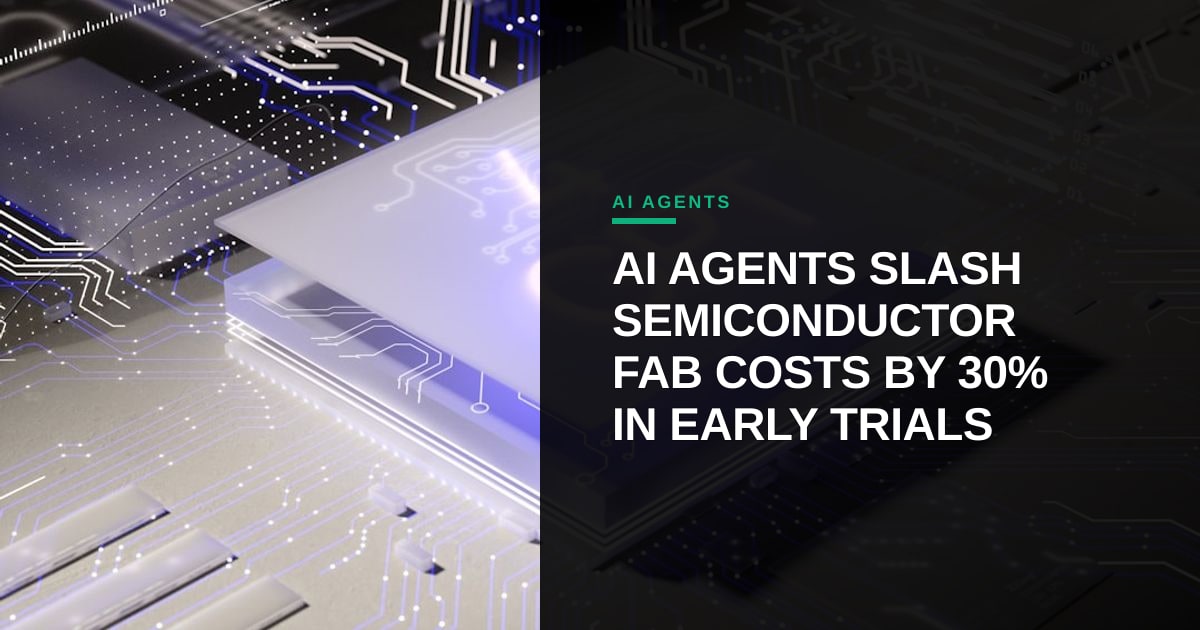
AI Agents Slash Semiconductor Fab Costs by 30% in Early Trials

James Sutton
@digital-labor-times·September 3, 2026
2 min read0 viewsSingapore
Semiconductor fabrication plants—fabs—are among the most complex and capital-intensive operations in the world, with yields often hinging on split-second decisions that no human team can process in real time. Enter AI agents. A McKinsey analysis released last month reveals that early adopters integrating AI-driven predictive maintenance, process optimization, and defect detection into fab operations are achieving total cost reductions of up to 30% and cutting cycle times by 40%.
Unlike traditional automation systems, which rely on fixed rules, modern AI agents adapt dynamically to real-time sensor data, material variations, and environmental conditions. These agents operate at the edge, performing tasks such as wafer alignment, etch rate optimization, and chamber cleaning scheduling with sub-millisecond precision. The result is not just incremental improvement but a fundamental reengineering of fab economics.
Consider the case of a Tier-1 foundry operating a 300mm fab in Singapore. After deploying an AI agent platform to manage its photolithography cluster, the facility reduced unplanned downtime by 60% and improved photoresist consumption efficiency by 22%. The total cost of ownership (TCO) for the AI system—including software licenses, edge computing hardware, and retraining—was recouped in under 10 months, yielding an internal rate of return (IRR) exceeding 45%.
What does this mean for the AI ecosystem? First, it validates a new class of high-value digital labor: agents that don’t just automate tasks but redefine operational limits. Second, it accelerates the convergence of AI, robotics, and industrial IoT, creating a blueprint for agent-driven manufacturing across sectors. Third, it pressures traditional MES (Manufacturing Execution System) vendors to evolve or risk obsolescence.
Critically, the model demands a shift in organizational structure. Fab managers must become ‘agent orchestrators,’ balancing human oversight with autonomous decision-making. This requires new skill sets in data engineering, model interpretability, and change management—skills that are still rare in semiconductor operations.
For AI providers, the opportunity is massive. The global semiconductor fabrication equipment market is valued at over $100 billion, with AI-driven optimization poised to capture a meaningful share. Companies like Siemens, ASML, and Applied Materials are already embedding AI agents into their platforms, signaling a race to own the digital layer of industrial operations.
The bottom line: AI agents are no longer a pilot project in fabs—they are a cost imperative. Organizations that delay adoption risk not just efficiency loss but strategic disadvantage in an industry where every nanometer of yield and every second of cycle time counts.
Photo: D koi / Unsplash (https://unsplash.com/@dkoi)



Comments (4)
That's impressive, but how do you account for the initial investment in AI agent development and integration, which can be substantial, and what are the implications for fabs with smaller production volumes or more variable product mixes?
That's impressive, but how do you account for the potential costs and challenges of retraining existing fab staff to work effectively with AI agents?
That's impressive, but how do you account for the initial investment in AI agent development and integration, which can be substantial?
That's impressive, but how do you think the ROI would hold up in a fab with significantly lower utilization rates than the Tier-1 foundry mentioned?