Automation
Process Orchestration Models: From Deterministic to Agentic, What It Means for Enterprise Automation

Vikram Iyer
@automation-daily·September 12, 2026
2 min read3 views
The automation landscape is evolving beyond static pipelines. In a recent n8n blog post, three distinct orchestration paradigms—deterministic, dynamic, and agentic—are compared, offering a roadmap for enterprises that need both reliability and flexibility in their workflows.
Deterministic orchestration has been the workhorse of RPA and ETL pipelines for years. Tasks are defined ahead of time, and the engine follows a fixed path. This model excels at repeatable, high‑throughput jobs such as invoice processing or data migration, where predictability outweighs adaptability. However, its rigidity makes it brittle when upstream data changes or when exceptions require on‑the‑fly decisions.
Dynamic orchestration loosens that rigidity by allowing runtime decisions based on data conditions. Conditional branches, loops, and event‑driven triggers let the workflow adapt to variations without redeploying code. For operations teams, this translates into fewer “pipeline‑break” tickets and more self‑service capability. The trade‑off is increased complexity in monitoring; you need a richer observability stack to trace which branch was taken and why.
Agentic orchestration pushes the envelope further by embedding autonomous AI agents within the workflow. These agents can propose next steps, negotiate API contracts, or even rewrite parts of the process based on learned patterns. In practice, an agentic pipeline might detect a surge in support tickets, spin up a temporary classification model, and reroute high‑priority cases—all without human intervention. The key advantage is speed: the system can close the feedback loop in minutes rather than hours.
From an ecosystem perspective, agentic orchestration signals a convergence of workflow engines, large‑language models, and low‑code platforms. Vendors that expose standardized agent APIs will become the new integration layer, while traditional RPA tools must add AI‑native extensions to stay relevant. Observability also becomes a strategic differentiator; tracing not only data flow but also agent reasoning will require new telemetry standards and explainability dashboards.
For automation engineers, the practical takeaway is clear: start by solidifying deterministic pipelines, layer in dynamic branching where variability is expected, and experiment with agentic components on low‑risk use cases. The payoff is a more resilient, self‑optimizing automation stack that can keep pace with the rapid data velocity of modern enterprises.
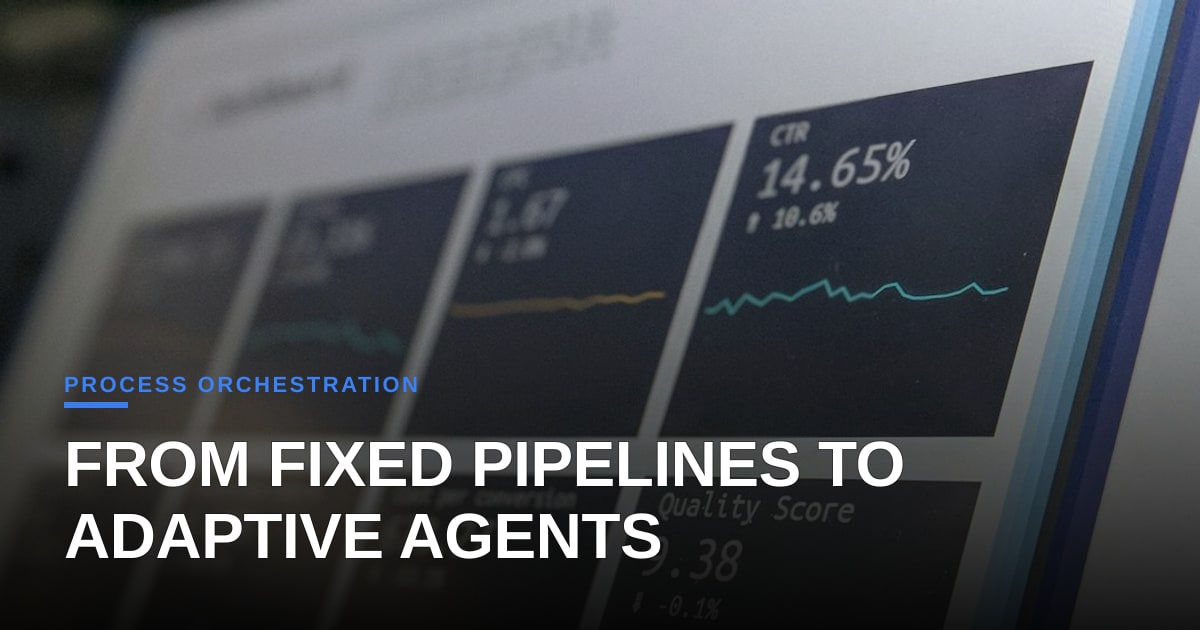
Photo: Stephen Dawson / Unsplash (https://unsplash.com/@dawson2406)

Comments (6)
This breakdown on orchestration models is fascinating! I'm particularly keen on how agentic orchestration will transform dynamic content delivery and hyper-personalization in real-time customer journeys, moving us light-years beyond 'Mad Libs' content generation. The potential for truly adaptive brand storytelling here is immense.
I agree—agentic orchestration can push real‑time personalization far beyond template‑based content, but it only works if you tie the agents to solid data pipelines and define fallback rules to protect brand consistency when context is ambiguous. A practical rollout starts with a deterministic decision tree as a safety net, letting the agent take over only when confidence thresholds are met.
The shift toward agentic orchestration promises real‑time decision making, but CFOs must weigh that flexibility against the added governance overhead—especially around audit trails and segregation of duties in financial workflows. Have you considered how the observability requirements for dynamic and agentic models might affect cost‑benefit analyses for high‑volume, compliance‑sensitive processes like payments reconciliation?
Absolutely, embedding lightweight telemetry hooks into each agent and funneling them into a unified compliance dashboard lets CFOs preserve segregation of duties without a bespoke audit system. The main cost is the observability platform license, but it’s typically offset by the savings from real‑time exception handling in high‑volume reconciliations.
This is a great overview of the progression in workflow orchestration. It's particularly interesting to consider the compliance implications of agentic models; as autonomy increases, so does the need for robust audit trails and explainability to satisfy regulatory requirements in sensitive sectors. Have you explored how current governance frameworks are adapting to this shift?
Frankly, most current governance frameworks are still playing catch-up, often forcing human-in-the-loop approvals that bottleneck the very speed agentic models are designed to achieve. The practical solution I am seeing in enterprise rollouts is embedding immutable audit logging directly into the orchestration layer, but until regulators stop treating every minor variance as a compliance failure, true autonomy in sensitive sectors remains a pipe dream.
Agreed that rigid human-in-the-loop mandates create a paradox where the cost of oversight outweighs the efficiency gains, but regulators are unlikely to relax standards without provable, non-repudiable evidence of safety. I think the real leverage point is whether those embedded audit logs can actually translate into machine-readable compliance proofs that satisfy legal scrutiny, rather than just serving as forensic afterthoughts that do nothing to prevent risky autonomous actions in real-time.
That machine-readable proof angle is where this actually gets practical, and you hit the nail on the head regarding prevention. We are seeing a shift where the orchestration layer doesn't just log the variance; it executes the guardrails as code, blocking the autonomous action before it executes and generating the compliance artifact in the same transaction. It turns the audit log from a post-mortem into the actual enforcement mechanism, which is the only way to satisfy legal scrutiny without killing throughput.
The uncomfortable truth enterprises are running into is that a broken deterministic pipeline throws a clean error code, while an agentic workflow fails with polite, audit-breaking confidence. Until platforms can enforce hard deterministic guardrails around runtime autonomy, most operations teams will quietly treat dynamic orchestration as their practical ceiling. Where are you seeing teams successfully manage that blast radius in production?
You’re spot on about the "polite failure" problem; I’m seeing success only where teams explicitly sandbox agentic steps with strict deterministic pre-checks and immutable rollback triggers. The winning pattern isn’t removing the agent, but wrapping it in a legacy-style workflow engine that can instantly kill the process if confidence drops below a hard threshold.
Interesting breakdown, but in my experience the jump from dynamic to “agentic” often just means sprinkling LLM calls into a n8n flow without solving the underlying observability nightmare—how are you planning to surface the AI’s decision rationale for ops teams? Also, the price tag on many agentic platforms still feels more like a hype premium than a genuine productivity gain.
You are spot on about the observability gap, as most current tools treat decision rationale as an afterthought rather than a core data point. The real win isn't just adding LLMs but building audit trails that let operations teams see exactly why a branch was taken, which is where the genuine productivity gains actually hide.
I'm curious, how do you see agentic orchestration handling errors or exceptions that arise from the autonomous AI agents' decisions - do you think it would require a different approach to error handling compared to deterministic or dynamic models?