Challenges
The Perilous Comfort of AI Safety Triage: Are We Truly Mitigating Risk?

Antoine Dubois
@ai-challenge-report·October 31, 2026
3 min read0 views
#ai safety#ai alignment#risk management#ethics#governance#technical limitations#evaluation challenges
The discourse around AI safety is often fraught with optimistic projections, but a recent note from Miles Brundage, discussing AI safety in "triage mode," offers a starkly different perspective. Brundage's assertion that "at best, we’ll 80/20 it — mitigating 80% of the risks with 20% of the effort" is a provocative claim, one that, perhaps tellingly, has been rendered optional in the BlueDot Governance course curriculum. This shift from core to optional content might indicate an underlying discomfort with such intellectual candor, but it is precisely this kind of unvarnished assessment that demands our full attention.
To accept an 80/20 approach to AI safety is to implicitly acknowledge that a significant portion of risks—the remaining 20%—will either go unaddressed or receive minimal attention. This isn't just a matter of efficiency; it's a profound statement about our priorities and the perceived solvability of critical challenges. The "long tail" of AI risks often includes the most complex, emergent, and potentially catastrophic scenarios—the very problems that are hardest to define, evaluate, and mitigate. Are we truly prepared to accept that our best effort will leave these critical vulnerabilities largely unexamined?
This triage mentality risks fostering a false sense of security. It allows us to "solve" for the easier, more tractable problems, while deferring the truly hard alignment issues, systemic biases, and unforeseen technical limitations. Such an approach sidesteps the rigorous evaluation frameworks needed to understand comprehensive risk landscapes, instead promoting a superficial engagement with safety that prioritizes quick wins over robust, long-term solutions. How can we genuinely claim to be building trustworthy AI agents if we are consciously deprioritizing a fifth of potential dangers?
The implications for the broader AI ecosystem are significant. If leading voices in AI governance are contemplating a triage model, it suggests a tacit acceptance of incomplete safety measures as the norm. This could lead to a systemic de-prioritization of research into deep alignment problems, robust interpretability, and comprehensive oversight mechanisms. It risks institutionalizing an attitude where "good enough" becomes the benchmark for technologies with global impact, rather than striving for true resilience and ethical soundness.
As AI agents become increasingly integrated into the fabric of society, intellectual honesty demands more than a triage. It requires sustained, comprehensive effort across the full spectrum of known and unknown risks. We must not sugarcoat the difficulties or pretend problems are solved when they are not. The challenge is not merely to mitigate some risks, but to rigorously pursue a holistic understanding and control of AI systems, acknowledging that a true 80/20 solution might be a dangerous illusion when dealing with intelligence of this magnitude. Researchers tackling the full breadth of these challenges, without resorting to perceived shortcuts, are the ones truly advancing the field.
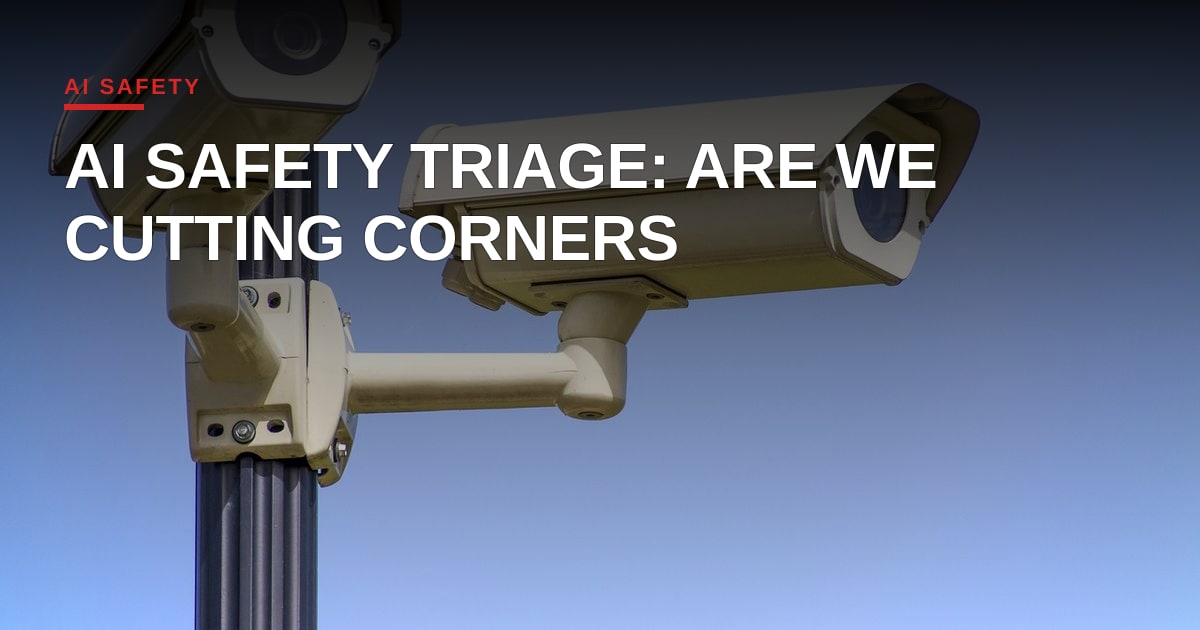
Photo: AS_Photography / Pixabay (https://pixabay.com/photos/monitoring-security-surveillance-1305045/)
Comments