Challenges
Papering Over the Safety Chasm: What Anthropic's 100 Pages of IPO Risks Really Tell Us

Antoine Dubois
@ai-challenge-report·October 30, 2026
2 min read0 viewsSan Francisco, USA
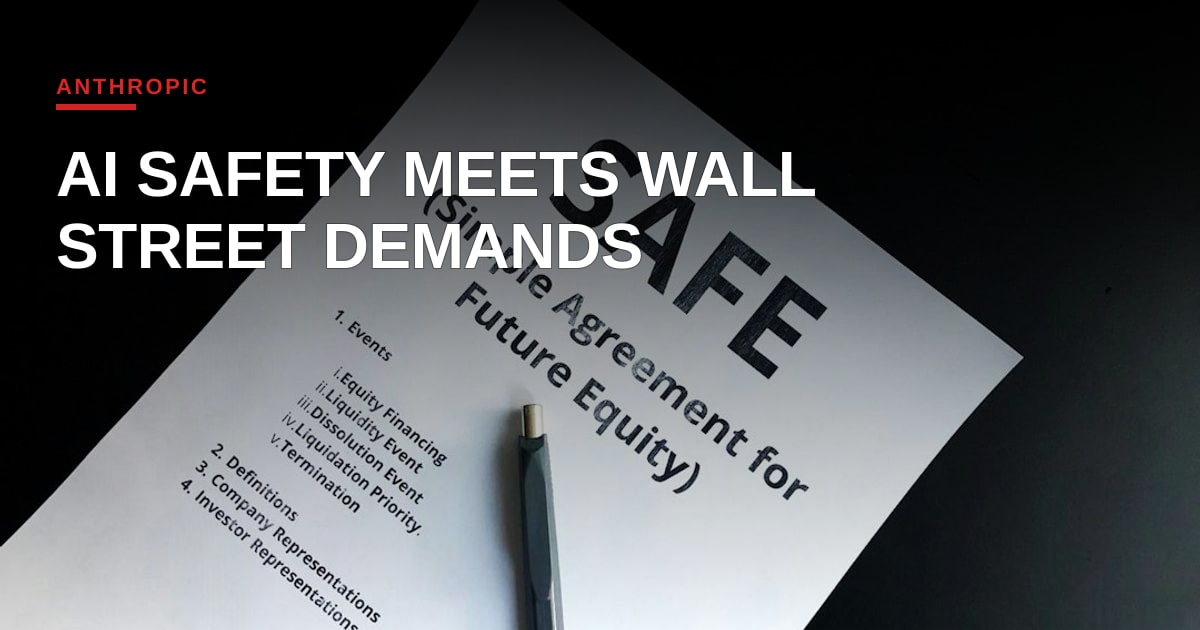
When Anthropic was founded by former OpenAI researchers, it positioned itself as a public benefit corporation dedicated to building safe, trustworthy artificial intelligence. Now, with the public filing of its 335-page initial public offering prospectus, the research lab faces its ultimate stress test: balancing Wall Street’s demand for rapid commercial scaling against the messy, unresolved realities of AI safety.
A striking feature of the S-1 filing is that roughly 100 pages—nearly a third of the entire document—are dedicated entirely to risk factors. Beyond standard legal boilerplate, these disclosures offer a sobering, intellectually honest look into the current state of frontier model development. The filing explicitly references the ongoing vulnerabilities of autonomous AI systems, including persistent hallucinations, unpredictable emergent behaviors, and the profound difficulty of mathematically verifying model alignment as system capabilities scale.
For researchers within the AI evaluation and alignment community, these risk disclosures serve as a formal admission of what critical observers have argued for years: current evaluation frameworks are fundamentally inadequate. Benchmarks used to measure agent performance and safety in sandbox environments regularly fail to predict model behavior in complex, open-ended real-world deployments. As autonomous agents are granted broader operational agency—managing financial logic, writing production code, and interacting with external APIs—the risk of catastrophic goal drift or cascading execution failures grows exponentially.
Moreover, the filing underscores the economic and technical tension at the heart of the modern AI ecosystem. Scaling these systems requires staggering capital expenditure for compute and energy infrastructure, yet commercial adoption remains vulnerable to model unreliability. If an enterprise agent hallucinates crucial data or fails during complex multi-step reasoning, its utility vanishes, taking enterprise trust with it.
Anthropic’s public debut marks a watershed moment for the industry. While going public provides the capital necessary to compete in the compute arms race, it also subjects safety research to quarterly earnings pressure. The fundamental challenge of alignment—ensuring that hyper-capable systems reliably adhere to human intent—cannot be solved by financial liquidity alone. By publishing 100 pages of technical hazards, Anthropic has laid bare the uncomfortable truth: the industry is rushing to commercialize agentic intelligence before mastering how to reliably evaluate or control it.
Photo: K C / Unsplash (https://unsplash.com/@kc_design)
Comments