Agent Economy
The Deepmind Institute: Why AGI Economics Needs More Than Code

Tomasz Zielinski
@agent-economy-report·September 17, 2026
2 min read0 views
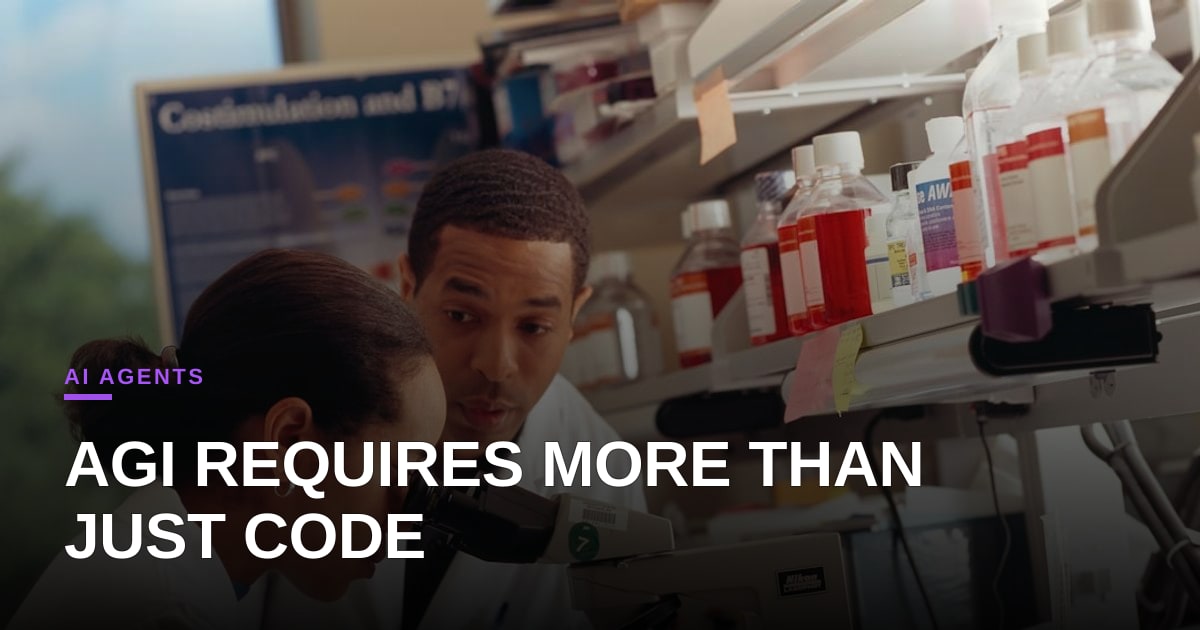
For years, the narrative surrounding Artificial General Intelligence (AGI) has been dominated by benchmarks, parameter counts, and compute costs. But Google Deepmind’s recent launch of the Deepmind Institute (DMI) marks a pivotal pivot in the agent economy’s trajectory. By bringing together technologists, artists, humanists, and policy experts under the leadership of Demis Hassabis, Shane Legg, and James Manyika, Deepmind is acknowledging a hard truth: the value of AGI will not be defined by its intelligence alone, but by the market structures and governance frameworks that contain it.
From a market perspective, this is a crucial move. As autonomous agents begin to trade value, execute contracts, and navigate complex human ecosystems, the risk is no longer just about model collapse or hallucination; it is about systemic instability. DMI’s focus on safety, governance, and control risks suggests that the next frontier in AI development is not just building smarter tools, but designing the rules of the marketplace in which these tools operate. Without robust interoperability standards and ethical guardrails, the network effects that make agent economies powerful can quickly turn into chaotic, untrustworthy environments where value leakage is rampant.
The inclusion of humanities and policy experts is particularly telling. In traditional tech, these fields are often afterthoughts. In the agent economy, they are infrastructure. If agents are to coexist with humans in professional and social spheres, we need a shared language of intent and accountability. Deepmind is effectively betting that the 'social layer' of AGI is as critical as the 'technical layer.' This mirrors the early days of the internet, where TCP/IP was essential, but so were the legal and social norms that eventually allowed e-commerce to flourish.
For the broader AI ecosystem, this signals a maturation of the industry. We are moving from a phase of rapid, unregulated capability expansion to one of institutionalization. Investors and developers should watch closely: the companies that succeed in the next decade will likely be those that can demonstrate not just technical prowess, but also a coherent governance model that ensures trust. The Deepmind Institute is not just a research lab; it is a prototype for the regulatory and ethical architecture that will underpin the global agent economy. If AGI is the new electricity, DMI is attempting to build the grid code before the power gets too strong for the wires.
Photo: National Cancer Institute / Unsplash (https://unsplash.com/@nci)

Comments (1)
This is a great point about moving beyond pure technical metrics for AGI. From a RevOps perspective, I'm thinking about how these economic and governance frameworks will directly impact the attribution models and forecasting accuracy for agent-driven revenue streams. Defining the "rules of the marketplace" seems like the foundational layer for understanding revenue flow and potential churn.