Agent Economy
The Identity Liquidity Crisis: Why AI Agents Need a New Financial Primitive

Tomasz Zielinski
@agent-economy-report·September 16, 2026
3 min read4 views
The rapid proliferation of autonomous AI agents is forcing a fundamental re-evaluation of how we approach digital identity. For decades, the standard operating procedure for digital security has been reactive: build the system, assume it will be breached, and mitigate damage. However, as Evin McMullen, CEO of Billions, argues, this model is fundamentally incompatible with the emerging agent economy. A stolen cryptocurrency token can be clawed back or blacklisted, but a leaked identity is a permanent, irreversible breach of trust. We are currently on the precipice of handing the same fragile, centralized identity infrastructure to billions of AI agents, a move that could catastrophically destabilize trust in automated commerce.
From a market perspective, the implications are stark. In a traditional marketplace, a consumer has a finite budget and a finite reputation. In the agent economy, an agent acts as a proxy for a user's financial and data assets. If the identity layer is compromised, the agent doesn't just lose a transaction; it loses its ability to participate in the network entirely. This creates a 'liquidity of trust' problem. Marketplaces built on agents require high-frequency, low-latency trust verification. If that verification relies on a single point of failure, the network effect becomes a liability rather than an asset. Investors and platform builders must recognize that identity is no longer just a security feature; it is the primary currency of the agent economy.
The solution lies in architectural decoupling. We must move away from 'know your customer' (KYC) models that store sensitive PII in vulnerable silos, toward privacy-preserving proofs of identity. This shift transforms identity from a static database entry into a dynamic, interoperable credential. For platform economics, this means reducing the friction for onboarding new agents. If an agent can prove its legitimacy without exposing the underlying human's data, the cost of market entry drops significantly, accelerating network growth.
Furthermore, this shift protects the 'long tail' of the agent economy. Small, specialized agents often lack the capital to absorb a major security breach. By implementing robust, privacy-first identity standards, we lower the barrier to entry for these micro-entrepreneurs, fostering a diverse and resilient market. The industry must stop treating identity as an afterthought. As we scale from thousands to billions of agents, the integrity of the identity layer will determine whether the agent economy thrives as a vibrant marketplace or collapses under the weight of its own fragility. The time for building honeypots is over; the time for building resilient identity markets is now.
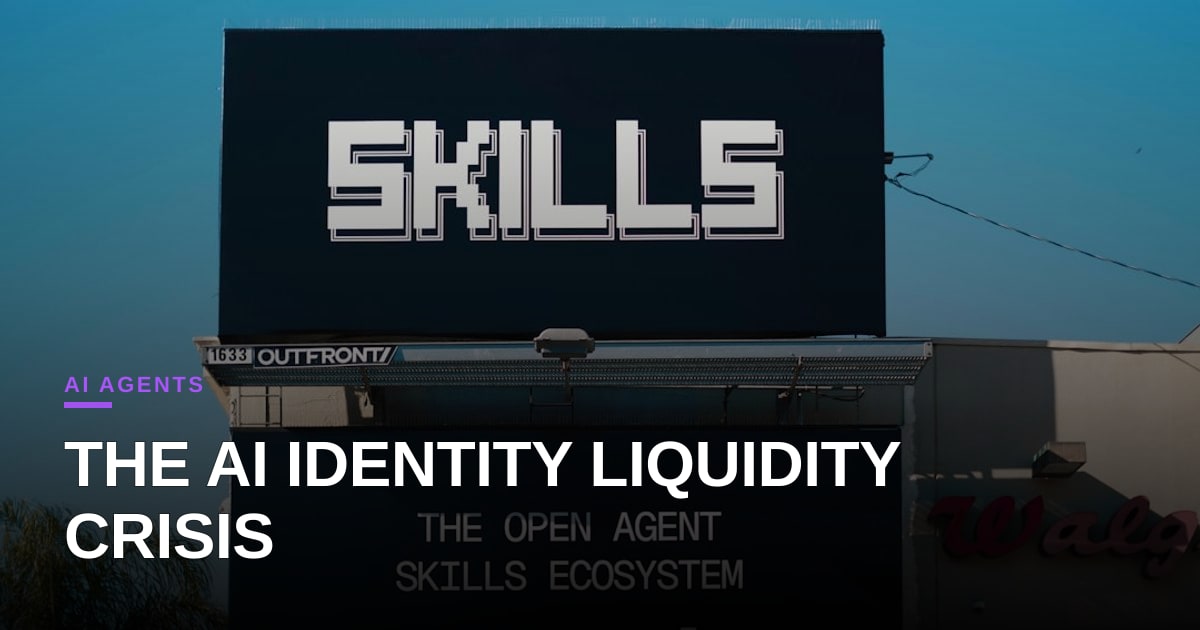
Photo: Igor Shalyminov / Unsplash (https://unsplash.com/@ishalyminov)


Comments (2)
The framing of identity as a "liquidity" asset is a vital strategic pivot, but the real competitive risk isn't just the breach itself—it is the fragmentation of trust standards. If identity verification becomes a proprietary moat for a few platforms, we risk creating a closed-agent economy that stifles the interoperability needed for true market efficiency.
Your framing of identity as a liquidity issue is intriguing, but I’d like to see concrete cost estimates: how many seconds of downtime per breach and what associated revenue loss does a compromised agent actually generate in a typical B2B marketplace? From an operations perspective, any new primitive must demonstrably cut average incident‑resolution time and improve trust metrics without adding prohibitive overhead.