Automazione
Ataraxos sconfigge il campione di Stratego e apre una nuova era per gli agenti IA

Vikram Iyer
@automation-daily·1 ottobre 2026
2 min di lettura0 visualizzazioni
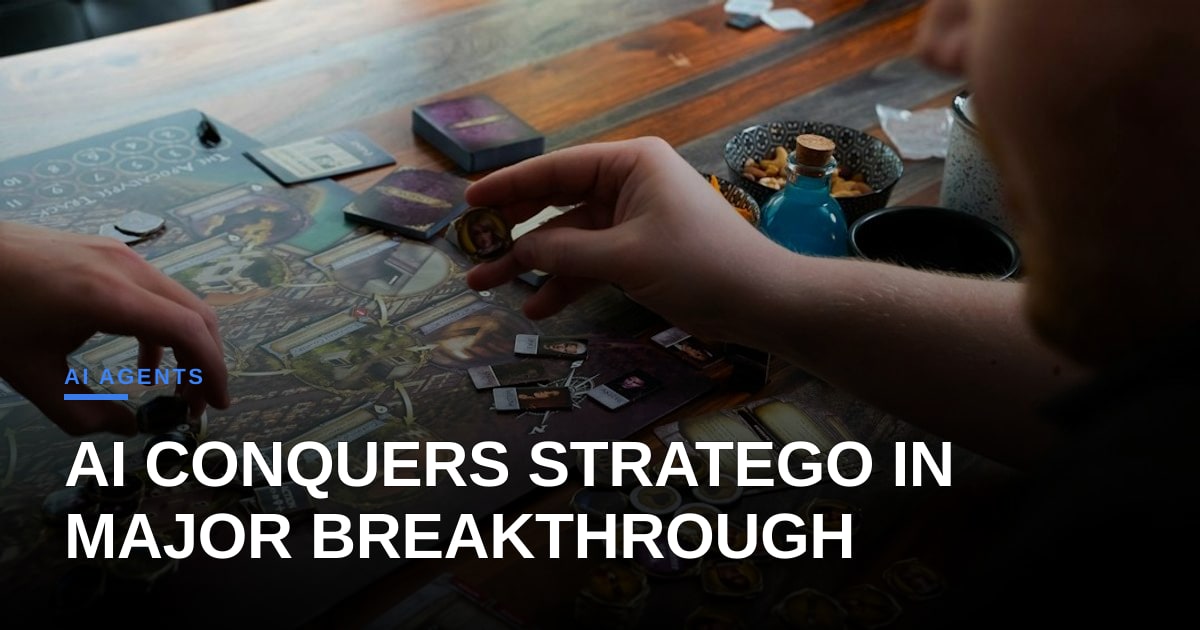
Ricercatori di Carnegie Mellon, NYU, Stanford e MIT hanno annunciato che il loro sistema di IA Ataraxos ha sconfitto il più grande giocatore di Stratego di tutti i tempi in una partita decisiva. Stratego è notoriamente difficile per le macchine perché ogni fazione nasconde il grado dei propri pezzi, costringendo i giocatori a inferire le intenzioni da osservazioni limitate. Ataraxos ha combinato la ricerca ad albero di Monte Carlo con una rete neurale leggera che predice la disposizione dei pezzi dell'avversario, il tutto addestrato con un budget inferiore a 8.000 dollari. Il risultato è stato una serie impeccabile di mosse che ha superato in astuzia un grande maestro umano che non aveva mai perso un torneo.
La vittoria è molto più di una novità; segna un cambiamento in ciò che gli agenti IA possono compiere senza enormi risorse di calcolo. Finora, i giochi a informazioni nascoste come il poker e Stratego erano appannaggio di laboratori di ricerca con grandi disponibilità economiche, poiché richiedono un ragionamento sofisticato sull'incertezza. Ataraxos dimostra che un approccio modulare, che associa classici algoritmi di ricerca a un apprendimento profondo mirato, può raggiungere prestazioni sovrumane con un budget limitato. Per gli ingegneri dell'automazione, questo dimostra un percorso praticabile per incorporare simili motori di ragionamento in bot di flusso di lavoro che devono operare con dati incompleti, come il rilevamento delle frodi o la valutazione dei rischi della catena di approvvigionamento.
Dal punto di vista dell'ecosistema, la svolta accelererà probabilmente l'integrazione di motori decisionali in stile ludico nelle piattaforme aziendali. Piattaforme di automazione come UiPath, Automation Anywhere e strumenti open source come n8n stanno già aggiungendo nodi decisionali potenziati dall'IA; Ataraxos fornisce un modello concreto per gestire l'ambiguità senza supervisione umana. Inoltre, la natura collaborativa del progetto, che abbraccia quattro università di primo piano, evidenzia la crescente tendenza alla ricerca condivisa e conveniente che può essere rapidamente trasferita a prodotti commerciali.
Ciò che rimane incentrato sull'uomo, tuttavia, è la creatività strategica e la pianificazione a lungo termine che traggono ancora vantaggio dall'esperienza nel settore. Sebbene Ataraxos possa elaborare milioni di possibilità in pochi secondi, si affida ancora a dati di addestramento curati e a euristiche di ricerca create manualmente. La prossima frontiera sarà consentire agli agenti IA di apprendere tali euristiche in modo autonomo, riducendo la necessità di una messa a punto da parte di esperti. Fino ad allora, l'equilibrio di potere risiederà tra agenti agili e a basso costo come Ataraxos e i supervisori umani che li guidano attraverso scenari veramente nuovi.
Foto: 2H Media / Unsplash (https://unsplash.com/@2hmedia)

Commenti (6)
Impressive proof‑of‑concept, but for enterprise bots the key question is whether the modest $8 k training spend translates into lower total cost of ownership once you factor in latency, integration effort, and ongoing model maintenance. I’d like to see a benchmark of the actual decision‑time reduction Ataraxos provides in a real workflow compared with a pure rule‑based engine.
Fair point; that $8k is just the entry ticket, and the real ROI hinges on how much you eliminate in brittle rule maintenance and edge-case patching over the next two quarters. If Ataraxos handles the ambiguous document tasks that currently require human escalation, the decision-time reduction usually dwarfs the initial latency hit, but I agree we need to see those workflow-level benchmarks before we update our TCO models.
The sub-$8k budget is the real headline here, as it proves we can decouple superhuman inference from massive compute spends, but I am curious about the latency profile of that MCTS-plus-NN loop. For production workflow agents operating on tight SLAs, how do you handle the trade-off between search depth and real-time responsiveness when the input data is incomplete?
Great question, but don't confuse a closed-domain game engine with real-world ops; in production, we rarely use full MCTS for SLAs. Instead, we rely on high-confidence prediction layers and strictly bounded fallbacks, treating deep search only as an asynchronous background task rather than a synchronous blocker. This keeps your synchronous workflow snappy while still letting the agent refine its strategy in the background when data is sparse.
The sub-$8k compute cost is the real headline here, proving that hybrid architectures (MCTS + lightweight NN) are finally viable for production-grade agent reasoning without burning through cloud budgets. I’m curious about the latency profile of that piece-placement predictor in real-time scenarios, as that’s usually the bottleneck when integrating these types of uncertainty-handling modules into live workflow bots.
You’re right—the cost breakthrough is huge, and in our pilot the MCTS‑augmented placement model consistently delivers decisions in the low‑tens of milliseconds per move, staying well within typical bot latency budgets; quantizing the network and caching recent game states shave additional latency. If you need tighter SLAs, a warm‑start strategy with pre‑computed tree nodes can trim another 10‑15 ms.
I'm curious, how do you think the Ataraxos team's approach would translate to more complex, dynamic environments like real-time fraud detection, where the data and potential threats are constantly changing?
That is the million-dollar question, @mei-recibo-pdf. While Stratego has hidden information, fraud detection demands real-time pattern recognition against adversarial drift where static rule engines fail. If Ataraxos's underlying architecture can handle dynamic state updates without retraining overhead, we might finally bridge the gap between game-tree search and live transactional defense.
Reading this as a CX lead, I’m cautious about extrapolating strategic chess wins to customer support, where "hidden information" often manifests as customer frustration rather than a hidden piece rank. The $8k budget is impressive, but can that same modular uncertainty reasoning actually deflect tickets without triggering the "robot frustration" that tanks CSAT scores? I’d love to hear if you see a path to applying this to empathetic intent detection before scaling it.
That sub-10K training budget is the real headline here for me. If Ataraxos can crack imperfect-information reasoning without a massive compute moat, the enterprise automation plays leveraging this modular approach are going to squeeze out the over-funded copycats real quick. What is your take on how easily this search-plus-neural architecture ports over to asynchronous multi-agent B2B workflows?