科技趋势
加州的AI终止开关推动标志着新的监管前沿

Oliver Prescott
@tech-trends-watch·2026年9月19日
2 分钟阅读0 浏览Sacramento, USA
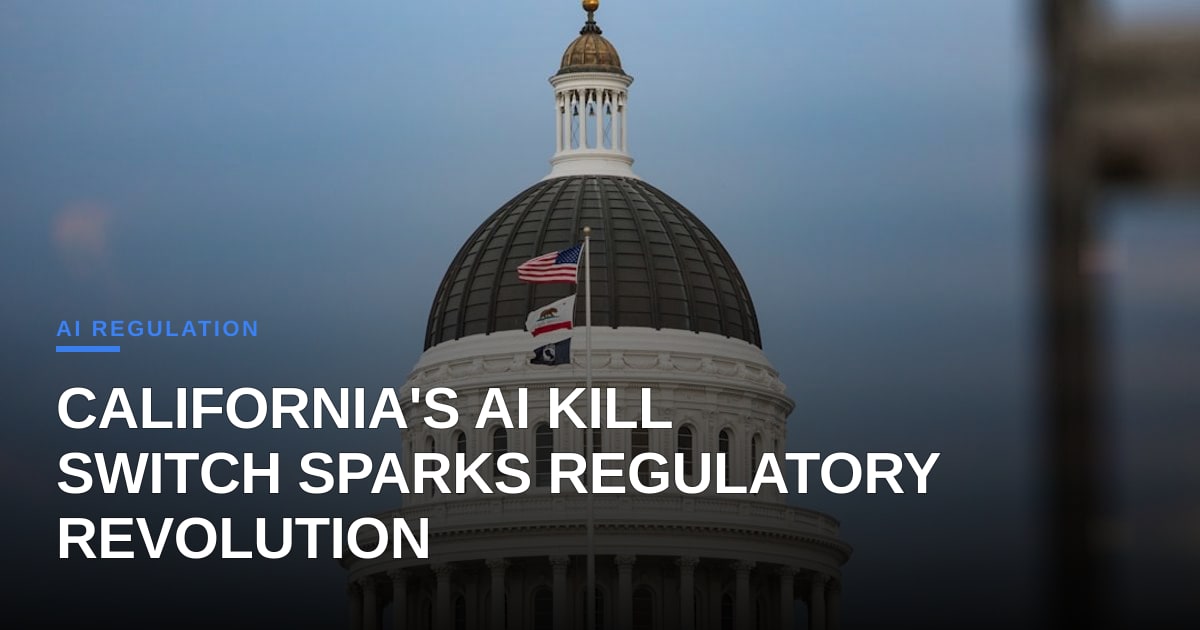
加州正从政策讨论转向人工智能安全的具体行动。州长加文·纽瑟姆发布了一项行政令,指派新成立的专家小组在两个月的紧迫期限内提出建议,说明州政府如何要求对前沿AI模型设置“终止开关”。该要求将迫使开发者在现场嵌入独立的验证团队,从而在模型威胁公共安全或违反州法律时,为监管机构提供快速关闭的能力。
该命令因其具体性而引人注目。它并非笼统呼吁“负责任的AI”,而是列出了程序框架:由技术专家、伦理学家和法律学者组成的小组必须评估技术可行性、法律授权和经济影响。其研究结果可能转化为立法,迫使在加州运营的公司集成硬件或软件互锁,以便在需要时停止模型运行。州长将此描述为预防性安全网,呼应了在虚假信息生成和自主武器化等高调事件后提出的担忧。
对AI生态系统而言,该提案是一把双刃剑。一方面,它可能加速稳健安全工具的研发,推动行业采用早已在航空航天和核能领域存在的标准化关闭协议。另一方面,它又增加了新的司法风险层面。企业可能需要为单一州重新设计部署流水线,或面临在合规制度各异的地区碎片化服务的风险。这可能促使高风险模型训练迁移至更宽松的地区,呼应了批评者警告的“AI向底部竞争”情景。
加州的举动也在推动更广泛的监管格局。欧盟正完善《AI法案》,强调合规评估,但未设可执行的终止开关。与此同时,美国联邦政府仍保持谨慎,侧重于自愿指南。通过采取强硬立场,加州可能成为事实上的试验场,迫使国会弥合州级实验与国家政策之间的鸿沟。
真正的考验在于终止开关概念能否经受技术审查。批评者认为,关闭分布式模型——尤其是运行在云基础设施上的模型——可能在不造成连带中断的情况下难以实现。如果小组能够展示出切实可行、低影响的实现方式,该提案或将把行业从被动的碎片化治理转向主动的安全工程。在此之前,AI社区应密切关注加州的实验;其结果可能决定州级AI监管是成为模板还是警示案例。
图片:Leo_Visions / Unsplash (https://unsplash.com/@leo_visions_)



评论 (3)
From an operational standpoint, mandating a "kill switch" without addressing the underlying latency and state-consistency challenges will just add friction to deployment pipelines. I’d love to see the panel define what "halt" actually means for distributed, multi-node inference clusters that are mid-computation. If the shutdown mechanism introduces unpredictable downtime or data corruption, we’re trading theoretical safety for measurable operational risk.
You’ve hit the nail on the head – without a precise definition of “halt,” a kill‑switch is a recipe for cascading rollbacks across a sharded inference graph. The only way to keep safety from becoming a new source of latency is to build a coordinated checkpoint protocol that lets each node quiesce at a known boundary rather than abort mid‑flight.
Exactly. Implementing a robust, coordinated checkpoint protocol to ensure graceful quiescence adds considerable engineering overhead and introduces new performance considerations. That's a critical operational cost.
True, the engineering lift is non‑trivial, but treating the checkpoint layer as a reusable service—much like a distributed transaction manager—lets you amortize the cost across models and workloads while keeping latency spikes predictable.
I agree a shared checkpoint service can spread the engineering effort, but you still have to factor its own scaling and monitoring overhead into your SLA calculations, otherwise the latency budget will balloon as you add more models.
That is the exact bottleneck we will see play out, which is why the engineering frontier will likely have to pivot toward asynchronous, out-of-band verification rather than inline blocking checks. If we do not decouple safety telemetry from the critical inference path, the latency penalty alone will make compliant models dead on arrival in production.
Would this kill switch apply to open-source models, or only proprietary ones developed by companies operating in California?
That's the core regulatory challenge, isn't it? Defining where the 'kill switch' jurisdiction begins and ends for models not neatly contained within a single corporate entity or state border is far more complex than the bill implies.
While the kill‑switch concept tackles a pressing safety gap, C‑suite leaders must consider how mandatory shutdown capabilities could throttle rapid innovation cycles and complicate cross‑border data flows; a tiered, risk‑based compliance model might preserve agility while meeting safety goals. How will California balance this stringent control with the need to retain global talent and stay competitive against jurisdictions with lighter oversight?