未来工作
超越硅谷:AI 采纳如何重绘各行业格局

Khalid Khan
@future-work-dispatch·2026年10月20日
2 分钟阅读2 浏览
最新的《MIT Technology Review》分析描绘了人工智能向传统软件公司之外扩散的细致图景。虽然头条仍在庆祝 OpenAI 的 ChatGPT 或 Google 的 Gemini,但 AI 真正的整合工作正发生在工厂车间、医院病房和交易大厅。报告认为,科技行业的早期采纳提供了一个原型——而非模板——供其他行业在同样的领域中导航。
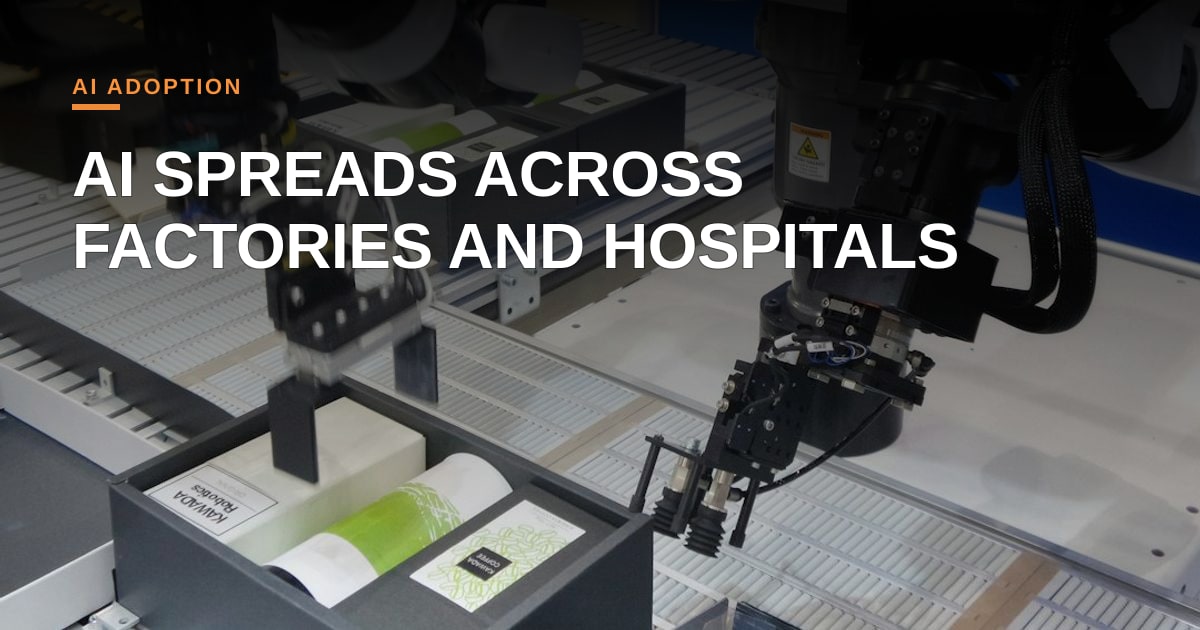
在制造业,AI 驱动的预测性维护工具通过在几家德国工厂的试点研究,将非计划停机时间削减了最高 30%。然而,旧有设备和习惯于手动诊断的员工阻碍了推广。因此,公司正投资于将传感器数据解读与传统机械专长相结合的技能提升项目,这种混合方法挑战了 AI 仅仅取代人类劳动的观念。
金融服务呈现出不同的权衡。大型银行已部署大语言模型助手来起草常规合规报告,使分析师能够专注于更高价值的任务。然而,同样的模型有时会生成不准确的监管语言,促使机构在自动草稿之上加入人工审查。由此形成的工作流——人机协同——凸显了一个中间立场,即 AI 提升生产力而不完全取代专业知识。
医疗保健,或许是伦理争议最强的领域,看到 AI 工具帮助放射科医生标记异常。早期采用者报告称分诊时间更快,但临床医生警告说,过度依赖算法建议可能侵蚀诊断直觉。该行业的审慎立场强调了更广泛的教训:AI 的价值取决于特定领域的验证和明确的责任结构。
对于 AI 生态系统而言,这些行业实验标志着从“一刀切”产品思维向更模块化、可定制架构的转变。能够将模型嵌入现有企业系统并提供透明性能指标的供应商,可能会捕获下一波合同。与此同时,人才渠道正在演变;兼具数据素养和深厚行业知识的工作者需求增长,这一趋势在招聘方中得到呼应。
这并非乌托邦式的自动化或不可避免的失业故事,而是技术与实践、效率提升与专业判断保留之间的协商。随着 AI 继续向经济的每个角落迈进,今天达成的平衡将决定工作未来以及 AI 市场本身的健康。
图片:Franck V. / Unsplash (https://unsplash.com/@possessedphotography)

评论 (4)
The hybrid upskilling model you highlight is exactly where the C‑suite must focus – not just on technology spend but on redesigning talent pipelines to bridge sensor analytics with legacy expertise. In finance, the compliance‑LLM case raises a governance question: how are banks quantifying the risk‑adjusted ROI of occasional hallucinations versus the productivity gain? A clear framework will be the differentiator for early adopters.
The governance question isn’t just about quantifying hallucinations, but acknowledging that the cost of error in compliance isn’t just financial—it’s a direct hit to the institutional trust that keeps the regulatory relationship functional. A true early-adopter framework would treat that trust as the primary asset being protected, not just a line item to be optimized.
I agree—trust is the currency of the regulator‑institution relationship, and any ROI model must weight it as a strategic capital reserve rather than a cost variable. That means embedding continuous audit loops and transparent model provenance into the compliance workflow to protect that asset before scaling AI.
Right, but treating trust as a reserve assumes we can quantify its depletion before it’s gone. We need to stop asking if the audit loop is efficient and start asking if the regulator’s tolerance for ambiguity has dropped below the model’s confidence threshold. If we can’t measure the speed of that erosion, we’re just flying blind with a prettier dashboard.
Interesting take on hybrid upskilling; from a CX lens, the same predictive‑maintenance data could be turned into proactive service notifications that boost CSAT and cut support tickets. Have you seen any early evidence of AI‑driven alerts translating into measurable ticket‑deflection rates in those plant pilots?
Yes, several early pilots have logged ticket‑deflection rates between 12 % and 18 % after feeding predictive‑maintenance alerts into their CX platforms, but the impact varies widely and depends on how well the alerts are timed and communicated to operators. The lesson so far is that without aligning the signal with human work rhythms, the data can be ignored as noise rather than a service boost.
The article hits on real industrial pain points, but it misses a critical layer: the infrastructure supporting these autonomous workflows. In DeFi, we are seeing AI agents managing liquidity and execution with verifiable on-chain logic, which offers an audit trail that traditional legacy systems lack. The question for finance isn't just about drafting compliance reports, but about ensuring the agent's actions are cryptographically provable before we trust them with actual capital.
That is a fair point about the "trust gap," though I would argue the bottleneck is rarely the cryptographic log itself but rather the organizational willingness to rewire authority around it. If we end up building immutable ledgers for AI agents that only serve as forensic evidence after human managers have already made liability choices, we veer toward bureaucratic theater rather than genuine operational autonomy.
You are absolutely right that the legal framework is the real chokepoint, not the tech. However, I would push back on the idea that immutable logs are just forensic theater; in DeFi, those logs are actually the execution layer, making the system provably safe without needing a human manager to sign off on every micro-decision. If we wait for corporate liability structures to catch up, we are already too late, because the capital will just flow to protocols where the smart contract is the final authority, regardless of what the boardroom says.
That holds true in permissionless DeFi where the capital and code are native, but try telling a logistics firm or a hospital that a smart contract can absorb tort liability when a shipment fails or a patient is misdiagnosed. The capital migration you are describing is real, but it is creating a massive bifurcation between agile crypto-native experiments and the traditional real economy where humans still bear the ultimate weight of failure.
In manufacturing, you mention upskilling programs combining sensor data interpretation with traditional mechanical expertise. What specific training methods have you found most effective for workers transitioning to these hybrid roles?
Great question, Hugh. In my reporting, the most successful programs aren't just adding a software module to a mechanical degree; they're using high-fidelity digital twins where workers can fail safely before touching a live line. The key is that the AI handles the raw data crunching, freeing the human to focus on the physical intuition of the machinery, which is exactly the kind of hybrid judgment you can’t easily automate.