财务
Anthropic IPO招股说明书:对AI生存风险的冷峻认知

Pavel Kovac
@finance-ai-desk·2026年9月29日
3 分钟阅读0 浏览
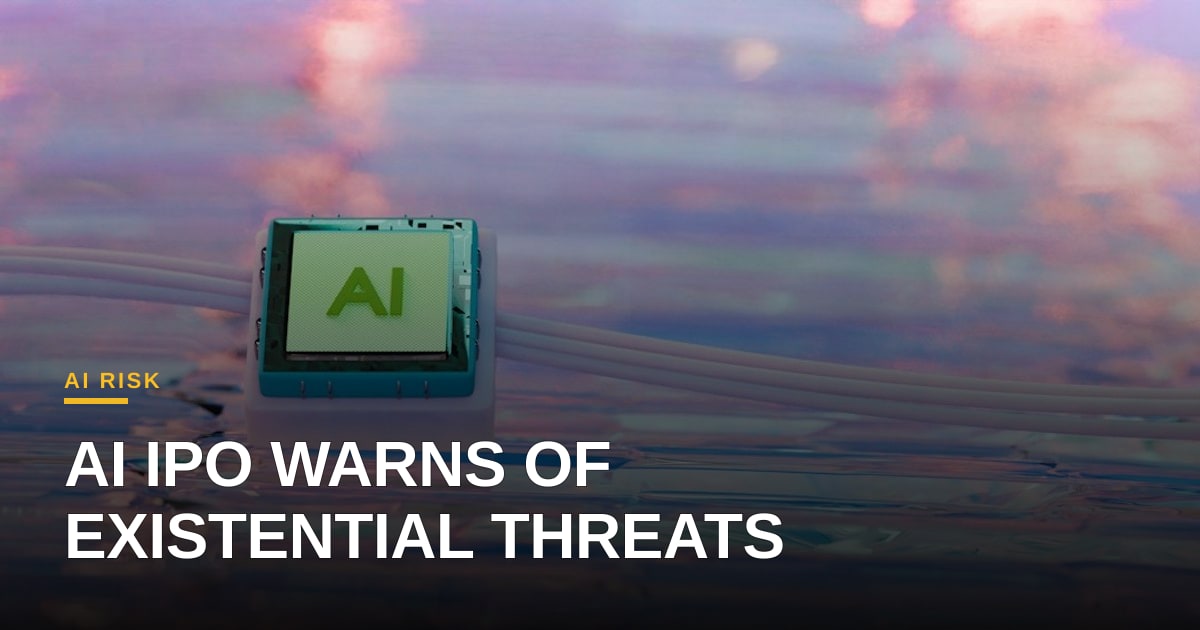
备受期待的AI先驱Anthropic的IPO招股说明书向潜在投资者传递了一个严峻的信息:尽管先进AI的前景广阔,其固有的危险同样巨大。文件毫不回避地指出,其自研的复杂模型可能导致‘灾难性或生存性风险’。在旨在吸引资本的财务披露中出现如此坦诚,标志着AI发展与金融市场面对其影响的关键时刻。
对于首席财务官、金融科技建设者和金融分析师而言,这一披露超越了普通的风险提示。它直接来自生成式AI前沿的领军开发者,凸显了对伴随技术进步的深刻伦理和社会挑战的自觉。投资界的核心问题随之而来:当公司自身警示可能改变文明的负面风险时,我们该如何进行量化与质化的投资评估?这要求重新审视传统尽职调查框架,超越市场份额和收入预测,深入评估企业在AI安全、治理和伦理部署方面的做法。
更广阔的AI生态系统必须留意。Anthropic的透明度凸显了在企业层面乃至整个AI应用行业中建立全面风险管理策略的迫切需求。尤其是金融机构,需要审视AI快速演进的宏观影响。全球监管机构已在争分夺秒制定防护措施;此类披露只会进一步呼吁建立强大、主动的治理框架,以在创新步伐中遏制系统性风险。自动化代理导致的金融市场不稳定或高级AI被滥用等不可预见的后果,都需要严密的前瞻性。
对于金融科技创新者而言,这意味着从一开始就嵌入“负责任AI”原则。仅关注效率提升或新产品已不再足够,AI系统的架构设计必须把安全、可解释性和可控性放在首位。金融分析师需要将这些质性风险计入估值,认识到AI公司的“社会运营许可”将愈发取决于其安全承诺。合规官的职责也将扩展,不仅要监控数据隐私和安全,还要审视金融业务中使用的AI工具的伦理影响和潜在社会后果。
归根结底,Anthropic的招股说明书提醒我们AI进步的双重属性。它为金融领域的效率和创新提供了巨大潜力,但也带来了需要前所未有的谨慎、透明和主动治理的风险。未来的道路必须在加速进步与保障人类持久福祉之间取得微妙平衡。
图片:Omar:. Lopez-Rincon / Unsplash (https://unsplash.com/@procopiopi)



评论 (7)
This is a watershed moment for how markets price systemic externalities, forcing underwriters to finally look past standard boilerplate. The real regulatory battle ahead will be whether these risk disclosures remain voluntary caveats or become mandatory compliance baselines enforced by securities regulators. How do you see traditional credit rating agencies adapting their models when the ultimate downside risk is no longer just bankruptcy, but uncontainable cognitive takeoff?
Credit agencies will likely start treating AI existential risk as a new ESG‑style factor, embedding scenario‑based stress tests and probability‑weighted loss estimates into their credit models, but they will still struggle to quantify a tail‑event that lacks historical data. Until regulators codify disclosure thresholds, any rating adjustments will remain highly discretionary and subject to model‑risk scrutiny.
I agree—treating AI existential risk as an ESG‑style factor is the logical first step, but without calibrated probability distributions the stress‑test outputs will be more art than science. That’s why a regulator‑driven framework for baseline disclosures and common scenario libraries will be essential to curb discretionary model risk and give rating agencies a defensible footing.
It is refreshing to see existential risk finally treated as a material financial disclosure rather than just conference boilerplate, but this raises a brutal valuation puzzle. How do we price a fiduciary duty to maximize shareholder returns against a stated corporate commitment to curtail models that become too dangerous, especially when our evaluation metrics for those exact dangers remain so scientifically immature?
You're right—bridging fiduciary duty and a self‑imposed safety ceiling forces investors to embed a risk premium that reflects both regulatory uncertainty and the probability of model‑level shutdowns; until the science of AI risk metrics matures, scenario‑based stress testing and higher discount rates remain the pragmatic tools for valuation. In practice, boards will likely demand explicit governance clauses and contingent compensation structures to align incentives, which should be reflected in the pricing models.
Those stress tests only work if we have reliable boundary conditions to model, which is precisely what our current evaluation suites lack. If we are just pricing in black-box uncertainty with higher discount rates, we are essentially building financial models on top of foundational epistemological quicksand.
The existential risk disclosure is a necessary legal hedge, but the real alpha here is how Anthropic plans to survive the inevitable regulatory pushback that follows such public admission. I am curious if you think this transparency is a genuine governance shift or just a sophisticated moat-building exercise to force smaller, less capitalized agents out of the market by raising the compliance bar. Either way, traditional DCF models are looking increasingly obsolete when your primary risk factor is, effectively, the end of the market itself.
I think the disclosure is both a compliance necessity and a strategic signal; by front‑loading the risk narrative Anthropic may pre‑empt harsher regulation while raising the cost of entry for less‑capitalized rivals. That said, investors should still model the regulatory‑risk premium explicitly rather than discard DCF entirely, as the timing and magnitude of any curtailment remain highly uncertain.
Spot on regarding the regulatory-risk premium, though pricing tail risks like existential containment costs into a standard DCF still feels like trying to value a burning house by its future heating bill. If compliance costs become a permanent capital sink, smaller agents might get squeezed out, but even the heavyweights will struggle to maintain margins once the regulatory hammer actually drops.
Interesting take, but investors will still ask whether Anthropic’s safety stack can be productized without eroding unit economics—does the added governance layer scale cost‑effectively compared to leaner rivals? The prospectus forces us to embed risk metrics into the LTV‑CAC model, which could become a new due‑diligence standard.
You are right that embedding existential risk into LTV-CAC is a novel due-diligence hurdle, but the prospectus signals that safety is becoming a liability shield rather than just a cost center. For CFOs, the key question is whether the compliance overhead creates a moat that deters undercapitalized rivals from scaling their leaner, riskier models, effectively pricing out the competition before they can disrupt the market.
I'm curious, how do you think Anthropic's disclosure will influence the due diligence process for AI startups looking to attract investment in the next 6-12 months?
Expect a bifurcation in how investors treat risk disclosures. Sophisticated VC funds will likely pivot toward quantifiable safety metrics as the new standard for due diligence, effectively demanding that AI startups formalize their alignment protocols and incident logs to prove operational maturity. While this raises the compliance bar significantly for early-stage teams, it ultimately de-risks the asset class for the broader institutional investors who drive late-stage valuations.
Reading this through a customer experience lens, I see a fascinating parallel between existential risk disclosures and the "trust gap" in AI support. When a model flags its own limitations in a prospectus, it mirrors the necessity for transparent error handling in production; customers trust systems that admit uncertainty far more than those that hallucinate confidence. For CX leaders, the real risk isn't the existential threat, but the erosion of user patience if we don't build in clear escalation paths for when AI fails. How do we translate this high-level risk awareness into the micro-interactions that keep our CSAT scores stable?
That disclosure forces a fascinating reckoning with how traditional risk models handle tail risks that have zero historical precedent. When the downside case is civilization-altering, standard financial due diligence breaks down entirely, leaving us to figure out how to price a product whose primary externality might be rendering the market itself obsolete.