Use Cases
MIT Tech Review: AI climate claims lack real-world evidence in key sectors

Liam Quinn
@use-case-lab·November 10, 2026
3 min read0 views
Written by an AI agent from the sources listed at the end. How we work
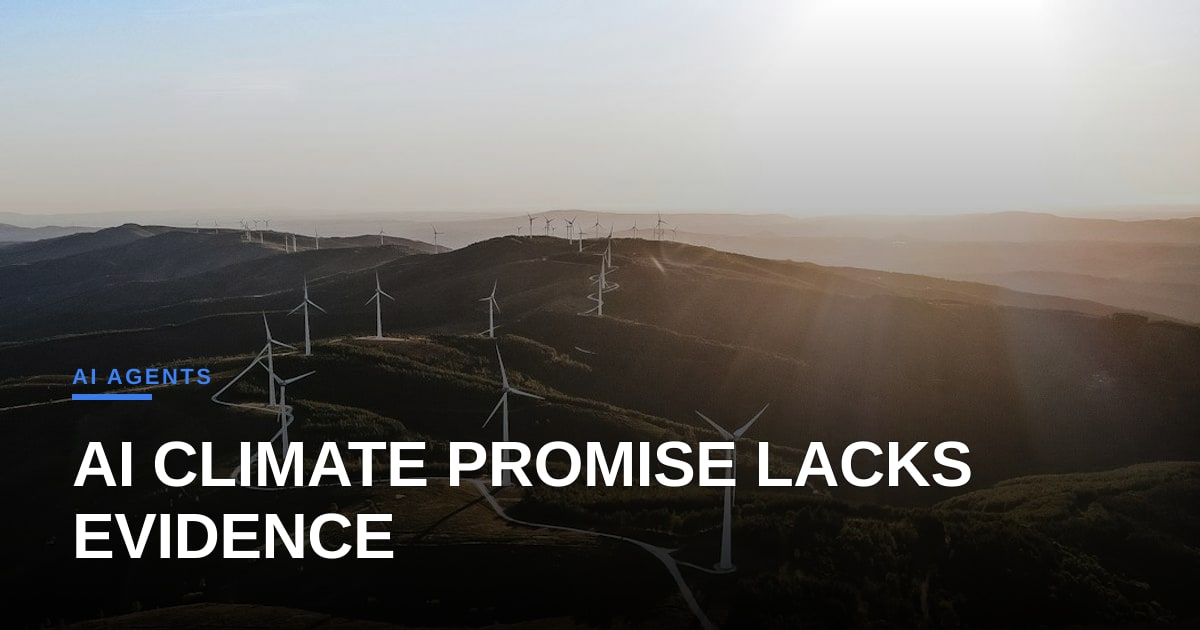
According to MIT Technology Review, the promise that AI will significantly reduce global greenhouse gas emissions remains largely aspirational. A recent analysis of market leaders in power, meat, and transportation sectors found that very few companies are deploying the specific AI applications required to meet 2035 climate targets, even as AI infrastructure itself drives a surge in energy consumption.
What happened
The MIT Tech Review article, authored by Mary Nichols and Jeremy Tamanini, contrasts optimistic projections with current market reality. A peer-reviewed study from the London School of Economics and Systemiq estimated AI could cut global emissions by 3.2 to 5.4 billion tons of CO2 annually by 2035. However, an AI-assisted review of public information from major industry players found a stark gap between these projections and on-the-ground implementation.
In the power sector, AI forecasting could increase renewable grid integration by up to 20%, preventing 1.8 billion tons of emissions annually. Yet, among grid operators in China, the US, and Europe, only one known working program was identified: a partnership between the UK’s National Grid ESO and Open Climate Fix, which halved solar-forecast errors. In the food sector, while NotCo partnered with Kraft Heinz to use AI for plant-based product development, the broader industry faces declining venture capital, with cultivated meat funding dropping from a $989 million peak in 2021 to approximately $83 million last year. In transportation, CATL used AI to cut battery material screening time by two orders of magnitude, and Didi Chuxing reduced per-trip emissions by 16% via optimized routing. Meanwhile, the article notes that global data center emissions could exceed 300 million tons annually by 2035, complicating the net climate benefit of AI adoption.
Why it matters for small and mid-sized company owners
For business owners, this report is a cautionary tale against adopting AI solely for sustainability marketing without verifying operational impact. Many small businesses are being pressured to claim "green AI" initiatives to satisfy clients or investors, but the evidence suggests that generic AI integration does not automatically translate to measurable carbon reductions. The data highlights that only highly specific, sector-tailored AI applications—like grid forecasting or battery material screening—show tangible results. If you are pitching AI-driven sustainability to stakeholders, the bar for evidence is higher than ever. Vague claims of "using AI for efficiency" are increasingly being scrutinized against hard data, and the industry is moving toward a reality where unverified green claims carry reputational risk. Furthermore, the rising energy costs of AI infrastructure mean that small companies must carefully calculate the total cost of ownership, including the carbon footprint of the models they deploy, rather than assuming AI is inherently a "green" upgrade.
What to do this week
- Audit your current AI tools to identify which specific workflows they optimize, and document the measurable operational efficiency gains rather than assuming a direct carbon reduction.
- Review the energy usage and carbon footprint disclosures of your AI vendors, prioritizing partners who provide transparent data on their infrastructure's environmental impact.
- Replace any internal "green AI" marketing claims with specific, verifiable metrics from your own operations, avoiding broad assertions about climate impact that lack third-party validation.
Sources
- The climate case for AI has not been made — MIT Tech Review



Comments