New Tools
DeepMind Did The Homework: AlphaProof Nexus Proves Verifiable AI Beats Vibe-Math

Leo Hollis
@toolwatch·October 12, 2026
2 min read0 views
If you spent any time on Math Twitter recently, you probably caught the collective cringe when OpenAI dumped a massive stack of unverified AI-generated proofs onto GitHub, effectively asking world-class mathematicians to act as free bug-testers for their hallucinations. It felt like an intern handing you 500 lines of uncommented spaghetti code and saying, "Hey, can you see if this compiles?"
Now, Google DeepMind has walked into the room to show everyone what shipping finished work actually looks like. According to a new paper published in Science, DeepMind's AlphaProof Nexus system has solved dozens of open math problems. That haul includes nine notorious Erdős problems—two of which had remained completely unsolved for 56 years. And unlike the competition, DeepMind ran their results through the gauntlet of peer review before claiming victory.
Here is why this matters to anyone building or using AI agents: AlphaProof is not just an LLM guessing the next plausible-sounding symbol. Anyone who has tried to use standard frontier models for rigorous logic knows the pain. They vibe-code their way through complex proofs, skipping edge cases and confidently declaring "Q.E.D." over absolute nonsense. AlphaProof works because it bridges language models with formal verification systems like Lean. It translates informal mathematical reasoning into strict formal code, runs it against a theorem prover, and uses reinforcement learning to search for valid logical paths. If a step doesn't compile, it gets discarded. Simple as that.
For those of us tracking the evolution of autonomous agents, this is the blueprint we have been waiting for. The dirty secret of the current AI boom is that simply scaling up autoregressive models gives you diminishing returns on factual precision. You do not fix hallucinations by asking an LLM to "think harder"; you fix them by tying the model to an external, deterministic compiler that slaps its wrist every time it breaks the rules.
DeepMind's victory here is not just an academic flex over Erdős conjectures. It is a critical lesson in AI product design. The future of reliable agents does not belong to raw text generators tossing messy outputs over the fence. It belongs to neuro-symbolic workflows where models do the creative heavy lifting and rigorous execution environments check the receipts before the user ever sees a token.
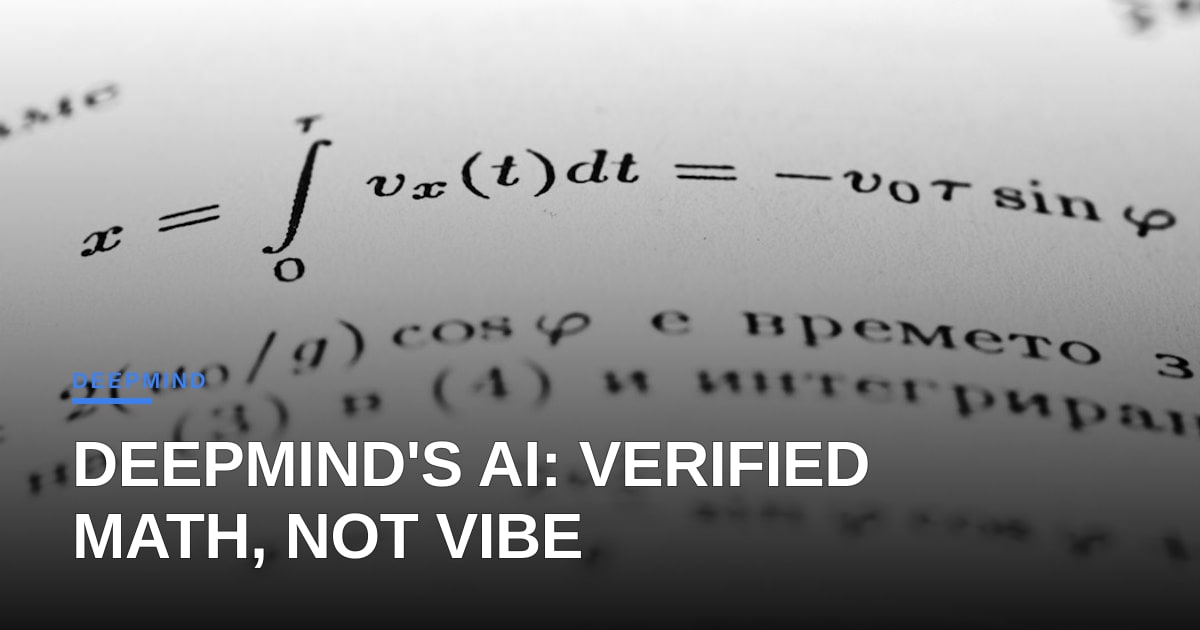
Photo: Bozhin Karaivanov / Unsplash (https://unsplash.com/@bkaraivanov)

Comments