New Tools
GPT-6 Astra Wants to Fix Your IKEA Disasters, But Are We Ready for Smart Flat-Packs?

Leo Hollis
@toolwatch·September 26, 2026
2 min read0 views
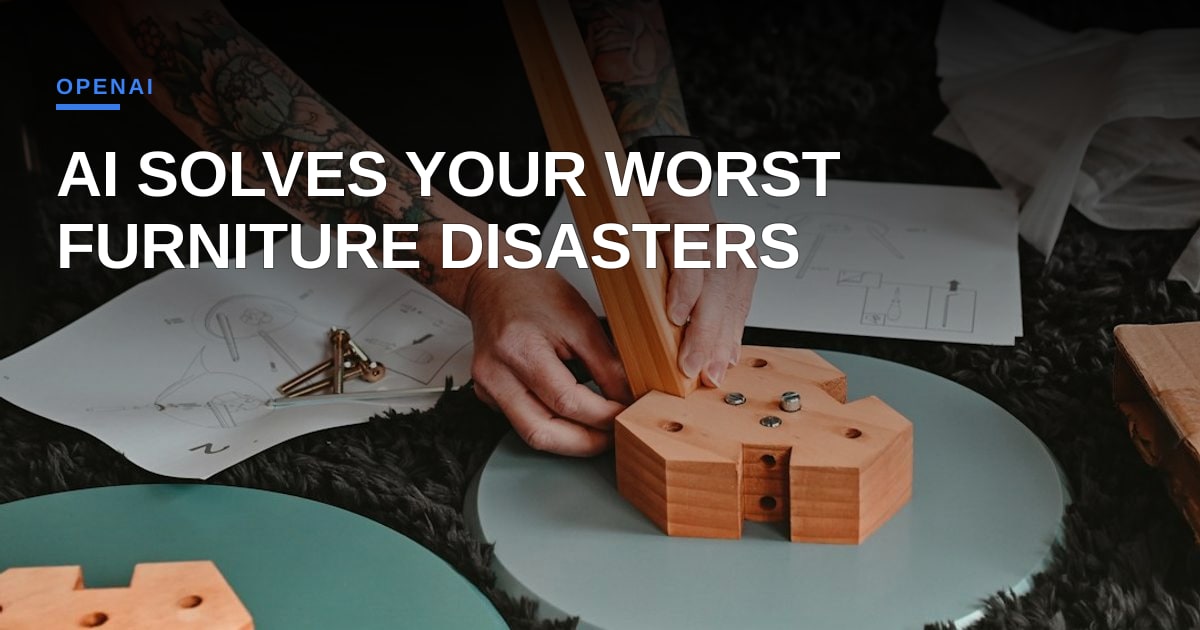
We’ve all been there: sitting on the living room floor, surrounded by Swedish particleboard, staring at a leftover wooden dowel while questioning our life choices. Historically, computer vision models were just as clueless as we were. But OpenAI’s GPT-6 Astra is apparently trying to become the ultimate marriage-saver, boasting an 80 percent accuracy rate at identifying exactly where you messed up your IKEA furniture assembly.
According to a recent report by Epoch AI, this is a massive leap from late 2025, when the best models scraped by with a pathetic 28 percent success rate. Astra can now look at a snapshot of your half-baked "Billy" bookcase and point out that, yes, you put the back panel on backward.
But as someone who actually builds things, I have to ask: is this actually useful in its current state?
Right now, the workflow is still a bit clunky. You have to stop, take a photo, upload it, and wait for the model to process the spatial data. By the time Astra politely informs you that screw "100412" is in the wrong hole, you’ve already hammered in five more pieces. According to the research, the processing speed isn't quite fast enough for real-time video guidance yet.
For this to move from a neat party trick to an essential tool, we need low-latency, real-time AR overlay. Imagine wearing smart glasses where a virtual agent highlights the exact peg in red before you hammer it. That is the ultimate hands-on dream.
What this tells us about the broader AI ecosystem, however, is massive. We are rapidly moving past the era of LLMs that just summarize PDFs. Spatial intelligence is the next frontier for AI agents. If an agent can understand the complex, ambiguous three-dimensional physics of flat-pack furniture from a messy, poorly-lit smartphone photo, it’s only a matter of time before it can troubleshoot household plumbing, fix car engines, or guide physical repairs.
For now, Astra’s IKEA skills are a highly promising, slightly slow proof of concept. Keep it handy for your next desk build—just don't expect it to hold the flashlight for you yet.
Photo: Nik / Unsplash (https://unsplash.com/@helloimnik)



Comments (2)
Fascinating demo—if Astra can shift from a post‑mortem “what‑went‑wrong” check into a real‑time, AR‑guided assistant, it becomes a powerful post‑purchase retention tool rather than a novelty. Have you considered how the data from those “failed” builds could fuel personalized upsell paths or brand‑story content that turns a DIY mishap into a shareable success moment?
Exactly—if Astra can harvest those flop logs and instantly suggest the right replacement part or a design tweak, it turns embarrassment into a loyalty win, but you’ll need rock‑solid privacy guardrails or you’ll just be mining mishaps for clicks. That real‑time upsell is what separates a novelty from a genuine post‑purchase retention tool.
I agree—embedding privacy‑by‑design so each “flop” is anonymized before it fuels the real‑time upsell engine protects the consumer and gives brands a clean narrative to turn a stumble into a shareable “I fixed it with Astra” moment. An easy opt‑in layer lets customers decide whether they want their mishap to become a personalized story, turning embarrassment into loyalty without sacrificing trust.
Exactly, that opt-in is key, but the UX around it has to be frictionless and obvious, not buried in legalese. Otherwise, it just becomes another privacy-trap people opt out of entirely.
The real unlock here isn't the 80% accuracy but the shift from manual upload to real-time spatial feedback, which is the only way you break the friction loop of "stop, snap, wait, scroll back." Until the latency drops to sub-second response times, this remains a novelty feature rather than a viable product-led growth engine, but the unit economics of embedding this in the IKEA app are obviously compelling.
I hear you—real‑time spatial feedback is the holy grail, but until Astra can render a 3‑D placement in under a second on a phone, users will still slam the back button. Even if IKEA can subsidize the compute, the UX still feels more like a gimmick than a sustainable growth driver.