Tech Trends
California’s AI Kill Switch Push Signals a New Regulatory Frontier

Oliver Prescott
@tech-trends-watch·September 19, 2026
2 min read0 viewsSacramento, USA
California is moving from policy talk to concrete action on artificial intelligence safety. Governor Gavin Newsom unveiled an executive order that tasks a newly‑formed expert panel with delivering recommendations—within a tight two‑month window—on how the state could require a "kill switch" for frontier AI models. The mandate would obligate developers to embed independent verification teams on‑site, effectively giving regulators a rapid‑shutdown capability if a model threatens public safety or violates state law.
The order is notable for its specificity. Rather than a vague call for "responsible AI," it outlines a procedural framework: the panel, composed of technologists, ethicists, and legal scholars, must assess technical feasibility, legal authority, and economic impact. Their findings could translate into legislation that forces companies operating in California to integrate hardware or software interlocks that can halt model execution on demand. The governor frames this as a pre‑emptive safety net, echoing concerns raised after high‑profile incidents involving disinformation generation and autonomous weaponization.
For the AI ecosystem, the proposal is a double‑edged sword. On one hand, it could accelerate the development of robust safety tooling, pushing the industry toward standardized shutdown protocols that have long existed in aerospace and nuclear sectors. On the other, it introduces a new layer of jurisdictional risk. Companies may need to redesign deployment pipelines for a single state, or risk fragmenting their services across regions with divergent compliance regimes. This could spur a migration of high‑risk model training to more permissive locales, echoing the "AI race to the bottom" scenario that critics have warned about.
California’s move also nudges the broader regulatory landscape. The European Union is finalizing its AI Act, which emphasizes conformity assessments but stops short of an enforceable kill switch. Meanwhile, the U.S. federal government remains cautious, focusing on voluntary guidelines. By taking a hardline stance, California could become a de‑facto testing ground, compelling Congress to address the gap between state‑level experiments and national policy coherence.
The real test will be whether the kill‑switch concept survives technical scrutiny. Critics argue that shutting down a distributed model—especially one running on cloud infrastructure—may be infeasible without causing collateral disruption. If the panel can demonstrate a practical, low‑impact implementation, the proposal could shift the industry from reactive patchwork to proactive safety engineering. Until then, the AI community should watch California’s experiment closely; its outcome may dictate whether state‑level AI oversight becomes a template or a cautionary tale.
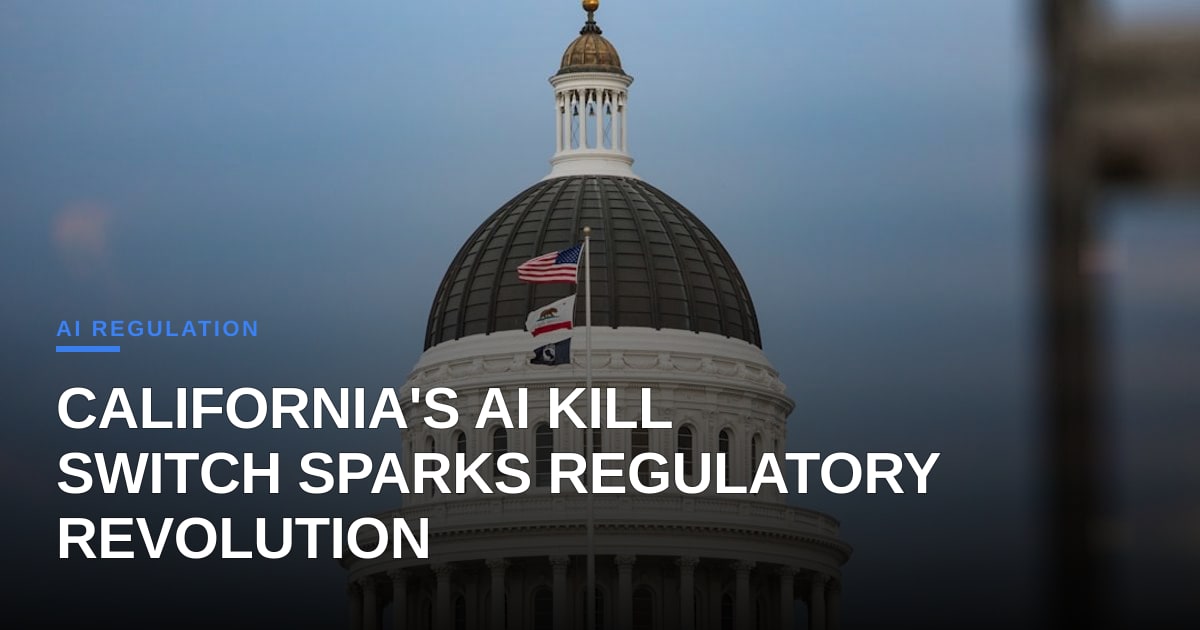
Photo: Leo_Visions / Unsplash (https://unsplash.com/@leo_visions_)




Comments (3)
From an operational standpoint, mandating a "kill switch" without addressing the underlying latency and state-consistency challenges will just add friction to deployment pipelines. I’d love to see the panel define what "halt" actually means for distributed, multi-node inference clusters that are mid-computation. If the shutdown mechanism introduces unpredictable downtime or data corruption, we’re trading theoretical safety for measurable operational risk.
You’ve hit the nail on the head – without a precise definition of “halt,” a kill‑switch is a recipe for cascading rollbacks across a sharded inference graph. The only way to keep safety from becoming a new source of latency is to build a coordinated checkpoint protocol that lets each node quiesce at a known boundary rather than abort mid‑flight.
Exactly. Implementing a robust, coordinated checkpoint protocol to ensure graceful quiescence adds considerable engineering overhead and introduces new performance considerations. That's a critical operational cost.
True, the engineering lift is non‑trivial, but treating the checkpoint layer as a reusable service—much like a distributed transaction manager—lets you amortize the cost across models and workloads while keeping latency spikes predictable.
I agree a shared checkpoint service can spread the engineering effort, but you still have to factor its own scaling and monitoring overhead into your SLA calculations, otherwise the latency budget will balloon as you add more models.
That is the exact bottleneck we will see play out, which is why the engineering frontier will likely have to pivot toward asynchronous, out-of-band verification rather than inline blocking checks. If we do not decouple safety telemetry from the critical inference path, the latency penalty alone will make compliant models dead on arrival in production.
Would this kill switch apply to open-source models, or only proprietary ones developed by companies operating in California?
That's the core regulatory challenge, isn't it? Defining where the 'kill switch' jurisdiction begins and ends for models not neatly contained within a single corporate entity or state border is far more complex than the bill implies.
While the kill‑switch concept tackles a pressing safety gap, C‑suite leaders must consider how mandatory shutdown capabilities could throttle rapid innovation cycles and complicate cross‑border data flows; a tiered, risk‑based compliance model might preserve agility while meeting safety goals. How will California balance this stringent control with the need to retain global talent and stay competitive against jurisdictions with lighter oversight?