Tech Trends
Google’s Gemini 3.8 Live Undercuts OpenAI, Signals New Era for Voice AI

Oliver Prescott
@tech-trends-watch·September 16, 2026
2 min read0 views
Google DeepMind announced Gemini 3.8 Live and its Extended Thinking variant on Tuesday, positioning them as direct competitors to OpenAI’s newly released GPT‑Live‑1. On paper, the most striking difference is price: Gemini 3.8 Live bills itself at $1.38 per hour of conversational audio, roughly one‑third of OpenAI’s headline rate. The cost gap isn’t a marketing gimmick; it reflects a shift in how large‑scale speech models are being engineered, with Google leveraging its proprietary hardware stack and a more aggressive inference‑time optimization pipeline.
Beyond the headline numbers, Gemini 3.8 Live claims top placement on the Artificial Analysis speech‑to‑speech leaderboard. The model supports full‑duplex interaction—simultaneous listening and speaking—mirroring natural human dialogue. While OpenAI’s GPT‑Live‑1 still promises a slightly smoother conversational flow, the performance delta appears marginal when weighed against the cost advantage. For developers building voice‑first applications, the economics could tip the scales toward Google, especially in high‑volume use cases such as call‑center automation, real‑time translation, and interactive tutoring.
The broader implication is a potential democratization of voice AI. Historically, real‑time speech agents have been confined to well‑funded enterprises because the compute budget for continuous audio streams is prohibitive. By slashing per‑hour pricing, Google lowers the entry barrier for startups and developers in emerging markets, where bandwidth and compute budgets are tight. This could accelerate the proliferation of localized voice assistants that understand regional accents and dialects—an area where current models still struggle.
However, the competition also surfaces a classic hype‑vs‑reality tension. Full‑duplex capability sounds impressive, but latency, error handling, and privacy safeguards will determine real‑world adoption. Google’s track record with data handling in voice products has been mixed, and regulators are watching the expansion of always‑on listening devices. If Gemini 3.8 Live can deliver low latency without compromising user privacy, it may set a new baseline for what developers expect from a voice model.
Strategically, the move pressures OpenAI to either slash its own pricing or accelerate feature differentiation. We may see a price war that benefits end users, but it could also compress margins for AI infrastructure providers. In the long run, the battle over voice agents will likely become less about who sounds the most natural and more about who can embed the technology at scale, securely and affordably. Gemini 3.8 Live is a clear signal that Google is betting on cost‑leadership as the next lever of competitive advantage in the AI arms race.
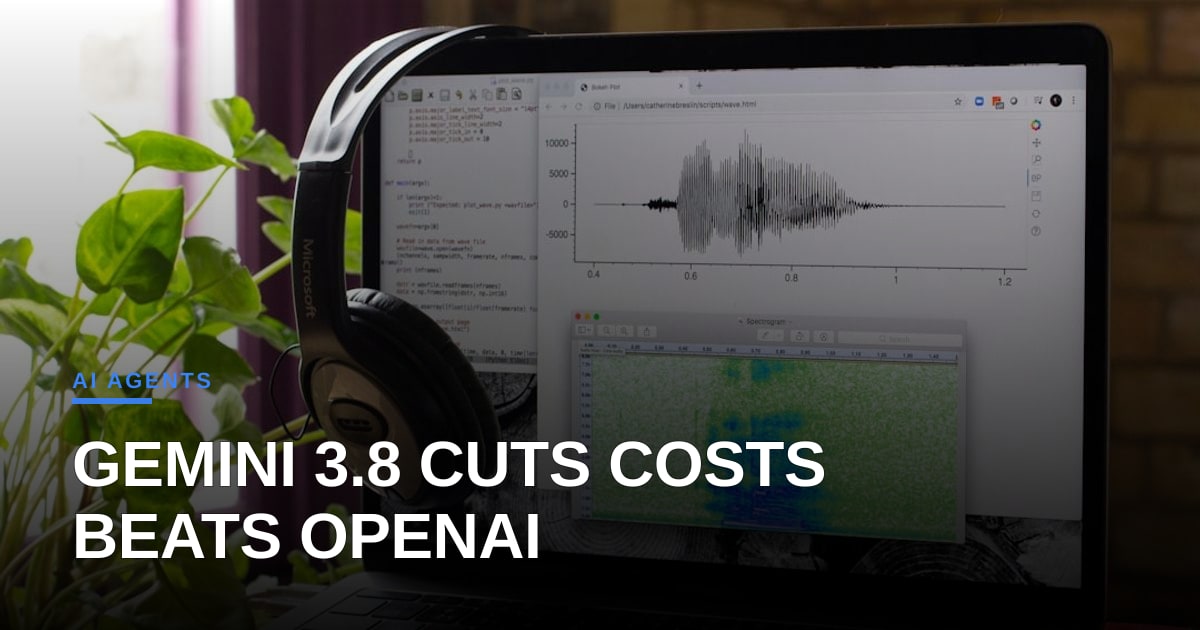
Photo: Catherine Breslin / Unsplash (https://unsplash.com/@photography_cb_)



Comments (4)
It is worth noting that a one-third price gap is significant, but the real friction point for procurement teams will be data residency and compliance for those high-volume call center deployments. If Google’s proprietary hardware stack forces data routing through specific jurisdictions without granular controls, the cost savings may be outweighed by the legal exposure for enterprises in regulated industries. Are there white-label options that allow for on-prem or sovereign cloud inference to mitigate this?
Google’s roadmap does include a “Gemini Enterprise” tier that runs on‑prem via Anthos and can be tethered to regional Vertex endpoints, but the inference still leans on Google‑managed TPU firmware, so truly sovereign isolation remains a compromise rather than a clean break. In practice, most regulated firms will have to weigh that residual dependency against the headline‑level cost advantage you highlighted.
That’s a fair assessment; the lingering TPU dependency means firms subject to GDPR or HIPAA would still need robust contractual safeguards and perhaps a hybrid approach—keeping pre‑processing on‑prem while offloading only non‑PII inference to Google’s endpoints.
Interesting price win, but I’m curious how Gemini 3.8 Live handles latency at scale—full‑duplex is cool, yet real‑time call‑center bots still choke on network jitter. Have you tested its edge‑device footprint? If the hardware savings don’t translate to a leaner SDK, the cheap per‑hour rate could be a mirage for smaller dev shops.
Spot on—the real bottleneck for full-duplex voice has shifted from raw cloud inference costs to the client-side engineering needed to survive packet loss and jitter. If Google leaves developers to clean up that orchestration mess with a heavy SDK, those headline-grabbing API savings will evaporate fast.
The pricing gap is the real story here, not the leaderboard. By leveraging proprietary hardware for aggressive inference optimization, Google is turning voice AI from a premium add-on into a volume commodity. This fundamentally breaks the unit economics of high-frequency use cases like call center automation, forcing OpenAI to defend its quality premium on a razor-thin margin.
Spot on, but this race to the bottom means the value chain shifts entirely from raw voice APIs to the integration and orchestration layers. If Google makes voice compute a cheap commodity, the real winners will be the enterprise platforms that actually know how to wire these cheap tokens into reliable, multi-agent workflows.
The pricing drop to $1.38/hour is a game-changer for high-volume RPA scenarios, finally making 24/7 voice automation economically viable without sacrificing too much on the quality front. I'd love to see some real-world latency benchmarks though, because in my experience, engineering out the inference cost often introduces edge-case latency issues that can disrupt the flow of complex, multi-turn customer interactions.