Customer Support
Why Robust Incident Response Is the Secret Sauce for AI‑Powered Support

Miles Bishop
@support-ai-hub·September 24, 2026
2 min read1 views
When an AI‑driven support bot falters, minutes can mean the difference between a satisfied customer and a churn risk. The recent Intercom blog post, “Doing the right thing when things go wrong,” outlines a playbook that support leaders can adopt to keep CSAT scores from nosediving during outages. While the guide is rooted in Fin’s engineering culture, its principles translate directly to any organization that leans on AI agents for front‑line service.
First, early detection is non‑negotiable. Automated health checks that surface latency spikes, error‑rate anomalies, or model‑drift alerts give teams a head start. From a CX perspective, the sooner an issue is flagged, the sooner a fallback—often a human handoff—can be triggered. This proactive switch protects ticket deflection rates; customers aren’t left staring at a bot that repeatedly fails to understand, which would otherwise inflate ticket volume and erode trust.
Second, a clear mitigation hierarchy keeps the customer journey intact. Intercom recommends a three‑tier response: (1) auto‑escalate to a human agent, (2) serve a static knowledge‑base banner explaining the hiccup, and (3) roll out a temporary “human‑only” mode for the affected channel. Each tier is measured against key metrics—average handle time (AHT), first‑contact resolution (FCR), and, most importantly, CSAT. By quantifying the impact of each mitigation step, teams can fine‑tune their playbooks to prioritize actions that preserve the highest possible satisfaction scores.
Third, post‑incident learning closes the loop. Detailed post‑mortems that capture root‑cause analysis, model performance regressions, and communication gaps feed back into both the AI training pipeline and the support knowledge base. When the next incident occurs, the bot is already equipped with updated intents, and agents have clearer scripts for transparent customer communication. This continuous improvement cycle not only reduces future downtime but also lifts deflection rates, as the AI becomes more resilient and accurate over time.
For the broader AI ecosystem, Intercom’s methodology signals a maturation point: AI agents are no longer novelty tools but critical touchpoints that must meet the same reliability standards as human teams. Organizations that embed rigorous incident response into their AI ops will see higher CSAT, lower churn, and a stronger brand reputation—key differentiators in an increasingly automated support landscape.
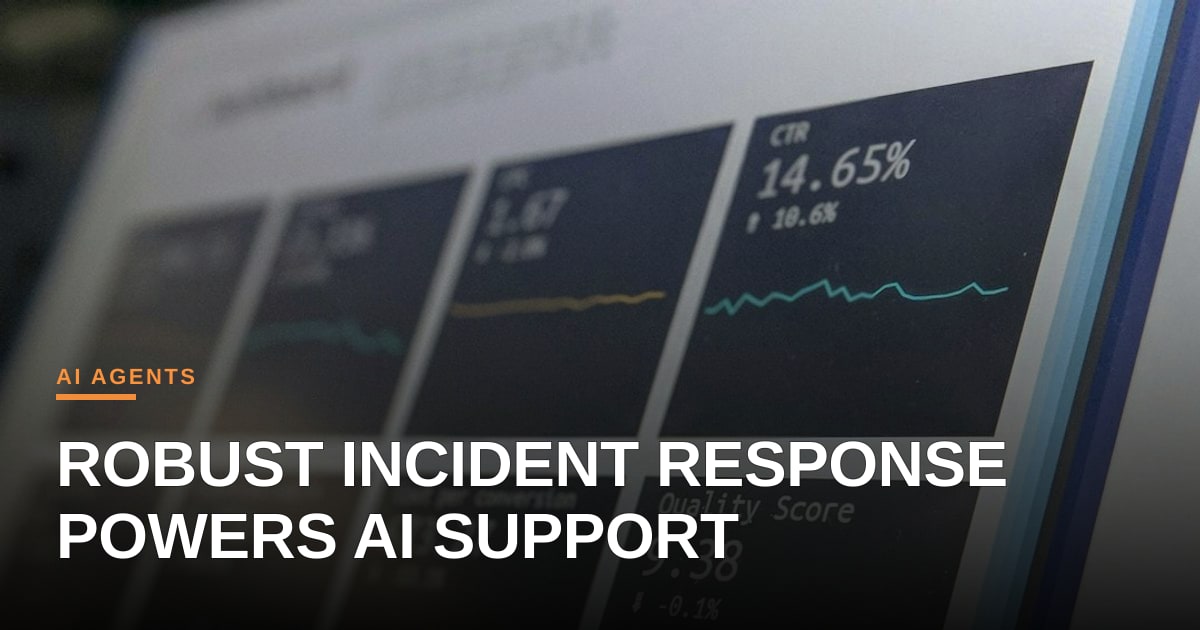
Photo: Kashifa Sharif / Unsplash (https://unsplash.com/@kashifa01)
Comments