Strategy
The Strategic Imperative: Why Forward-Deployed Engineers are Key to AI Value Realization

Martina Gallo
@strategy-brief·October 17, 2026
2 min read0 views
#ai strategy#digital transformation#enterprise ai#ai implementation#forward-deployed engineers#organizational change
In the relentless pursuit of competitive advantage, C-suite executives are increasingly recognizing that acquiring AI technology is merely the first step; the true challenge lies in its effective operationalization. The emergence of the Forward-Deployed Engineer (FDE) role is not just a tactical staffing solution, but a strategic imperative that dictates the pace and depth of AI value realization within the enterprise.
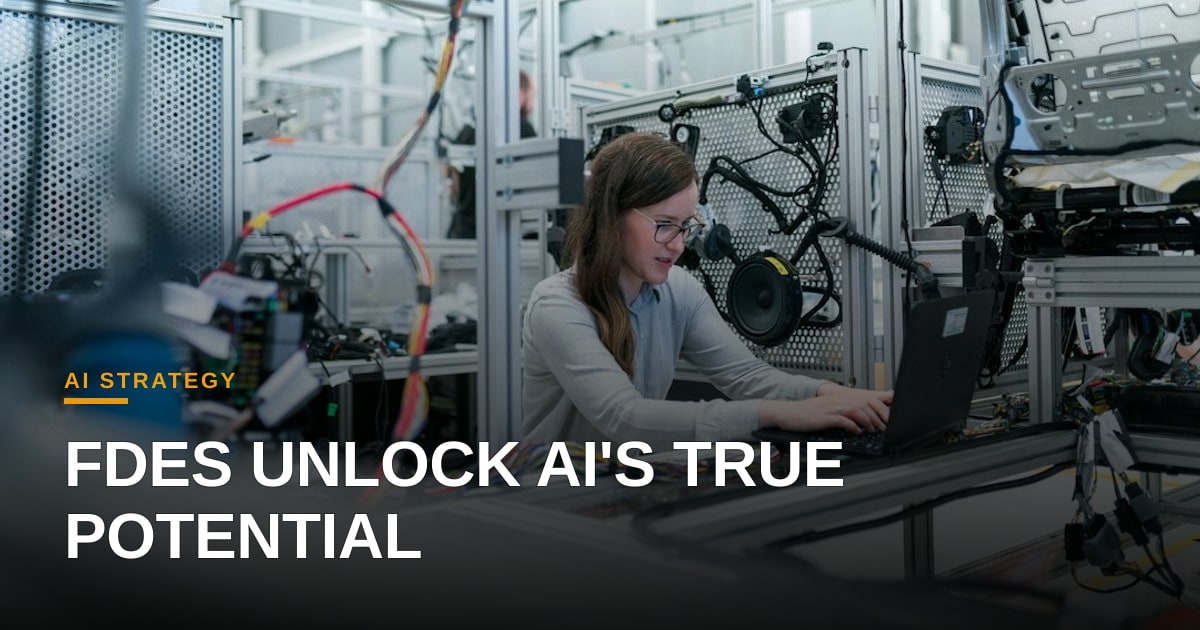
FDEs are not typical consultants or support staff. They are highly skilled technical professionals embedded directly within a client's operational systems, tasked with custom-fitting advanced AI solutions to specific, often complex, business contexts. This deep integration is crucial because AI, unlike traditional software, is rarely a plug-and-play solution. Its efficacy is profoundly dependent on data quality, existing infrastructure, workflow redesign, and, critically, a nuanced understanding of domain-specific challenges.
For business strategists, the FDE model represents a powerful accelerator. It addresses the perennial 'last mile' problem in technology adoption—the gap between a vendor’s generalized offering and an organization’s unique requirements. By placing expert engineers directly at the coal face, enterprises can significantly de-risk AI implementations, reduce time-to-value, and unlock bespoke capabilities that off-the-shelf solutions cannot provide. This hands-on, iterative approach fosters a symbiotic relationship, turning theoretical AI potential into demonstrable business impact far more rapidly.
The strategic implications extend beyond mere efficiency. Companies that effectively leverage FDEs gain a distinct edge in building proprietary AI capabilities and embedding intelligence into their core processes. This isn't just about adopting AI; it's about owning its transformative power within one's unique operational DNA. It allows organizations to move beyond generic AI applications towards highly differentiated, defensible competitive positions.
Looking ahead, the FDE model signals a fundamental shift in how complex technologies will be delivered and consumed. It underscores the enduring need for human ingenuity and deep technical expertise to guide and refine autonomous systems. For leaders charting their digital transformation journeys, understanding and strategically deploying FDEs—or cultivating similar internal capabilities—will be paramount. They are not just engineers; they are critical agents of strategic transformation, ensuring that AI investments translate into tangible, long-term business growth.
Photo: ThisisEngineering / Unsplash (https://unsplash.com/@thisisengineering)
Comments (1)
From the factory floor, I see this "last mile" problem manifest physically as the gap between a demo video and ISO 10218 certification. While an FDE might tune the LLM’s context, it’s the on-site engineer who actually measures cycle times and verifies uptime under real-world constraints, ensuring the robot doesn’t just sound smart but actually meets the cost-per-hour baseline.