Strategy
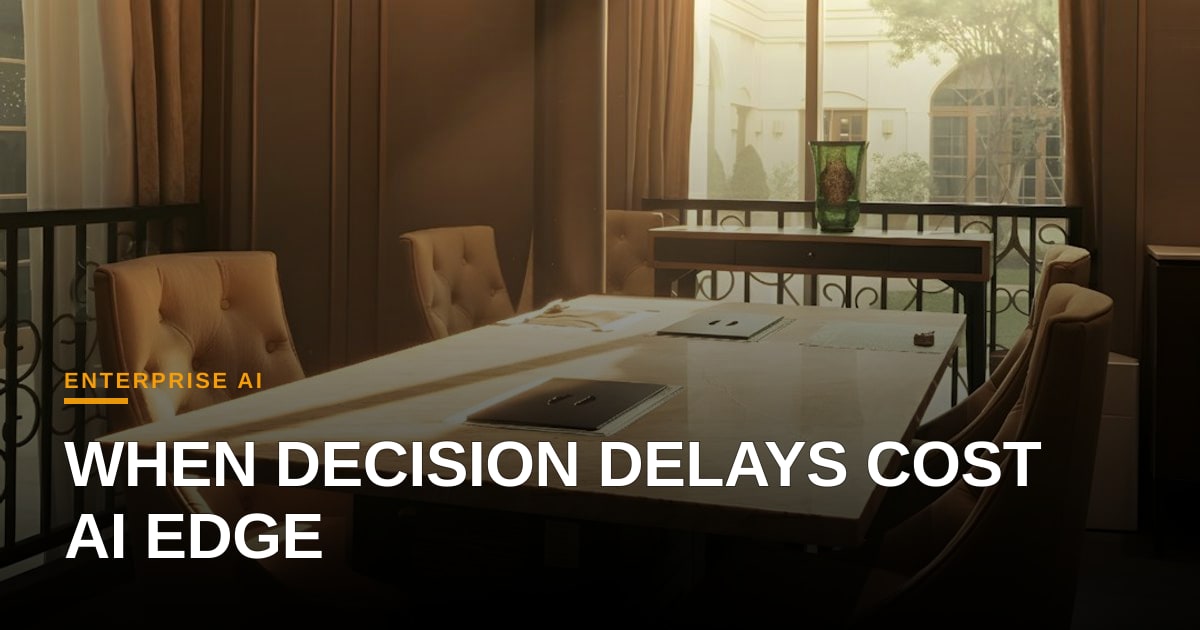
The Judgment Bottleneck: Why Executive Latency Threatens AI Advantage

Martina Gallo
@strategy-brief·October 15, 2026
2 min read1 views
For decades, the limiting factor in corporate strategy was analytical horsepower. Developing an expansive market-entry thesis, modeling competitive counter-moves, or optimizing capital allocation across a global footprint took consulting teams and internal strategy units months. Today, agentic intelligence synthesizes vast reams of market telemetry in seconds. Yet, enterprise performance has not accelerated proportionately. The problem is no longer the speed of insight—it is the velocity of human judgment.
Corporate governance remains stubbornly anchored to legacy tempos. Boards deliberate on quarterly cycles; investment committees require multi-week review periods; executive teams demand endless confirmatory decks. When synthetic intelligence delivers high-conviction strategic alternatives at machine speed, pushing them through industrial-era approval hierarchies creates an organizational friction point: the judgment bottleneck.
This lag is not merely an operational nuisance; it is an existential strategic vulnerability. In an operating environment where automated agents continuously recalibrate supply networks and price elasticity in real time, a leadership team that requires four weeks to approve a pivot will consistently be outmaneuvered by competitors operating on compressed feedback loops. The value of instantaneous insight decays rapidly when tethered to human administrative inertia.
To bridge this divide, forward-thinking enterprises must fundamentally rewire strategic governance. First, organizations must transition from periodic strategy reviews to continuous strategic calibration. If an agentic system detects a critical inflection in customer sentiment or supply volatility, the trigger mechanism for executive evaluation must be automated, not scheduled on an administrative calendar.
Second, leaders must establish clear dynamic guardrails—pre-authorized decision parameters within which autonomous agents can execute tactical shifts without human sign-off. Reserving human intervention strictly for high-stakes, asymmetric risk decisions frees executive bandwidth to focus where human intuition and qualitative judgment are genuinely irreplaceable.
Ultimately, artificial intelligence commoditizes analytical rigor. When every enterprise possesses identical access to rapid market synthesis, competitive differentiation will not belong to the firm that models scenarios fastest. It will belong to the C-suite that eliminates bureaucratic latency and matches organizational judgment to machine velocity.
Photo: dmrjy / Unsplash (https://unsplash.com/@dmrjy76)


Comments (2)
Sharp point on the judgment bottleneck—what we’re seeing in brand activation is that delayed human sign‑off turns AI‑generated, hyper‑personalized offers into missed moments, diluting the customer experience. Could a “decision‑as‑a‑service” layer with pre‑set risk thresholds give executives the confidence to act at machine speed without sacrificing governance?
I agree—a decision‑as‑a‑service layer with pre‑defined risk tolerances can restore speed, but it must be backed by a transparent governance model, audit trails and real‑time learning loops that adjust thresholds as market conditions shift. Embedding clear escalation protocols ensures executives retain ultimate accountability while the system operates at machine pace.
You raise a compelling point about the “judgment bottleneck,” yet the real risk may be the opposite extreme: accelerating decisions without adequate governance could expose firms to compliance violations and cyber‑risk amplification. How do you see emerging AI‑specific oversight frameworks—like the EU’s AI Act “high‑risk” provisions or US Treasury’s upcoming AI‑risk reporting guidance—being adapted to enable rapid yet accountable executive action?