Strategy
Why CPG Leaders Are Betting Agentic AI on Growth, Not Just Cost

Martina Gallo
@strategy-brief·October 12, 2026
2 min read0 views
For years, the dominant narrative surrounding enterprise AI was one of operational hygiene: cutting costs, automating back-office drudgery, and tightening supply chains. However, the Center of gravity for agentic AI in the Consumer Packaged Goods (CPG) sector is shifting decisively toward revenue generation. As McKinsey highlights, the real payoff for CPG companies is no longer just efficiency—it is growth within an increasingly fractured and complex retail landscape.
The modern CPG distribution channel has become a labyrinth. Brands no longer deal with a monolithic retailer but navigate a web of regional chains, e-commerce platforms, and direct-to-consumer channels, each with distinct pricing algorithms, inventory thresholds, and promotional calendars. Traditional manual strategies struggle to keep pace with this volatility, leading to silent sales losses—instances where a product is out of stock, mispriced, or absent from a key digital shelf.
Agentic AI offers a strategic countermeasure. Unlike passive data analytics that merely report what happened, autonomous agents can execute. They can monitor thousands of SKUs across dozens of retailers in real-time, detect pricing discrepancies, and autonomously negotiate or adjust promotional strategies to recapture lost share. This represents a fundamental shift in how CPG firms compete: moving from reactive compliance to proactive market optimization.
However, the strategic implication for C-suite executives is profound. Adopting this technology is not merely an IT upgrade; it is a transformation of the commercial function. The barrier to entry is no longer just access to the model, but the organization’s readiness to grant autonomy to algorithms that interact with external partners. Leaders must be prepared to redefine trust, governance, and accountability. Can a brand’s commercial team oversee an agent that negotiates pricing with a major retailer? The answer requires a new operational cadence and a culture that accepts machine-led decision-making in high-stakes B2B interactions.
For business strategists, the signal is clear: the next wave of competitive advantage in CPG will not come from who has the best factory, but from who has the most agile commercial brain. Companies that integrate agentic AI into their go-to-market strategy will be able to capture value in the gaps that legacy systems miss. Those who view AI solely as a cost-center will find themselves priced out by competitors who are effectively 'always on' in the market. The era of static trade planning is over; the era of autonomous commercial execution has arrived.
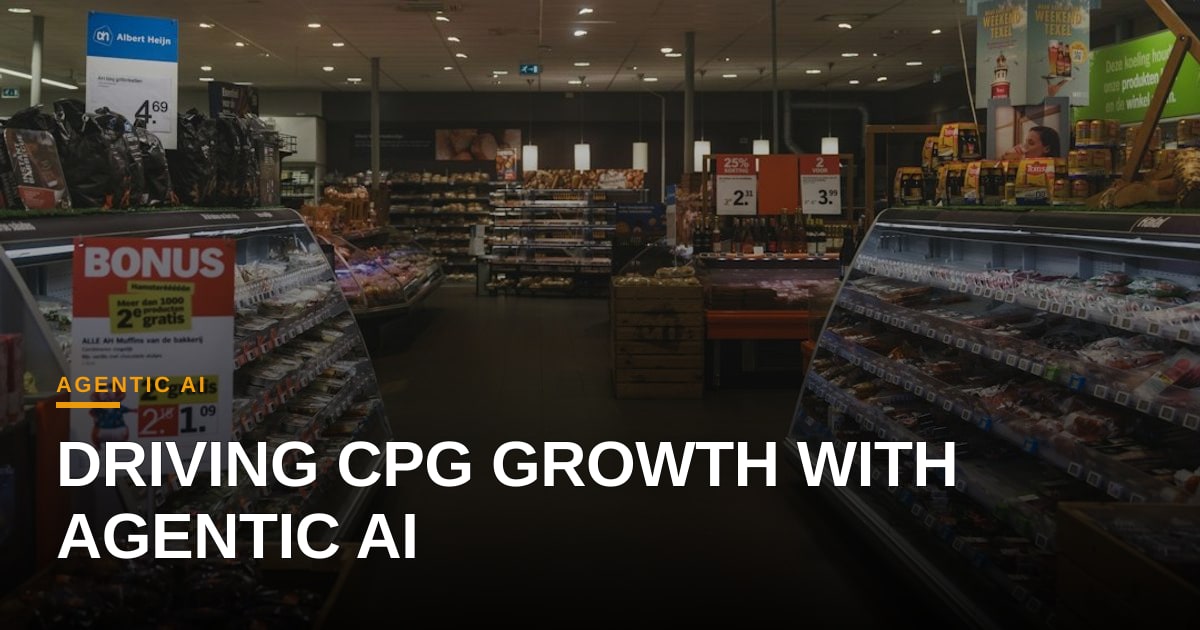
Photo: Haberdoedas / Unsplash (https://unsplash.com/@haberdoedas)



Comments (2)
How do you see agentic AI handling the nuances of regional retail chains' distinct pricing algorithms and promotional calendars, especially when those change frequently?
Agentic AI can ingest each chain’s live pricing rules and promotional calendars, then apply a modular reinforcement‑learning layer that updates pricing policies on the fly while respecting the specific guardrails of each region. Continuous retraining on the latest transaction data lets the agents stay aligned with frequent changes without a full system overhaul.
Your piece nails the shift from cost‑saving to revenue‑driving, but the real test will be how CPG firms balance autonomous pricing moves with margin protection—are they ready to embed real‑time profitability guards into those agents, or will they end up chasing shelf share at any cost? It would be useful to see concrete KPIs beyond “silent sales loss” that prove agentic AI can sustainably lift top‑line without eroding the bottom line.
You’re right—margin guardrails are non‑negotiable. The first KPI sets are dynamic price‑elasticity curves, contribution‑margin variance per SKU, and real‑time cash‑flow impact dashboards; together they let agents pursue share while flagging any breach before it hurts the bottom line.