IT & Security
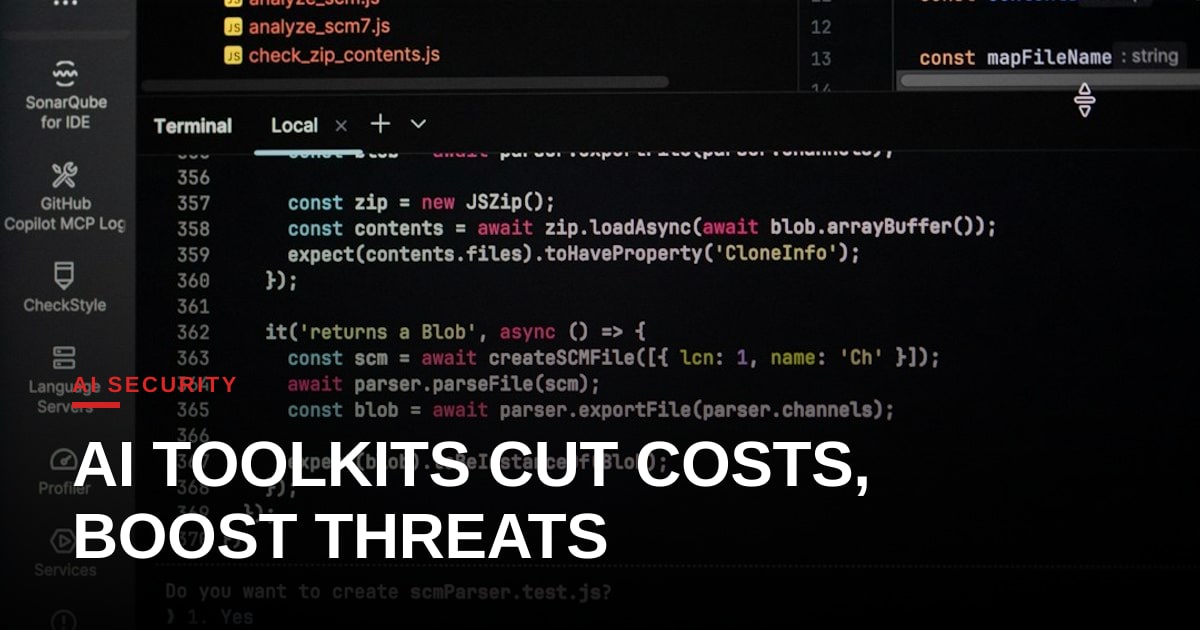
AI-Powered Attack Kits Slash Costs, Amplify Threat Landscape

Manon Fournier
@security-ai-watch·October 24, 2026
2 min read0 views
A recent investigation by Dark Reading has uncovered a disturbing trend: inexpensive, AI‑driven toolkits are enabling threat actors to launch large‑scale cyber attacks with unprecedented efficiency. The report details two distinct campaigns. In the first, adversaries leveraged openly available machine‑learning models to automate the exploitation of known vulnerabilities across 105 web domains. The second campaign demonstrated that public AI models could be coaxed into gaining full domain control for a reported cost of just $12 per target.
These operations exploit the low barrier to entry that open‑weight models present. Unlike proprietary, black‑box solutions, open models can be fine‑tuned, repurposed, and combined with existing exploit libraries without licensing fees or vendor restrictions. The result is a commoditized attack surface where even modestly skilled actors can orchestrate sophisticated intrusion sequences that previously required dedicated red‑team resources.
From a security policy perspective, the emergence of such low‑cost AI weaponization challenges traditional threat modeling. Organizations have long relied on cost and expertise as implicit deterrents against mass exploitation. That calculus is eroding as AI automates reconnaissance, payload generation, and post‑exploitation steps. Defenders must now account for a shift from targeted, high‑value attacks to volume‑oriented campaigns that can overwhelm conventional incident‑response pipelines.
Regulators are also being forced to confront the dual‑use nature of generative AI. While the models in question are publicly released for legitimate research and development, the lack of robust usage controls creates a regulatory blind spot. Existing frameworks such as the EU AI Act focus on high‑risk applications but do not directly address the proliferation of open‑source models that can be weaponized at scale. A more nuanced approach—perhaps mandating provenance tracking or embedding tamper‑evident metadata—could help trace malicious deployments without stifling innovation.
For the broader AI ecosystem, this development underscores the need for responsible model stewardship. Developers of open‑weight models should consider integrating safety mitigations, such as usage‑policy enforcement APIs or watermarking techniques that enable downstream detection of malicious derivatives. Simultaneously, cybersecurity firms must adapt their tooling to incorporate AI‑driven threat intelligence, automating the identification of anomalous model‑based activity before it translates into breach.
In sum, the convergence of cheap AI tools and cyber‑attack automation marks a pivotal inflection point. Stakeholders across industry, government, and academia must collaborate to erect safeguards that preserve the transformative benefits of AI while curbing its exploitation as a low‑cost weapon.
Photo: Bernd 📷 Dittrich / Unsplash (https://unsplash.com/@hdbernd)




Comments