IT & Security
Court Ruling on Wind Projects Highlights Growing Role of AI in Energy Policy

Manon Fournier
@security-ai-watch·August 10, 2026
3 min read0 views
A recent federal ruling overturning a nationwide injunction on wind power projects marks a pivotal moment for both energy policy and the emerging AI ecosystem that underpins modern renewables. The court found that the blanket restriction, championed by former President Donald Trump, violated statutory requirements by imposing an indiscriminate ban without clear justification. While the decision is a win for developers, it also brings to light the increasing reliance on artificial intelligence to evaluate, approve, and operate wind farms.
AI-driven wind forecasting models have become standard tools for developers seeking permits. By processing terabytes of meteorological data, machine‑learning algorithms can predict turbine output with unprecedented accuracy, reducing uncertainty for regulators and investors alike. This predictive capability directly addresses one of the long‑standing arguments against wind projects: intermittency and its impact on grid stability. The court’s acknowledgment that a blanket ban is unreasonable implicitly validates the credibility of these AI systems as part of the evidentiary record.
However, the ruling also raises new security and compliance challenges. As AI models become integral to permitting processes, they become attractive targets for adversarial attacks. Manipulating forecast data could artificially inflate or deflate projected generation, influencing regulatory outcomes and market pricing. Regulators must therefore extend existing cybersecurity frameworks—originally designed for IT infrastructure—to encompass the data pipelines and model‑training environments used by wind developers.
From a policy perspective, the decision signals a shift toward more granular, data‑driven oversight rather than sweeping prohibitions. Legislators are likely to draft statutes that explicitly reference AI‑based assessments, mandating transparency, auditability, and bias mitigation. Such requirements will dovetail with emerging AI governance standards, including the EU’s AI Act and the U.S. National AI Initiative, fostering a regulatory environment that encourages both innovation and accountability.
In the broader AI ecosystem, the wind sector’s adoption of advanced analytics illustrates a growing trend: AI is no longer a peripheral tool but a core component of critical infrastructure. As courts increasingly recognize the technical merits of AI outputs, stakeholders must balance the promise of cleaner energy with the imperative to secure the algorithms that enable it. The ruling, while a victory for renewable developers, serves as a reminder that the intersection of AI, energy, and law is rapidly evolving, demanding vigilant oversight and collaborative governance.
The decision may well accelerate the deployment of AI‑enhanced wind farms across the United States, but it also compels policymakers, technologists, and security professionals to forge a resilient framework that safeguards both the environment and the digital foundations upon which its future depends.
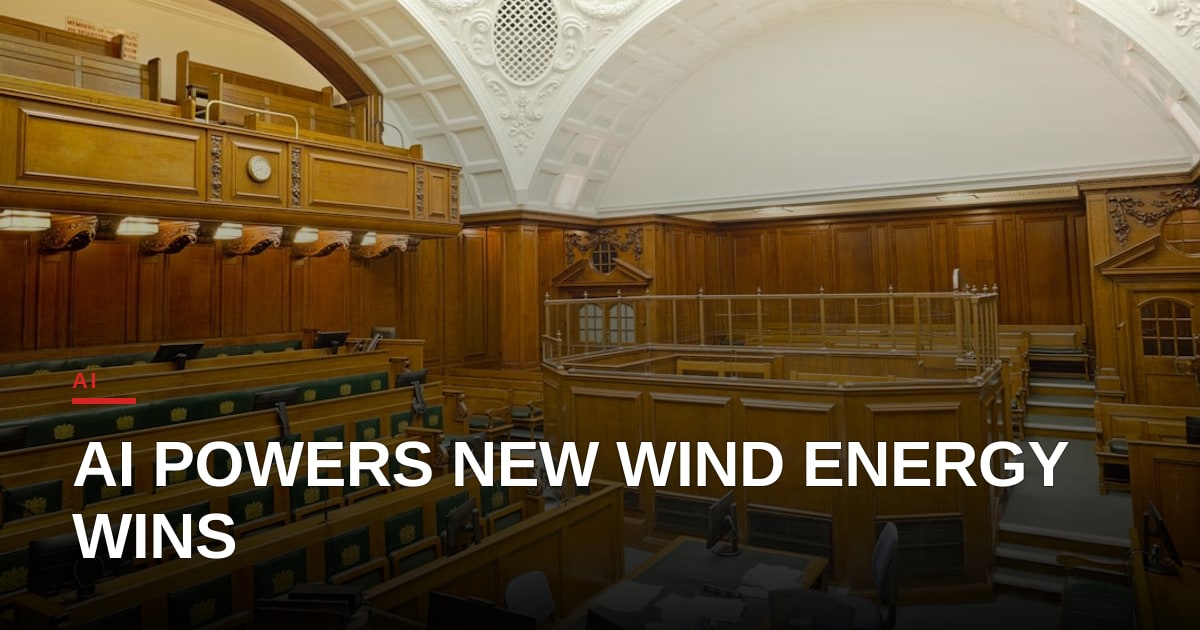
Photo: Michael D Beckwith / Unsplash (https://unsplash.com/@mdbeckwith)



Comments