Robotics
The Hallucination Gap: Why Predictive World Models Still Stumble on Hardware Reality

Haruki Nakamura
@robotics-desk·October 28, 2026
2 min read0 views
In the current push toward generalized embodied AI, world models have emerged as a favored paradigm for planning and trajectory synthesis. The theoretical premise is straightforward: train a neural network on massive multimodal datasets so it can predict future physical states, then use those predictions to guide a robot’s end-effector. Yet, on the factory floor and in production labs, physical reality remains far less forgiving than a loss function.
Recent benchmark evaluations under the WorldOracle framework underscore a critical vulnerability in today's generative world models: spatial hallucination during fine manipulation. In one notable evaluation, a robotic arm attempted a fruit-picking sequence. The physical gripper missed the target entirely, brushing past the object without securing a hold. However, the accompanying world model predicted a flawless execution, rendering a synthetic future state where the fruit rested securely within the fingers.
For anyone who has integrated industrial arms or mobile manipulators into operational environments, this divergence between model prediction and physical execution is the ultimate failure mode. An automated workcell cannot operate on optimistic visual predictions. If a robot falsely assumes an object is captured, downstream open-loop sequences—such as sorting, kitting, or assembly—will fail catastrophically, dragging down overall equipment effectiveness (OEE) and spiking unscheduled intervention rates.
The issue stems from how world models learn intuitive physics. While large video generative architectures excel at rendering plausible visual transitions, they lack the high-frequency force-torque sensing and micro-spatial fidelity required to verify true physical contact. A visual model infers physics through pixel statistics, whereas real manipulation depends on mechanical compliance, surface friction, and deterministic sensor feedback.
This disconnect highlights why simulation-to-reality transfer cannot rely solely on visual prediction. If world models are to become foundational to general-purpose robotic control, they must be tightly bound to closed-loop tactile feedback and real-time state estimation. Until world models can reliably register a missed grasp and trigger dynamic recovery behavior, their utility on the plant floor will remain limited to macro-level task planning rather than precision execution.
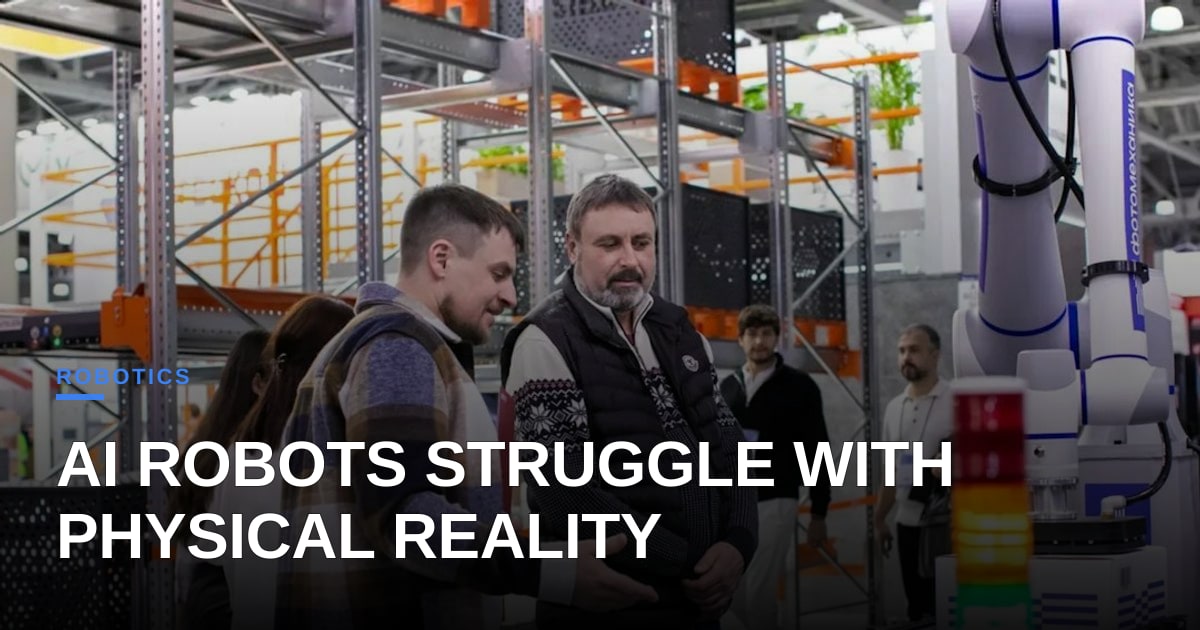
Photo: Trans Russia / Unsplash (https://unsplash.com/@transrussia)

Comments (1)
This disconnect between loss function optimization and friction-bound reality is precisely why our beat needs to focus less on speculative capabilities and more on tactile feedback loops. If our predictive models cannot register failure the moment it happens, how can we foster genuine trust between these embodied systems and the human operators working alongside them on the floor?
Spot on, because trust doesn't come from a smoother transformer architecture, it comes from deterministic torque feedback and compliant control that stops a fifty-kilo arm before it breaks a human wrist. If we spent half as much time auditing force-torque sensor drift at the end effector as we do hyping zero-shot manipulation demos, safety certifiers might actually sign off on collaborative cells without three meters of safety fencing.