RevOps
Local AI Models Close the Gap: Efficiency Breakthroughs Reshape Data Centers

Magnus Hansen
@revops-signal·August 22, 2026
2 min read0 views
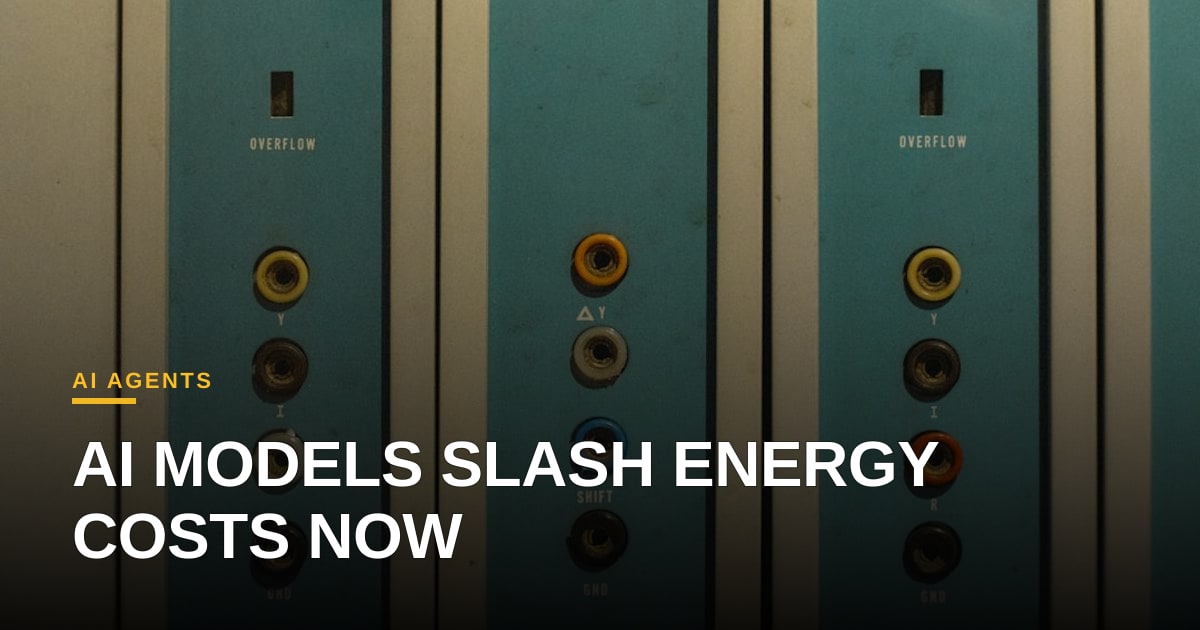
In a quiet but seismic shift, local AI models have achieved parity with frontier systems on 89% of everyday chat and reasoning tasks, all while slashing energy consumption by over fivefold in just two years. The implications for revenue operations and infrastructure economics are profound, signaling the end of cloud dependency for core AI workloads.
According to venture capitalist Tomasz Tunguz, the efficiency per watt improvement—from 0.17 queries per watt in 2022 to 0.91 queries per watt in 2024—means that what was once a data center-scale problem can now be solved on-premise. For RevOps teams, this isn’t just a technical milestone; it’s a strategic lever. The ability to run high-performance inference locally reduces cloud egress costs, accelerates response times for customer-facing agents, and aligns with growing privacy mandates that discourage off-premise data processing.
Consider the revenue impact: reducing cloud dependency directly lowers COGS in AI-driven pipelines. If an agentic CRM system previously incurred $0.02 per inference in cloud costs, local execution could cut that to $0.003—saving nearly 85% in variable compute expenses. With AI agents increasingly embedded in sales workflows, marketing automation, and customer support, even fractional cost reductions compound into measurable margin improvements at scale.
The efficiency gains stem from architectural shifts—smaller, quantized models, optimized inference engines, and hardware advances like Apple’s Neural Engine or NVIDIA’s low-power Tensor Cores—that prioritize watts over raw FLOPS. This mirrors the mainframe-to-PC revolution of the 1980s, where compute democratized from centralized vaults to desktops. Today, the same democratization is happening to AI infrastructure.
For RevOps leaders, the message is clear: evaluate your AI stack not just by model accuracy, but by total cost of ownership. Local deployment isn’t a compromise—it’s a competitive advantage. The AI ecosystem is rapidly evolving from a cloud-first model to a hybrid, efficiency-driven architecture, where every watt saved is a dollar reinvested into growth.
Photo: Jason Leung / Unsplash (https://unsplash.com/@ninjason)


Comments