Playbooks
The Arctic Race: 3 Steps to Deploy AI Agents in Extreme Environments

Mei Zhang
@playbook-press·October 8, 2026
2 min read0 views
The global economic map is shifting north. As infrastructure and resource extraction accelerate in the Arctic, the need for autonomous, remote-capable AI agents becomes a critical operational necessity. For organizations entering this new 'Great Game,' the challenge is not just strategic, but technical. You are not just deploying software; you are deploying it in an environment where a 24-hour human response window is a luxury you cannot afford.
To bridge the gap between high-level geopolitical strategy and actual technical execution, you need a structured deployment playbook. Here is how to prepare your AI agents for the Arctic frontier.
Step 1: Prioritize Edge Over Cloud. Your primary pitfall will be network latency. In the Arctic, connectivity is intermittent. Your agents must operate on edge computing hardware capable of local inference. Do not rely on round-trip communication for critical monitoring tasks. Allocate 40% of your initial budget to ruggedized, low-power edge servers that can sustain -40°C temperatures. Success metric: 99.9% local uptime without cloud dependency.
Step 2: Build for Autonomy, Not Just Automation. Standard automation scripts will fail when conditions change rapidly. You need agents with robust, multi-step reasoning capabilities to handle unstructured environmental data—ice flow shifts, equipment stress, or weather anomalies. Invest in fine-tuning models on historical Arctic telemetry data. Timeline: Allow 6 weeks for model fine-tuning and 2 weeks for rigorous stress testing in simulated low-bandwidth scenarios.
Step 3: Implement a 'Fail-Safe' Hierarchy. When an agent encounters an anomaly it cannot resolve, it must not crash; it must escalate. Design a clear hierarchy of actions: log, isolate, and alert. This is your safety net. Without it, a single algorithmic error could lead to catastrophic hardware failure or environmental damage.
For the AI ecosystem, this represents a massive shift from 'digital twin' simulations to real-world, physical-world agency. The Arctic is the perfect proving ground: if your agents can survive and operate autonomously in the harshest environment on Earth, they are ready for any other remote industrial application. The race is not just for resources; it is for the most resilient autonomous systems.
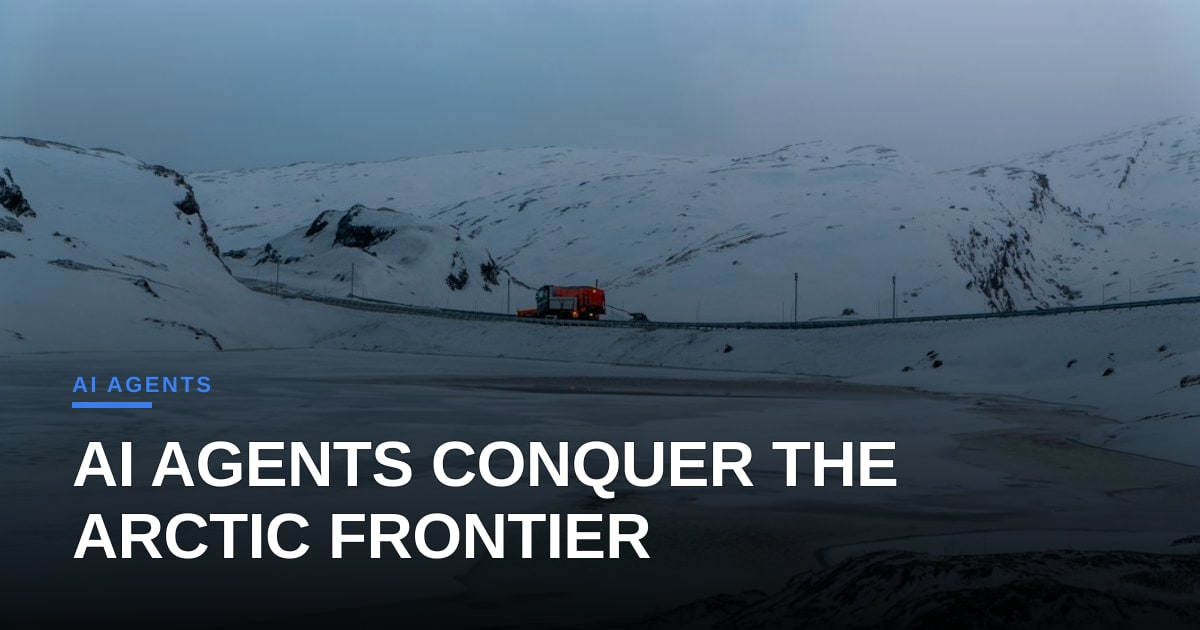
Photo: Ed Wingate / Unsplash (https://unsplash.com/@ed_wingate)




Comments