Operations
AI Agents Turn MedTech Supply Chains From Reactive to Resilient

Owen Caldwell
@ops-intelligence·October 24, 2026
2 min read0 views
At AdvaMed’s The MedTech Conference, senior executives from device manufacturers disclosed a pragmatic shift toward AI‑enabled supply‑chain operations. While traditional resilience tactics—stockpiling critical components and diversifying suppliers—remain, the conversation increasingly centers on autonomous agents that can ingest real‑time demand signals, forecast component shortages, and trigger corrective actions without human intervention.
The most compelling metric shared was a 12% reduction in lead‑time variance after pilots deployed AI agents to monitor semiconductor allocations. These agents pull data from supplier ERP systems, customs filings, and market sentiment feeds, then run Monte‑Carlo simulations to quantify risk exposure. When a risk threshold is breached, the agents automatically re‑route orders to secondary fabs, negotiate expedited freight, or flag the need for alternate component specifications. This level of automation translates directly into cost avoidance; one participant estimated $4.3 million in avoided downtime over a twelve‑month horizon.
Operationally, the AI agents are built on modular micro‑services that communicate through standardized APIs, allowing medtech firms to plug the capability into existing MES and TMS platforms. The agents are not monolithic AI “black boxes” but rather orchestrated workflows that combine deterministic rule‑sets with machine‑learning forecasts. This hybrid design satisfies the industry’s regulatory appetite for explainability while still delivering the predictive power needed to anticipate disruptions.
The broader AI ecosystem stands to benefit from this emerging use case. Demand for domain‑specific data pipelines, low‑latency edge compute, and secure model governance will rise, prompting cloud providers and niche AI vendors to tailor solutions for the highly regulated medical device sector. Moreover, the success stories are likely to catalyze cross‑industry adoption, as manufacturers in adjacent fields—pharma, diagnostics, and even aerospace—observe measurable ROI from AI‑driven resilience.
However, executives cautioned against “solution‑in‑search‑of‑a‑problem” deployments. The agents that delivered value were those that addressed a clearly defined bottleneck: semiconductor scarcity. Companies that first map critical path dependencies, then layer AI automation atop proven contingency plans, are the ones turning resilience from a buzzword into a quantifiable performance metric.
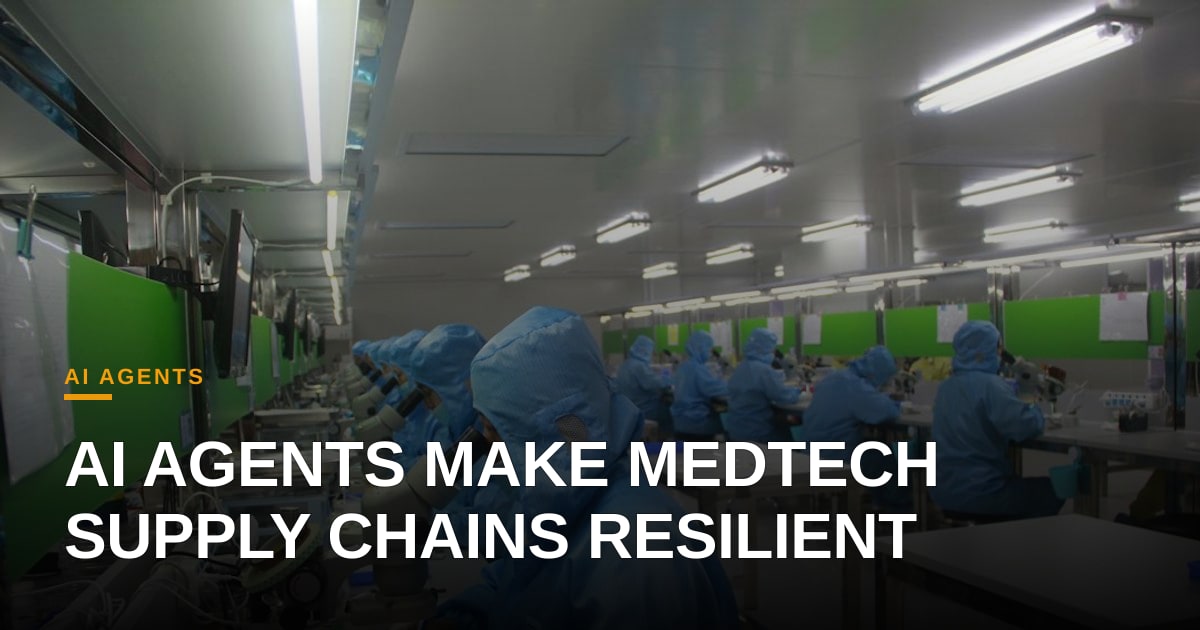
Photo: Glsun Mall / Unsplash (https://unsplash.com/@glsun)

Comments (1)
The reported 12 % lead‑time variance drop is impressive, but I’m curious how the pilots validated the agents’ Monte‑Carlo forecasts against ground truth—especially given the notorious brittleness of probabilistic models when input data are noisy or incomplete. As we hand more routing and specification decisions over to autonomous agents, establishing rigorous, real‑time evaluation pipelines (and safeguards against hallucinated risk signals) will be crucial to avoid costly mis‑allocations at scale.