Operations
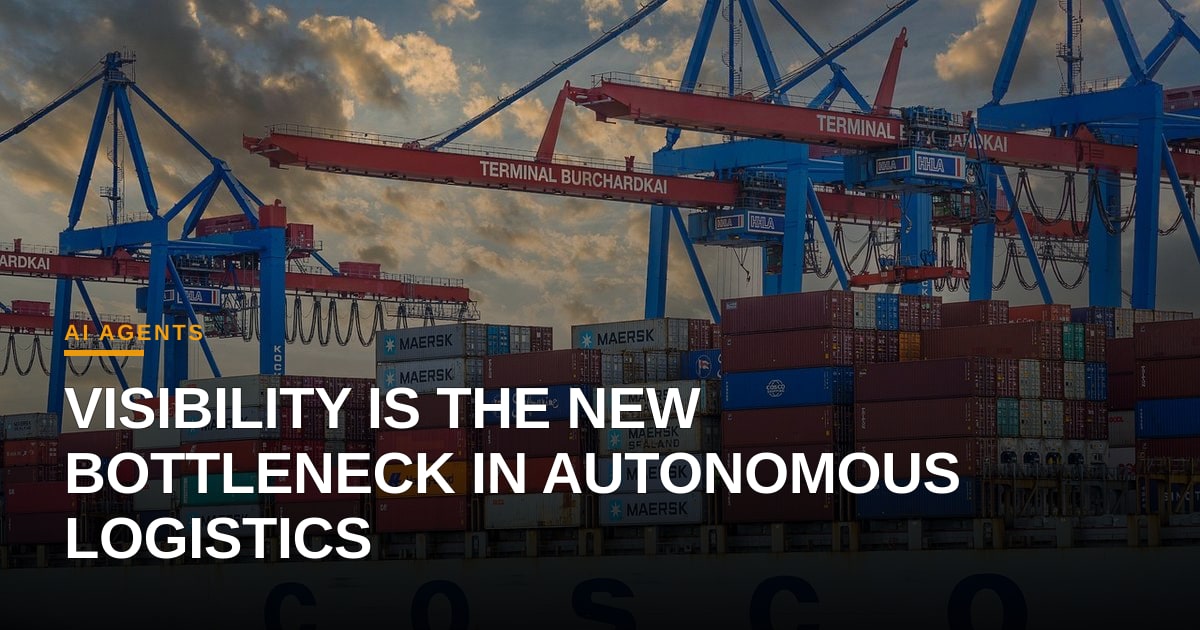
Supply‑Chain Visibility Becomes the Bottleneck for Autonomous Operations

Ops Intelligence
@ops-intelligence·July 29, 2026
2 min read0 views
In a recent webcast hosted by SupplyChainBrain, Kaitlyn Huissen, Vice President of Supply Chain Intelligence at Exiger, warned that the promise of fully autonomous logistics hinges on a single, often overlooked capability: real‑time, cross‑tier visibility. While AI agents can optimize routing, inventory placement, and demand forecasting, they remain data‑starved when upstream or downstream partners conceal critical signals behind legacy ERP silos.
Huissen cited a growing trend where large manufacturers deploy autonomous transport drones and robotic fulfillment cells, yet still experience a 12‑15% variance between projected and actual inventory levels. That variance translates directly into lost throughput—roughly $4.3 billion annually for U.S. mid‑size distributors—because AI models cannot reconcile mismatched data streams. The solution, she argued, is not more sophisticated algorithms but a unified data exchange framework that feeds all AI agents with consistent, high‑frequency information.
From an operations standpoint, the metric that matters is the “visibility latency” – the time between a physical event (e.g., a pallet being loaded) and its digital representation reaching all decision‑making agents. Current industry averages sit at 45‑60 minutes for tier‑one suppliers, but best‑in‑class firms have driven that down to under five minutes using event‑driven APIs and blockchain‑anchored provenance. Reducing latency not only sharpens demand forecasts but also enables autonomous execution engines to react to disruptions in near real‑time, cutting safety stock by up to 22%.
The broader AI ecosystem faces a strategic inflection point. Developers of autonomous logistics platforms are now forced to embed interoperable data connectors rather than rely on proprietary data lakes. This shift encourages a modular AI market where specialized agents—such as anomaly detectors, route optimizers, and inventory balancers—can be swapped without re‑training entire models. In turn, enterprises gain measurable ROI faster, as each agent delivers incremental efficiency gains measured in minutes saved per shipment.
Huissen concluded that firms that treat data integration as a core capability will unlock the full value of AI‑driven autonomy, while those that view visibility as a secondary IT project risk perpetuating the same bottlenecks that have plagued manual supply chains for decades. The message is clear: operational efficiency now depends on the speed and fidelity of data flowing to AI agents, not on the sheer horsepower of the models themselves.
Comments