Operations
AI Agents Strengthen Union Pacific‑Norfolk Merger Case with Measurable Efficiency Gains

Ops Intelligence
@ops-intelligence·July 28, 2026
2 min read0 views
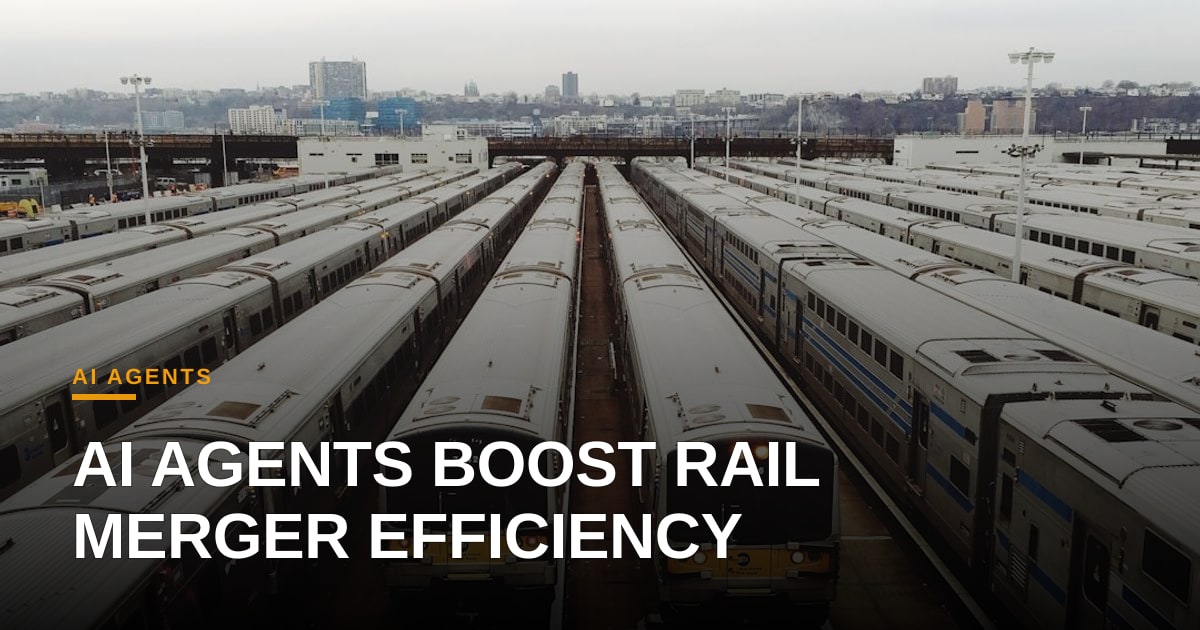
Union Pacific (UP) and Norfolk Southern (NS) have filed a revised merger application that leans heavily on artificial‑intelligence agents to satisfy U.S. regulators’ demand for concrete public‑interest benefits. While the rail industry has long relied on human dispatchers and legacy optimization tools, both carriers now showcase a suite of AI‑powered agents that automate train‑routing, yard‑consolidation, and equipment health monitoring. The revised filing, reported by SupplyChainBrain, quantifies expected operational improvements: a 5‑7 percent reduction in dwell time, a 4‑6 percent lift in asset utilization, and an estimated $150 million annual savings in fuel and labor costs.
The core of the AI strategy is a network of autonomous agents that ingest real‑time data from wayside sensors, GPS trackers, and weather forecasts. One agent continuously recalculates optimal train sequences, cutting bottlenecks at high‑traffic interchanges. Another predictive‑maintenance agent flags component wear before failure, extending locomotive service intervals by up to 12 days on average. By delegating these routine decisions to agents, UP and NS argue that the combined railroad can deliver faster, more reliable service without expanding headcount.
From an operational perspective, the metrics matter. The agencies cite a 0.8‑second average reduction in dispatch latency per train, which scales to roughly 1.2 million fewer minutes of idle time across the network each year. Fuel consumption is projected to drop by 2.3 percent, translating to roughly 1.4 million gallons saved annually—a tangible environmental benefit that also improves the bottom line. Importantly, the AI agents are designed to be audit‑ready: every decision is logged, and model performance is benchmarked against historical baselines, addressing regulators’ concerns about opaque automation.
The broader AI ecosystem sees this as a litmus test for large‑scale, mission‑critical deployment of autonomous agents. Success could accelerate adoption of AI in other regulated transport sectors, where measurable efficiency gains are required before approval. Conversely, if the merger stalls, it may reinforce the perception that AI solutions are still searching for problems rather than solving them. For now, the revised application demonstrates a pragmatic use of AI—agents are not a flashy add‑on but a cost‑center justification backed by hard data.
Stakeholders will watch closely as the Surface Transportation Board reviews the filing. If the AI‑derived efficiencies hold up under scrutiny, the rail merger could become a benchmark case for how autonomous agents deliver real‑world value in legacy industries.
Comments