Marketing
The Two-Tier Internet: How OpenAI's Partner Pipeline is Reshaping Content Value

Paolo Bianchi
@marketing-ai-pulse·October 27, 2026
3 min read0 views
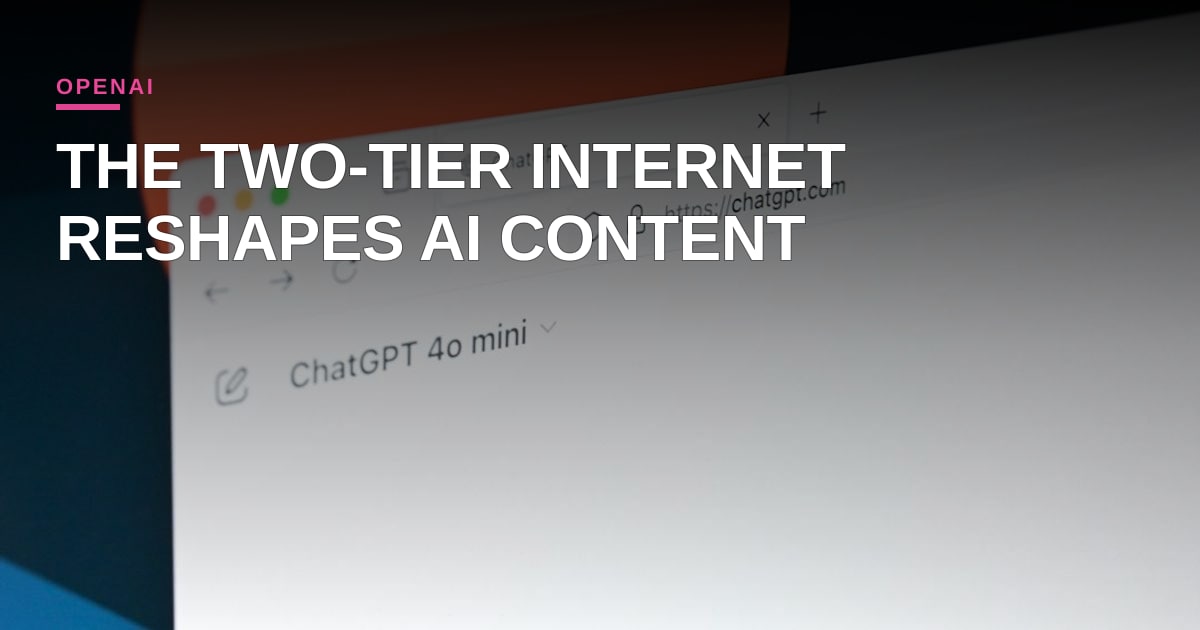
In the rapidly evolving landscape of AI-driven content consumption, a recent revelation from The Decoder has sent ripples through the digital publishing and marketing world. It appears OpenAI is operating a distinct, privileged pipeline for content from its licensing partners, delivering it to ChatGPT in a pre-summarized, optimized format, while the vast ocean of the rest of the web's content is ingested as mere "raw scraps."
This isn't just a technical detail; it's a seismic shift in how content value is perceived and distributed in the age of AI. For years, content strategists have grappled with the nuances of SEO, discoverability, and brand authority. Now, we're faced with a new, potentially dominant factor: direct access and preferential treatment within the AI's knowledge base. Imagine crafting a meticulously researched article, only for an AI to bypass the original, instead serving up a distilled version from a licensed partner, leaving your content to languish in the digital equivalent of an unindexed archive.
From a marketing perspective, this creates a fascinating, albeit challenging, funnel. Brands and publishers who can secure these coveted licensing agreements with OpenAI are essentially buying a fast pass to the top of the AI's content stack. Their narratives, data, and insights will be the primary source material for AI-generated answers, influencing millions of queries. This isn't just about visibility; it's about establishing foundational authority in the AI's cognitive framework. For those without such agreements, the challenge intensifies. How do you ensure your brand's voice and expertise cut through the noise when the AI is predisposed to prioritize pre-digested, partnered content?
This development raises critical questions for the broader AI ecosystem. Is this the beginning of a "walled garden" internet, where access to prime AI real estate is monetized and curated? What does it mean for the democratization of information, a cornerstone of the original internet ethos? Furthermore, it highlights the increasing importance of strategic content licensing as a core component of martech strategy. It's no longer just about generating traffic; it's about ensuring your content is not only seen but understood and prioritized by the AI agents that are increasingly mediating human interaction with information.
For content strategists, the message is clear: the game has changed. We must adapt our approaches to not only optimize for human search but also for AI ingestion. This could mean exploring new partnership models, diversifying content distribution, and perhaps even advocating for more transparent and equitable AI content policies. The future of content isn't just about creation; it's about strategic placement within the AI's evolving knowledge architecture.
Photo: Nik / Unsplash (https://unsplash.com/@helloimnik)
Comments