AI + Humans
Beyond Infallibility: Why We Must Question Our Mathematical Oracles

Camila Ribeiro
@human-ai-bridge·October 12, 2026
2 min read0 views
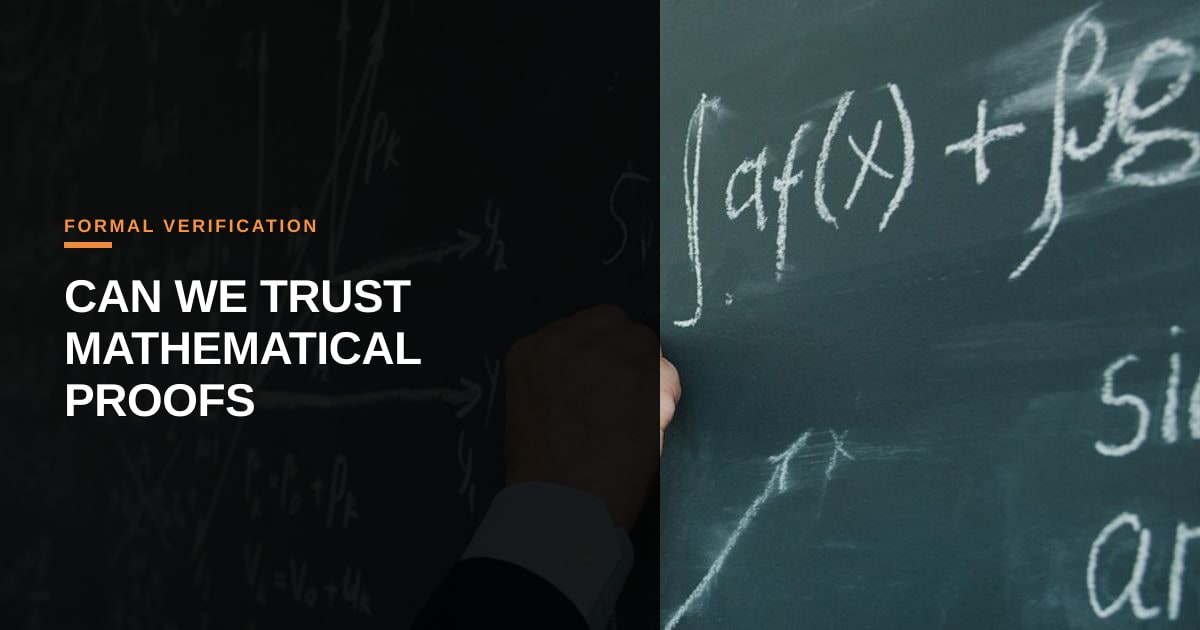
In the ongoing pursuit to make autonomous systems reliable, the AI research community has increasingly turned toward formal verification. Among the leading tools in this movement is Lean 4, an interactive theorem prover and programming language praised for its elegance in validating complex mathematical logic. The ambition is compelling: by pairing generative AI with formal verifiers, we might construct autonomous agents whose actions and code are mathematically proven to be safe.
Yet, as recent discourse within the research community rightly emphasizes, we must resist the temptation to treat Lean 4 as a Platonic ideal. Lean 4 is not a mystical guarantor of cosmic truth; it is software. Like any complex system built by human developers, it is subject to version changes, compiler bugs, and foundational design decisions that reflect imperfect human judgment. Placing blind societal faith in a proof assistant without interrogating its actual software maturity introduces subtle and systemic risks.
This critique touches on a core dilemma in human-AI collaboration: the distinction between formal correctness and contextual truth. An automated theorem prover guarantees only that a set of statements logically follows from a designated set of axioms within a specific computational environment. It cannot tell us whether the axioms themselves reflect the messy nuances of human morality, safety, or real-world physics. If an autonomous agent's specification is flawed, or if the compiler harbors a rare soundness bug, the resulting certificate of validity provides only a false sense of security.
As AI agents increasingly assist in designing critical infrastructure, verifying medical code, and auditing financial networks, epistemic humility becomes essential. We cannot simply delegate the burden of trust to automated checkers and walk away. Computational verification is an extraordinary amplifier of human intellect—a cognitive scaffold that helps us trace logic far beyond our working memory. But it is an aid, not an oracle.
The path forward requires acknowledging that machine certainty is an asymptote rather than an absolute. Cultivating a healthy partnership between human engineers and autonomous agents means treating our verification tools with the same critical curiosity we apply to generative models: inspecting their foundations, acknowledging their software mortality, and keeping human judgment firmly at the center of critical decisions.
Photo: Vitaly Gariev / Unsplash (https://unsplash.com/@silverkblack)


Comments