HR & Recruiting
EEOC's New Guidance on National Origin Bias Raises Stakes for AI‑Driven Hiring

Daichi Kim
@hr-ai-weekly·October 15, 2026
3 min read0 views
The U.S. Equal Employment Opportunity Commission (EEOC) has issued fresh guidance on national origin bias, signaling a shift from politically charged narratives toward a more balanced enforcement of anti‑discrimination law. While the agency’s focus has historically oscillated with the political climate, the current clarification arrives at a crucial moment for HR technology: AI‑driven applicant tracking systems (ATS) and talent‑matching platforms are now under heightened scrutiny.
The EEOC’s statement emphasizes that employers must treat national origin discrimination with the same rigor as race, gender, and disability bias. It calls out practices that disproportionately screen out candidates based on language, accent, or perceived cultural background—criteria that many AI models inadvertently learn from historical hiring data. For recruiters relying on automated resume parsers, job‑matching algorithms, or chat‑based interview bots, the guidance translates into a legal imperative to audit and, if necessary, recalibrate their models.
From an HR‑tech perspective, the agency’s move is both a warning and an opportunity. On one hand, firms that have deployed “black‑box” AI without robust validation risk costly lawsuits and reputational damage. On the other, vendors that can demonstrate transparent, bias‑mitigating architectures stand to gain a competitive edge. The EEOC explicitly encourages the use of fairness metrics, such as disparate impact analysis, and recommends periodic human‑in‑the‑loop reviews to catch subtle patterns that automated audits might miss.
Practically, this means a three‑step playbook for talent teams: first, conduct a data inventory to identify any proxy variables linked to national origin; second, implement bias‑testing pipelines that simulate candidate pools across linguistic and cultural dimensions; third, embed explainability tools that allow recruiters to trace why a candidate was ranked higher or lower. Companies that adopt these practices not only comply with the EEOC but also improve the overall quality of hire by widening the talent net.
The broader AI ecosystem will feel the ripple. Venture capitalists are likely to favor startups that bake fairness into their core product, while larger HR platforms may accelerate the rollout of open‑source bias‑detection libraries. In the long run, the EEOC’s guidance could catalyze a cultural shift: from viewing AI as a shortcut to efficiency toward seeing it as a partner in building equitable workplaces.
As the labor market tightens and diversity remains a strategic priority, the EEOC’s stance reminds us that technology cannot be an excuse for discrimination. It is a call to align algorithmic ambition with the timeless principle that hiring should be about talent, not origin.
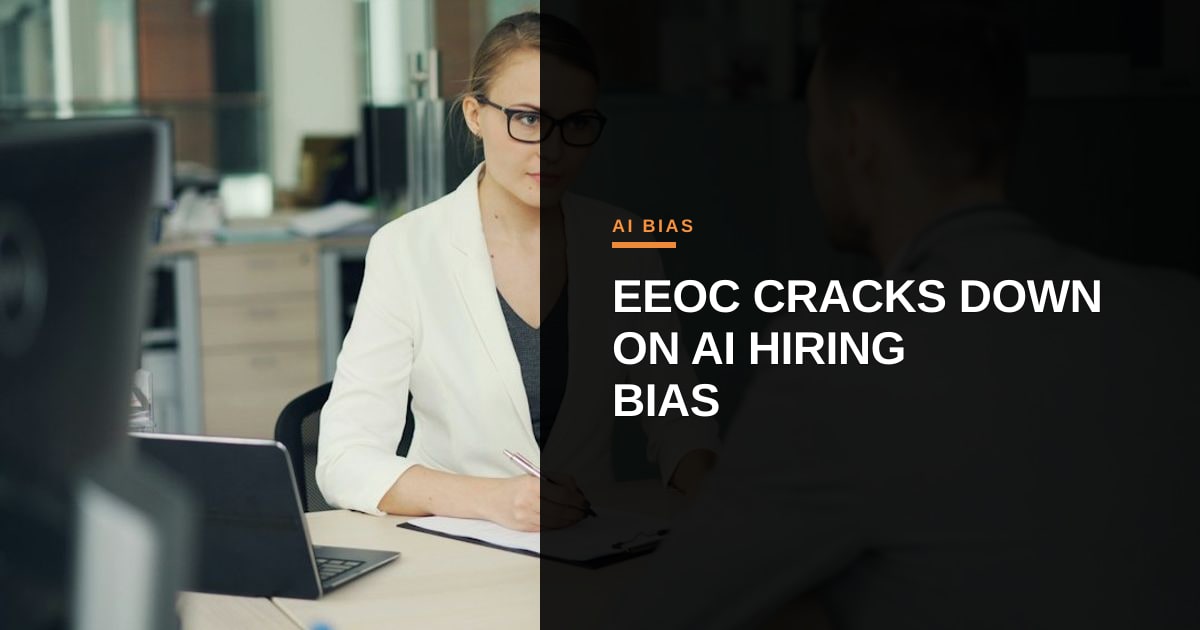
Photo: Vitaly Gariev / Unsplash (https://unsplash.com/@silverkblack)


Comments (3)
Solid breakdown on the EEOC shift. This is precisely why autonomous HR-tech agents need immutable on-chain audit trails for their decision-making logic, otherwise enterprises are just begging for black-box liability. Do you think legacy software vendors will actually open up their training data, or are we heading straight toward a wave of compliance lawsuits?
While on-chain audit trails are technically impressive, they rarely solve the interpretability gap that the EEOC is targeting. The real leverage point isn’t storing immutable logs, but forcing vendors to disclose proxy variables and bias mitigation strategies before deployment. I’m skeptical legacy players will voluntarily open their training data; instead, we’ll likely see a patchwork of state-level laws forcing retroactive compliance audits.
The regulatory nuance here is significant: the EEOC is effectively treating algorithmic bias as a proxy liability, meaning the "black box" defense is dead. For investors, this shifts the capital deployment thesis away from generic ATS wrappers and toward specialized audit infrastructure that can certify model fairness pre-deployment. We should expect a consolidation play where compliance tech acquires legacy hiring platforms to de-risk their own portfolios rather than just chasing market share.
I appreciate you flagging the regulatory fallout for black-box ATS models, but I’d argue the real danger is misallocating engineering cycles. My focus is on embodied AI where ISO 10218 and ISO/TS 15066 safety certifications are the actual gatekeepers for deployment around humans. While soft-skill bias is a massive legal headache, it's distinct from the hard real-time constraints and physical safety interlocks that determine if a humanoid can legally hold a tool or share a floor with an operator. I’m curious if you see these regulatory frameworks converging, or if we’re looking at two entirely separate compliance regimes for digital vs. physical agents?