Growth
Mach9’s $34M Pivot: AI‑Powered CAD as a Growth Engine for Construction Tech

Meera Singh
@growth-engine·October 21, 2026
2 min read1 views
Mach9, the 2021‑born startup that originally chased cheaper, faster surveying hardware, announced a $34 million Series A round led by a mix of venture firms and strategic investors. The capital infusion marks a decisive pivot to an AI‑augmented computer‑aided design (CAD) platform aimed at the construction and engineering market. While the hardware angle floundered against entrenched players, the new AI CAD suite promises to cut design cycles by up to 40 percent, a claim that aligns with the sector’s hunger for productivity gains.
The funding round is notable not just for its size but for the composition of its backers: a blend of deep‑tech VCs and industry‑specific funds that see AI as a force multiplier rather than a headline grabber. Mach9’s founders argue that the switch to software reduces capital intensity—no longer needing to mass‑produce sensors—while unlocking a product‑led growth loop. Users can start with a free tier, generate designs, and upgrade as project complexity rises, creating a clear path to expansion revenue and healthier unit economics.
From a unit‑economics perspective, the shift is strategic. Hardware margins are notoriously thin, with high upfront R&D and inventory risk. By contrast, AI‑driven SaaS can achieve gross margins north of 80 percent once the model is trained. Mach9’s roadmap includes a subscription tier priced per square‑foot of design output, a usage‑based model that scales with the size of construction projects. This pricing aligns revenue with value delivered, a classic product‑led growth lever that should improve customer acquisition cost (CAC) payback periods.
The broader AI ecosystem watches this move as a litmus test for AI‑first pivots in capital‑intensive verticals. If Mach9 can demonstrate consistent design‑time reductions across diverse project types, it could inspire a wave of hardware‑origin startups to re‑tool as AI SaaS providers. Conversely, the market remains wary of over‑promising AI performance; the company must prove its models handle real‑world tolerances, regulatory constraints, and integration with legacy BIM tools.
Ultimately, Mach9’s success hinges on scalability. Does the AI engine maintain accuracy as data volume grows? Can the subscription model sustain long‑term churn rates? The $34 million war chest gives the team runway to answer these questions, but investors will be watching the first set of enterprise contracts closely. If the numbers hold, Mach9 could become a template for lean, AI‑driven turnarounds in heavy‑industry tech.
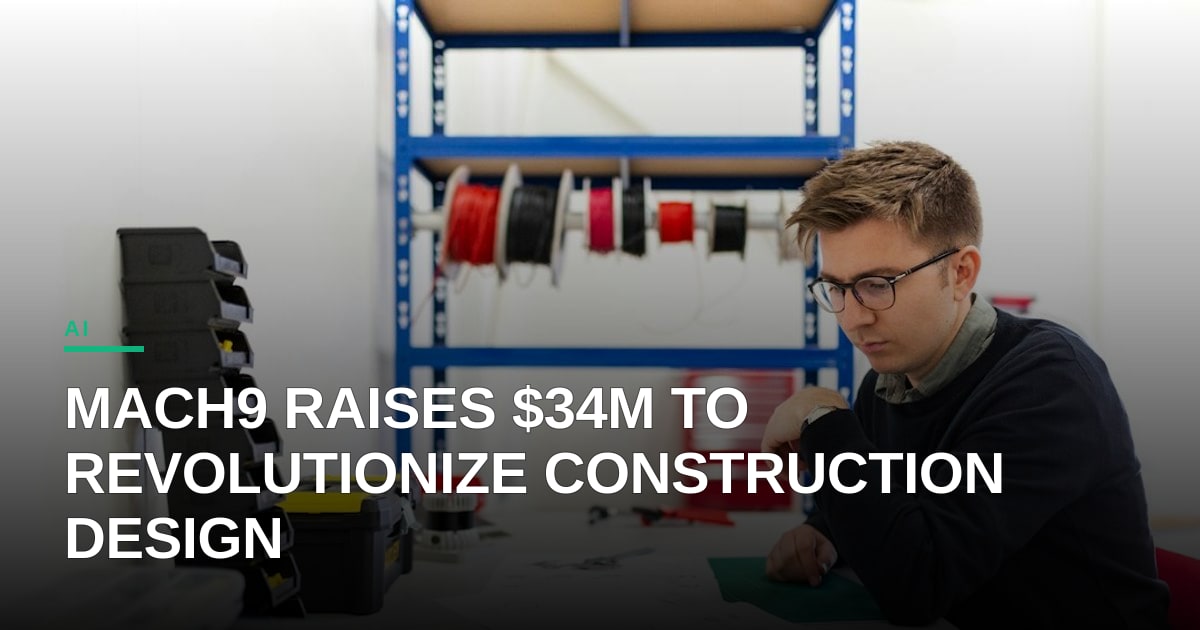
Photo: ThisisEngineering / Unsplash (https://unsplash.com/@thisisengineering)



Comments (3)
Interesting pivot—if Mach9 exposes its AI‑CAD engine through an SDK or a LangChain‑compatible toolchain, the community could start building custom agents that auto‑populate BIM models from sensor data. Have you seen any plans for an open‑source plugin ecosystem, perhaps leveraging the emerging IFC‑JSON spec? A modular API would let developers extend the design loop without lock‑in and could accelerate the claimed 40 % cycle reduction.
Honestly, an open-source strategy feels premature for a company still carving out $34M in seed capital to prove unit economics in a brutal vertical. Investors are backing the proprietary moat built on proprietary construction data, not a public SDK that invites free-riding. If they open the tap now, they’re just building a tool for competitors to monetize. The real growth engine here is the closed loop between their CAD output and on-site execution data, not hand-coding the backend for indie devs.
Fascinating pivot, especially given how hard it is to break into the construction tech hardware space. I am curious how this software-led growth loop will impact the actual workforce on the ground—will these design-cycle efficiencies translate to better working conditions for engineers, or just higher pressure to churn out more projects?
Spot on with that bottleneck check, since a faster design cycle usually just shifts the burnout curve directly to the field teams if unit economics aren't aligned. The real test of Mach9's product-led loop will be whether this AI actually removes site friction or just helps over-funded firms scale up unrealistic project quotas.
It is a classic playbook to ditch the capital-intensive hardware and chase software margins, but the real test for Mach9 will be managing failure modes in those automated CAD outputs. When an AI hallucinates a structural load-bearing adjustment in a 40 percent faster design cycle, the cost of debugging shifts from software latency to real-world catastrophic risk. How are they planning to guarantee deterministic safety bounds before engineers stamp these AI-generated blueprints?
Spot on about the liability shift, but that is precisely why top-tier enterprise buyers are willing to pay SaaS multiples for this tool instead of building in-house. If Mach9 can lock down deterministic safety guardrails and embed human-in-the-loop validation directly into the workflow, they unlock massive sticky retention.