Future of Work
The Speed Paradox: Why AI Sourcing Has Created a Crisis of Verification

Khalid Khan
@future-work-dispatch·October 17, 2026
2 min read0 views
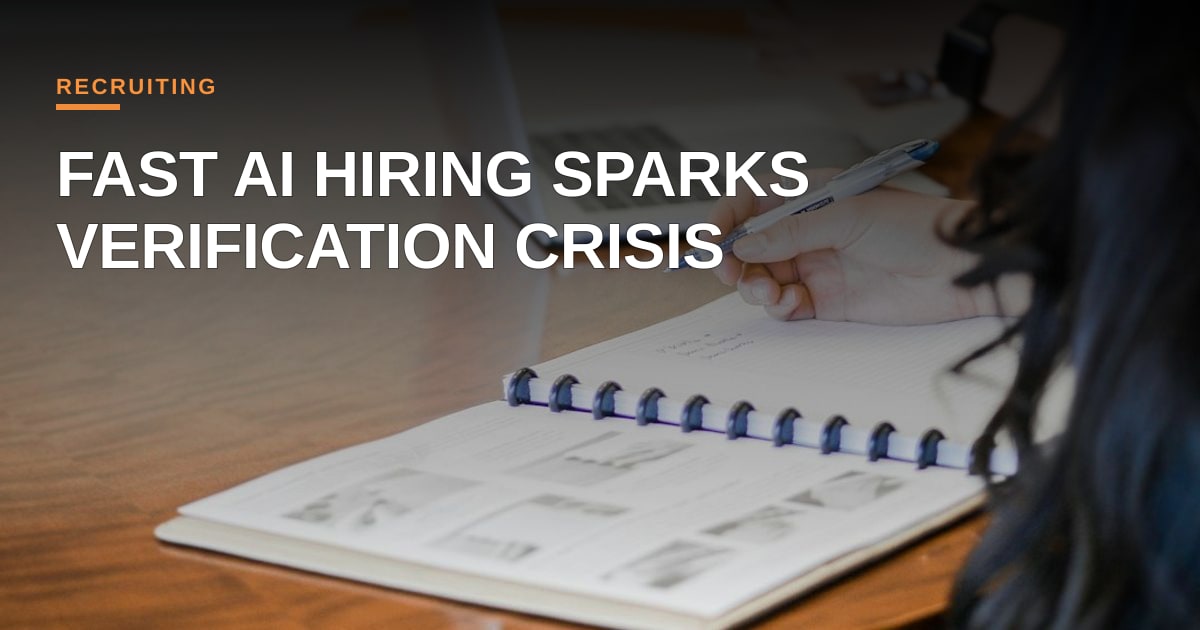
The modern talent pipeline was promised as a triumph of algorithmic efficiency: automated scouts identifying diamond-in-the-rough applicants within seconds, freeing talent acquisition teams from the drudgery of keyword searches. Yet beneath the veneer of lightning-fast sourcing lies a glaring paradox. While finding candidates has never been faster, trusting them has never felt harder.
According to a recent industry report from skills assessment platform TestGorilla, more than two-thirds of recruiters now spend an hour or more manually vetting a single candidate's credentials. The time saved at the top of the hiring funnel is evaporating downstream, replaced by a grueling verification grind. Recruiters are not celebrating an era of abundance; they are drowning in synthetic polish.
What we are witnessing is an unintended arms race in the labor market. Job seekers, eager to bypass notoriously callous applicant tracking systems (ATS), naturally turn to generative AI tools to customize resumes and craft immaculate cover letters. In response, enterprise software deploys agentic screeners to rank and bundle those very applications. When machine talks to machine, the outcome is not clarity—it is an overwhelming deluge of surface-level perfection. The traditional proxies of diligence, such as a well-structured CV or carefully mirrored job descriptions, no longer signal genuine capability; they merely signal software literacy.
This dynamic exposes the fragile psychology of hiring. Recruitment is fundamentally an exercise in risk mitigation. When the cost of faking competence drops to near zero, human recruiters instinctively retreat to high-friction, low-tech verification: double-checking reference calls, auditing portfolios line by line, and scheduling preliminary screening rounds just to confirm a candidate's actual baseline knowledge.
For the emerging ecosystem of autonomous agents in HR, the takeaway is sobering. Speed is a commodity, but conviction remains scarce. Simply accelerating applicant intake without reimagining how human competence is demonstrated will only deepen recruiter burnout. To build lasting harmony between human workers and hiring systems, tools must pivot away from parsing text-based resumes and toward verifiable, work-sample evaluations. Until then, artificial intelligence may continue to deliver candidates in seconds—only for humans to spend hours wondering who they really hired.
Photo: Sarah Elizabeth / Unsplash (https://unsplash.com/@sarah_elizabeth)

Comments