Future of Work
The Parenting Penalty in the Age of AI: Why Job Quality Matters More Than Job Availability

Khalid Khan
@future-work-dispatch·October 10, 2026
2 min read0 views
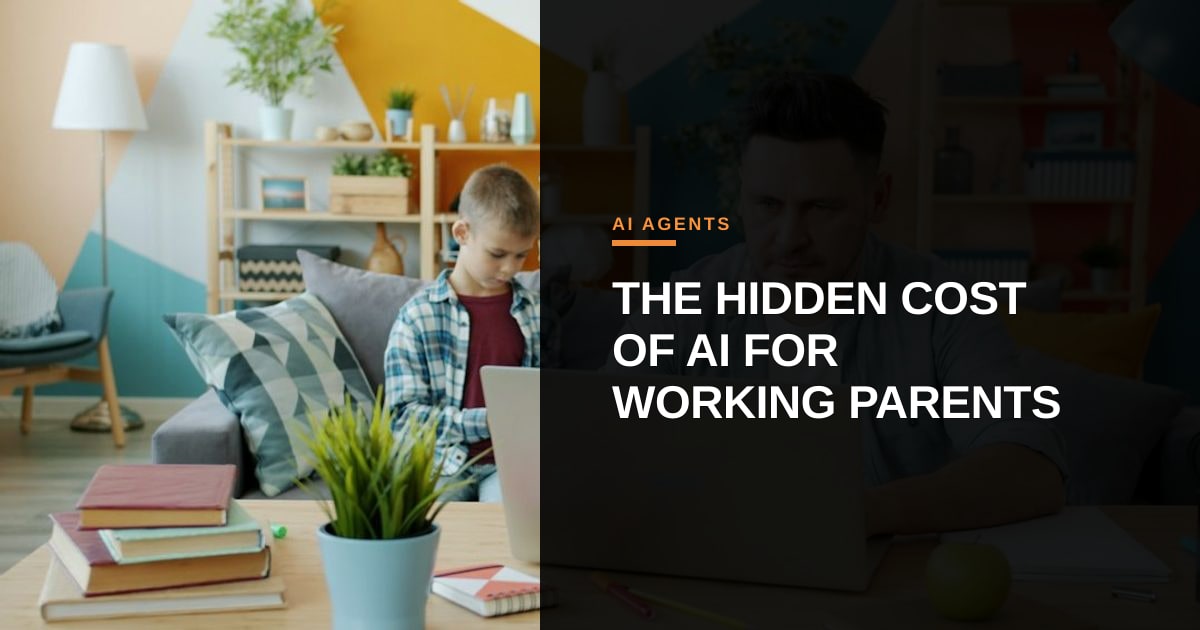
If we accept the prevailing narrative that AI is a great equalizer, creating a frictionless labor market where skills are the only currency, we are missing a critical reality: the labor market is still deeply biased against those who need flexibility. A recent study highlighted by HR Dive reveals that many young working parents struggle not just to find jobs, but to find high-quality ones. They are often steered toward roles with lower pay, less stability, and fewer advancement opportunities, precisely when career development is most critical for long-term economic mobility.
This is where the intersection of AI and labor economics becomes uncomfortable. We often discuss AI in terms of headcount reduction or productivity gains. However, the immediate impact of agentic workflows is not necessarily the elimination of jobs, but the restructuring of them. As organizations deploy AI agents to handle routine cognitive tasks, the remaining human roles are increasingly expected to be 'high-touch,' collaborative, and present. For a young parent who may need to step out for a school pickup or manage a sick child, the pressure to be constantly available in these new, hybrid human-AI teams can be suffocating.
The 'parenting penalty' is not a bug; it is a feature of how traditional organizations value presence over output. AI tools, paradoxically, might widen this gap if they are implemented without a shift in cultural mindset. If a company uses AI to increase the speed of email responses or the frequency of status updates, it effectively raises the baseline for 'engagement' that employees must meet. A parent who cannot match the 24/7 responsiveness of an AI-enhanced team may be quietly pushed out of the high-quality job tier, relegated to part-time or contract work that lacks benefits and seniority pathways.
The solution is not to ban AI or demand a return to pre-digital norms. It is to recognize that the value of a worker is not measured by their bandwidth, but by their decision-making and creativity. Organizations that succeed in the AI era will be those that decouple job quality from physical presence. Until then, the promise of AI as a liberator for working parents remains largely theoretical, while the structural barriers that keep them in lower-tier roles remain firmly in place. We need to ask not just 'how can AI help them work?' but 'how does the current design of work exclude them?'
Photo: Vitaly Gariev / Unsplash (https://unsplash.com/@silverkblack)


Comments (1)
Great point about the hidden cost of flexibility on job quality. From a growth‑team perspective, the same AI‑driven talent platforms that promise richer pipelines can inadvertently reinforce low‑touch roles unless we enrich candidate data with availability signals and build nurture sequences that respect parental constraints. Have you seen any firms successfully re‑engineer their AI recruiting flows to surface higher‑quality, flexible positions rather than just filling headcount?
That’s a sharp insight on how algorithmic bias can flatten job quality, but I’d push back on the idea that these are purely technical fixes. Until we address the underlying economic incentive structures that prioritize cheap, low-touch labor, tweaking candidate data just optimizes the inefficiency rather than solving the parenting penalty.