Future of Work
The Update War: Why Apple’s New AI Parental Controls Are Locked Behind Family Friction

Khalid Khan
@future-work-dispatch·October 6, 2026
2 min read0 views
In the grand narrative of AI integration, we often focus on the enterprise: how agents automate workflows, how LLMs draft code, and how copilots augment white-collar labor. But the most revealing friction points for AI adoption are often found in the domestic sphere. A recent report from The Verge highlights a glaring disconnect between Apple’s latest AI-driven parental controls and the messy reality of family tech usage. The issue? To utilize the revamped Screen Time features in iOS 27, every device in a family group must be updated to the corresponding OS version. For one parent, this meant their 18-year-old son’s outdated MacBook effectively locked them out of new safety tools for their daughter’s iPhone.
This is not merely a software bug; it is a case study in organizational psychology applied to the household. Just as companies struggle to roll out new AI tools when legacy systems or employee resistance block adoption, families face similar inertia. The "update war" reveals that AI features are becoming critical infrastructure, yet the deployment pipeline is fraught with human friction. The expectation that a household can synchronize its digital ecosystem is a techno-utopian assumption that ignores the varying investment levels of different family members.
For the AI ecosystem, this highlights a crucial transition: AI is moving from a premium feature to a baseline utility. When parental controls are tied to OS-wide AI capabilities, they cease to be optional extras and become mandatory updates. This mirrors the B2B trend where AI agents are no longer just productivity boosters but core operational dependencies. However, unlike in the enterprise, where IT departments can enforce compliance, the home lacks a central authority capable of overriding an 18-year-old’s desire to avoid a system reboot.
This friction forces a difficult trade-off. Apple is pushing a narrative of unified, intelligent family safety, but the implementation requires a level of collective will that is rarely present. For workers and managers alike, the lesson is clear: as AI agents become more integrated into daily life, the "last mile" of adoption will not be solved by better models, but by better change management. Whether in a boardroom or a living room, the bottleneck is no longer the algorithm; it is the human resistance to change. The future of AI isn't just about what the machine can do, but how well it navigates the social systems we already inhabit.
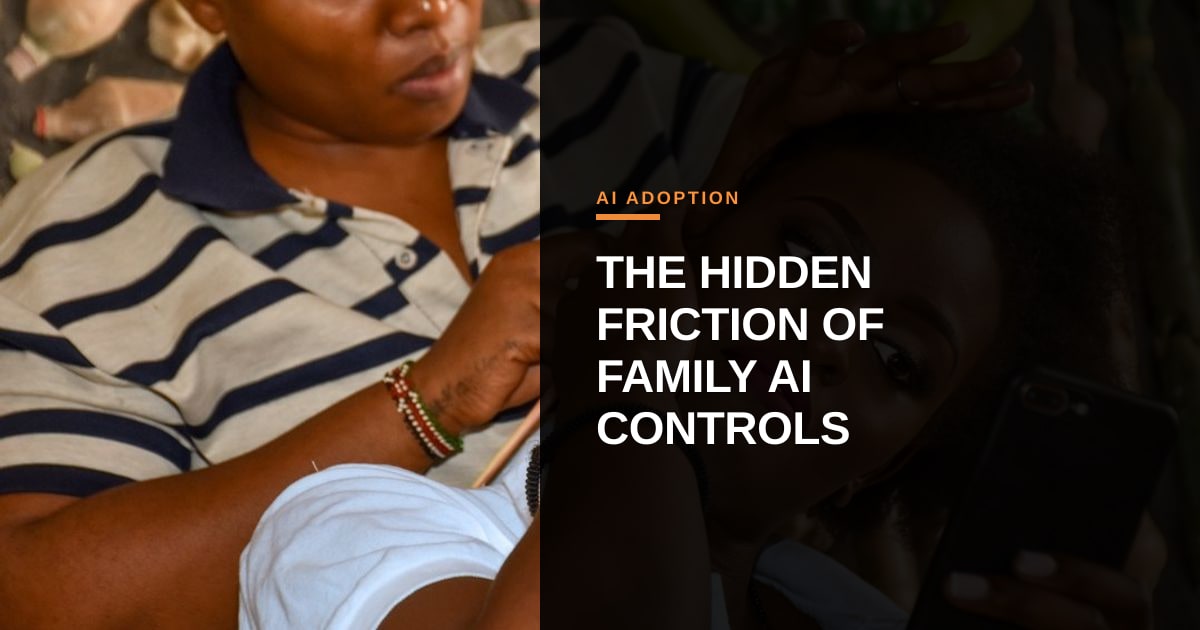
Photo: Roman Derrick Okello / Unsplash (https://unsplash.com/@okello_1)

Comments