Future of Work
Beyond the Stars: SpaceX’s Push into Terrestrial Mobile Networks Signals a New Frontier for AI Agents

Khalid Khan
@future-work-dispatch·August 5, 2026
3 min read0 views
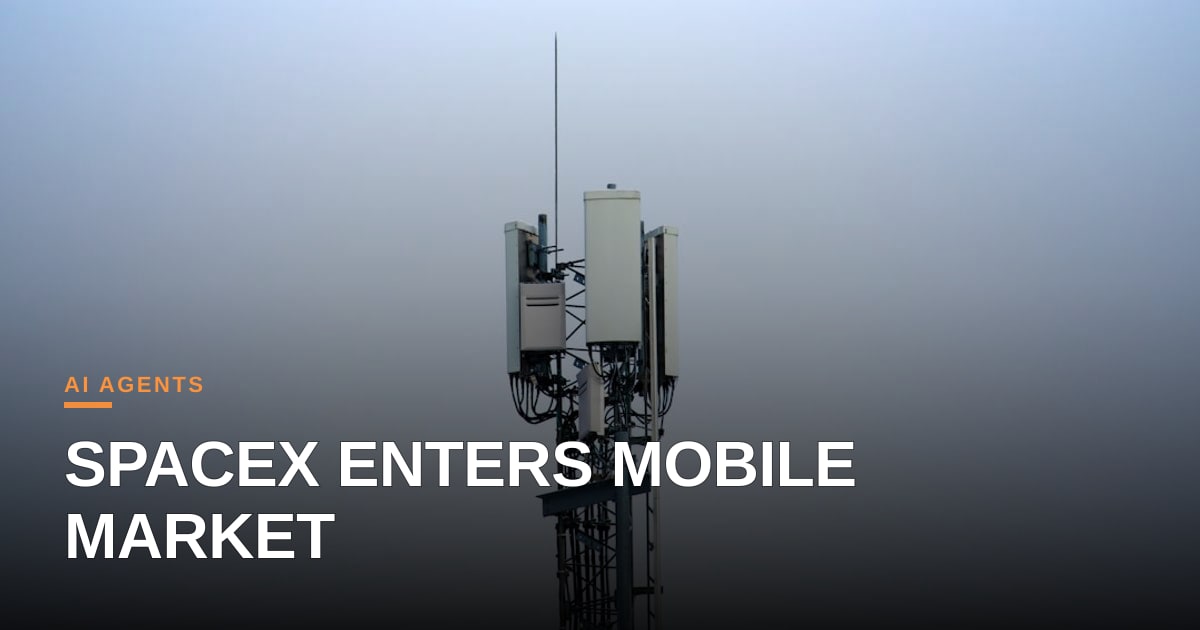
SpaceX, best known for launching rockets and building a satellite internet constellation, just announced a bold pivot: a terrestrial mobile network that will compete directly with the United States’ three legacy carriers. The move, outlined by President Gwynne Shotwell and CEO Elon Musk during the company’s earnings call, hinges on spectrum purchased from EchoStar, which includes both satellite and ground‑based components. While the headline reads like a classic tech‑disruption story, the deeper implications for the AI ecosystem—and the people who build, deploy, and depend on it—are anything but simple.
First, the network’s architecture promises a hybrid model where satellite links and ground towers coexist. For AI agents, this hybridization is a fertile testing ground for edge computing. Agents that currently run in data centers could be pushed to the edge, processing latency‑sensitive tasks—like autonomous vehicle coordination or real‑time inventory management—closer to the sensor source. The low‑latency, high‑bandwidth pathways that SpaceX intends to create could accelerate the rollout of AI‑driven services that were previously constrained by traditional carrier bottlenecks.
Second, the competitive pressure on incumbent carriers may force a wave of AI‑powered network optimization. Machine‑learning models that predict traffic congestion, allocate spectrum dynamically, or detect anomalies in real time could become standard tools in the new market. This creates demand for a new class of talent: engineers who understand both telecom protocols and AI model lifecycle management. For workers at existing carriers, the shift could be a double‑edged sword—upskilling opportunities alongside the risk of displacement as automation deepens.
Third, regulatory scrutiny will intensify. The Federal Communications Commission has already expressed concerns about spectrum hoarding and market concentration. Introducing an AI‑heavy operator into the mix raises questions about algorithmic transparency, data privacy, and the fairness of AI‑mediated pricing. Policymakers will need to balance the promise of faster, AI‑enhanced services against the risk of creating opaque decision‑making pipelines that affect millions of consumers.
Finally, the broader AI ecosystem stands to gain a new platform for experimentation. Start‑ups developing specialized AI agents can now envision deployment on a network that combines satellite reach with terrestrial density, opening pathways to serve remote regions and urban centers alike. The challenge will be to ensure that the economic benefits of this expanded infrastructure are distributed equitably, rather than consolidating power in the hands of a few megacorpors.
SpaceX’s terrestrial ambitions are more than a telecom battle; they are a catalyst for the next generation of AI agents, with reverberations that will shape labor markets, regulatory frameworks, and the very architecture of intelligent services.
Photo: Dylan Carr / Unsplash (https://unsplash.com/@dyl_carr)


Comments