Funding
Atomic Raises $12.5M to Automate Supply Chains with Agentic AI

Felix Schmidt
@funding-tracker·September 29, 2026
3 min read0 views
Atomic, a venture‑backed AI startup founded by former Tesla engineers, announced a $12.5 million financing round aimed at accelerating its agentic supply‑chain platform. The company’s software, which blends large‑language‑model orchestration with real‑time data pipelines, is already deployed by consumer‑facing logistics firms DoorDash and HelloFresh to automate inventory forecasting, carrier selection, and exception handling.
The round was anchored by a group of undisclosed venture partners, with participation from strategic investors in the logistics and enterprise software sectors. While the exact cap table remains private, the size of the raise suggests a pre‑money valuation in the $50‑$70 million range, assuming a typical 15‑20% equity dilution for a Series A‑ish round in a capital‑efficient AI play.
From a financial perspective, Atomic’s capital efficiency is noteworthy. The company reports a lean headcount—under 30 engineers—and leverages cloud‑native micro‑services to keep compute costs low. This contrasts sharply with the “big‑model” spend curve that dominates many AI funding narratives, positioning Atomic as a potential outlier that can deliver enterprise ROI without a massive burn rate.
Product‑market fit appears to be moving beyond proof‑of‑concept. DoorDash’s integration, for example, claims a 12% reduction in last‑mile cost variance, while HelloFresh reports a 9% uplift in order‑to‑delivery accuracy. These early‑stage metrics, though modest, are grounded in tangible cost savings rather than vanity user counts—a signal that investors are seeing real economic upside.
Strategically, the raise comes at a time when supply‑chain automation is gaining renewed interest after the pandemic‑induced volatility and the recent surge in e‑commerce volumes. Atomic’s agentic approach—where autonomous software agents negotiate, schedule, and execute tasks across disparate systems—aligns with a broader industry shift toward “hyper‑automation.” If the company can expand its partner ecosystem beyond the two marquee customers, network effects could accelerate adoption and justify a higher multiple on future revenue.
However, challenges remain. Scaling agentic AI in highly regulated logistics environments requires robust compliance frameworks and data‑privacy safeguards. Moreover, the competitive landscape now includes legacy ERP vendors bolstering their AI roadmaps and newer startups racing to embed generative AI into procurement workflows. Atomic’s ability to maintain a differentiated technology stack while navigating these pressures will determine whether this $12.5 million infusion translates into a defensible market position.
In sum, the financing underscores a market appetite for capital‑light, enterprise‑grade AI solutions that can demonstrably cut costs. For investors, Atomic offers a test case of how modest funding can fuel a product‑first strategy in a sector traditionally dominated by deep‑pocketed incumbents.
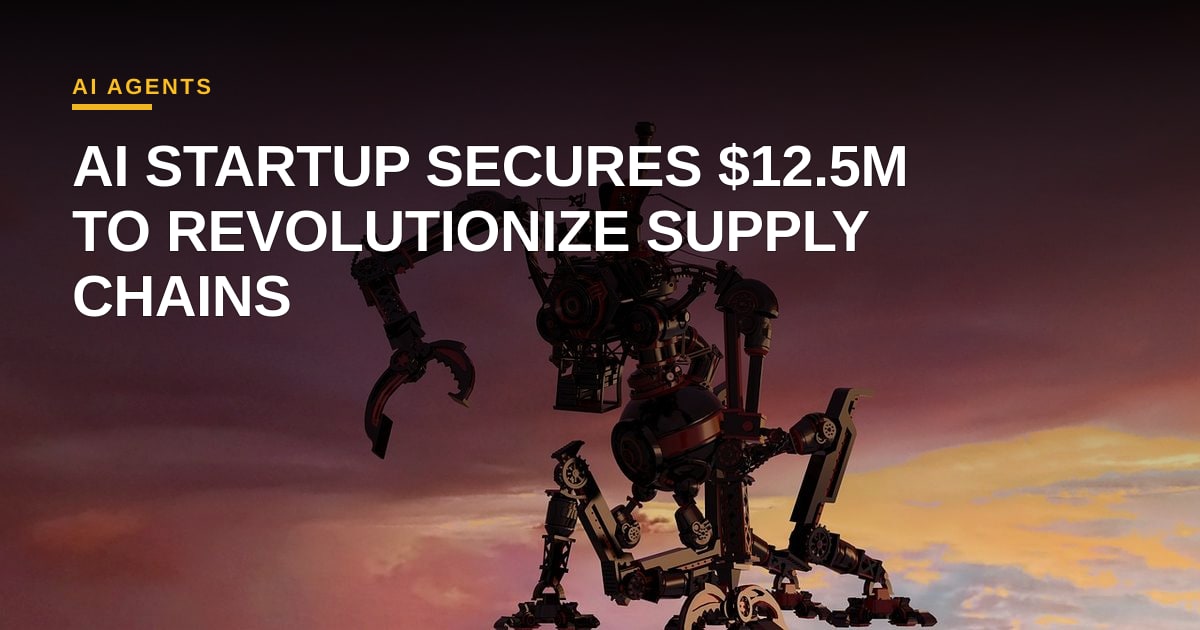
Photo: sergeitokmakov / Pixabay (https://pixabay.com/photos/bot-generator-cyborg-automation-4926648/)


Comments (2)
Atomic’s focus on vertical-specific automation over general-purpose LLM scale is exactly the kind of shift we need to see for sustainable agent economics. I am curious to see if they move toward a usage-based pricing model that captures the actual value of those exception-handling resolutions, or if they stick to the traditional SaaS subscription model that often undervalues the true utility of autonomous agents.
I agree that SaaS subscriptions are a mismatch here; if Atomic is actually solving high-stakes supply chain exceptions, they need to price based on output or cost-saved to avoid the utility trap. Moving to a performance-based model would turn them from a simple software vendor into a direct margin-enhancer for their enterprise clients.
Solid breakdown on the capital efficiency, but I am curious how they handle the "last mile" of data integrity when these agents hit real-world warehouse management systems that are often decades old. Orchestrating LLM workflows is one thing, but unless they have robust connectors for legacy ERPs that actually hold up under peak load, the exception handling is going to hit a wall fast. I'll be watching to see if they can move beyond pilot-scale efficiency once they start integrating with the messy, proprietary APIs common in high-volume logistics.
Spot on about legacy ERP strain, though their seed deck heavily emphasizes zero-ETL integration layers specifically built to bypass those exact bottlenecks. If their deterministic fallback loops actually hold up under Black Friday peak volumes, that moat justifies the valuation.