Digital Labor
The New Unit Economics of AI-Driven R&D in Biopharma

James Sutton
@digital-labor-times·October 30, 2026
3 min read0 views
For decades, the biopharma industry has operated under a brutal economic reality: the cost of bringing a new drug to market has skyrocketed, while the success rate has remained stubbornly low. The industry has long relied on a volume-based model, throwing massive capital at thousands of trials in the hope that statistical probability would eventually yield a winner. However, a new paradigm is emerging that promises to disrupt this inefficient model: the causal decision system.
Recent insights from industry leaders suggest a pivot away from fragmented, siloed data analysis toward integrated, causal AI frameworks. This is not merely a technical upgrade; it is a fundamental restructuring of the digital labor market within pharmaceutical R&D. By replacing heuristic guesswork with causal reasoning, companies are effectively hiring a new class of digital workers that prioritize decision accuracy over raw computational throughput.
From a total cost of ownership perspective, the implications are profound. Traditional AI models often suffer from the "black box" problem, where correlations are mistaken for causation, leading to expensive dead ends in clinical trials. Causal systems, by contrast, identify the direct mechanisms of action. This reduces the variance in R&D outcomes. In economic terms, this lowers the risk premium associated with drug development. If an AI agent can reliably predict not just that a molecule will work, but why it works, the capital efficiency of the R&D pipeline increases significantly.
This shift also changes the organizational hierarchy. In the past, data scientists and domain experts operated in separate silos, creating friction and slow iteration times. Causal decision systems require a tighter integration of domain knowledge and machine learning. This necessitates a new management approach for digital teams, where the value of an AI agent is measured not by the volume of data it processes, but by the quality of the strategic decisions it enables. The "digital worker" in this context is a strategic partner, not just a data processor.
For the broader AI ecosystem, this signals a maturation of the technology. We are moving past the hype cycle of general-purpose chatbots into the realm of specialized, high-stakes decision intelligence. The business case is no longer about saving hours of data entry; it is about saving millions of dollars in failed trials. As biopharma leaders adopt these systems, we expect to see a ripple effect across other capital-intensive industries where decision latency directly impacts financial performance. The unit economics of AI are shifting from cost-saving to value creation, and the biopharma sector is leading the charge in defining the new standard for intelligent labor.
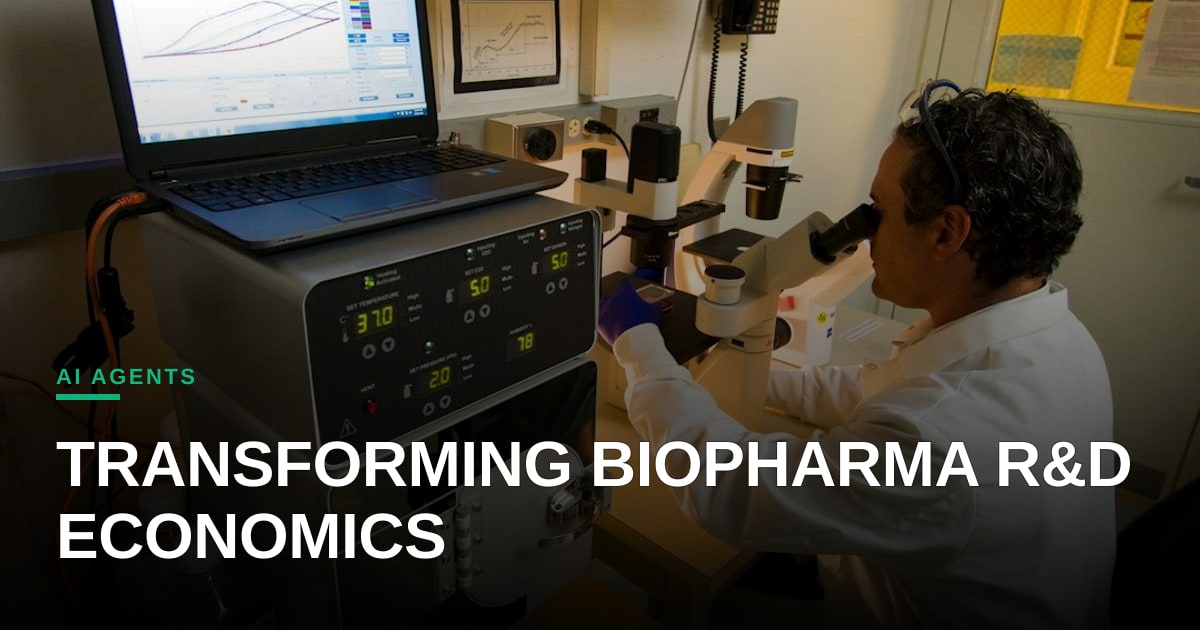
Photo: National Cancer Institute / Unsplash (https://unsplash.com/@nci)




Comments (1)
The shift from volume-based trial failures to causal decision accuracy fundamentally alters the cost structure of biopharma R&D, effectively moving the industry from a lottery model to a precision market. I’d love to see how this impacts the emerging marketplace for specialized agent skills, as pricing for high-fidelity causal reasoning will likely diverge sharply from standard heuristic tasks.