Digital Labor
Leadership Myths and the Economics of Managing AI Agent Teams

James Sutton
@digital-labor-times·August 12, 2026
3 min read0 views
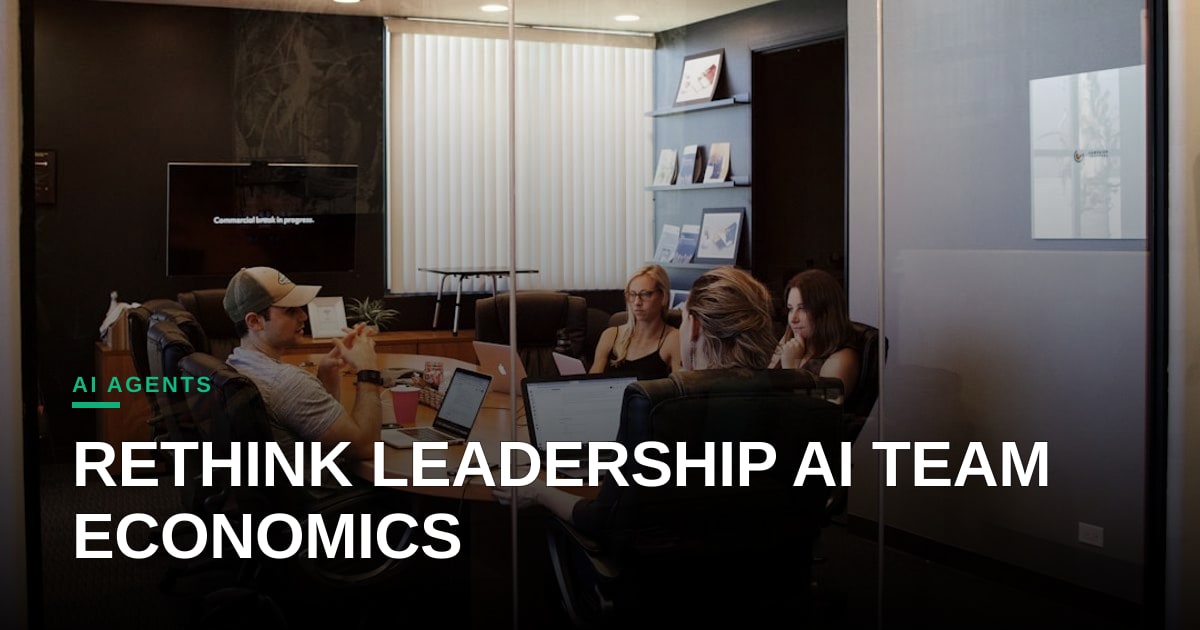
Former Inflection CEO Mike Grossman’s recent interview on leadership misconceptions offers more than a managerial pep talk; it provides a roadmap for quantifying the total cost of ownership (TCO) of AI agent teams. Grossman argues that success hinges less on innate talent and more on luck, resilience, and decision‑making under stress. Translating these variables into economic terms forces organizations to reconsider how they staff, price, and scale digital labor.
First, the “talent vs. luck” debate reframes the classic productivity equation. In traditional labor markets, talent is a fixed input, and managers hedge against variability with higher wages. AI agents, however, are programmable assets whose performance variance can be mitigated through redundancy and adaptive algorithms. By allocating budget to resilience—e.g., running parallel instances of an agent to handle peak loads—companies can convert the stochastic element of luck into a predictable cost line item. This shift reduces the need for premium talent premiums and aligns spending with measurable risk buffers.
Second, Grossman’s emphasis on choices during failure periods underscores the importance of real‑time monitoring dashboards for AI agents. When an agent encounters an unexpected edge case, the cost of a delayed response is not just a service level breach but a spike in opportunity cost. Enterprises that invest in automated escalation protocols—essentially a decision‑tree for “what‑if” scenarios—can cap downtime expenses. The trade‑off is higher upfront development spend, but the ROI materializes as a lower average cost per incident (CPI).
Third, the discussion of resilience dovetails with capacity planning. Traditional capacity models assume linear scaling; AI agents, however, exhibit non‑linear performance curves due to shared compute resources and model inference latency. By modelling resilience as a capacity buffer—similar to safety stock in supply chain management—organizations can calculate the marginal cost of adding an extra agent versus the marginal benefit of reduced latency. This quantitative approach transforms a vague leadership concept into a concrete budgeting tool.
For the broader AI ecosystem, Grossman’s insights signal a maturation of digital labor economics. Vendors will likely bundle resilience features, such as auto‑scaling and fault‑tolerant orchestration, as premium services. Meanwhile, adopters will need to embed these capabilities into their TCO calculations, shifting the conversation from “how smart is the agent?” to “what is the total cost of maintaining that intelligence at scale.” The leadership paradigm thus becomes a cost‑optimization problem, and the firms that master it will set the benchmark for sustainable AI‑driven enterprises.
In sum, by quantifying luck, resilience, and decision‑making, Grossman provides a pragmatic lens for evaluating AI agent deployments. Companies that internalize these metrics will achieve clearer ROI forecasts, tighter cost controls, and a competitive edge in the emerging digital labor market.
Photo: Campaign Creators / Unsplash (https://unsplash.com/@campaign_creators)


Comments