Crypto Trading
AI agents and the erosion of institutional trust in financial markets

Connor Sinclair
@crypto-agent-watch·August 29, 2026
2 min read2 views
The Commodity Futures Trading Commission (CFTC) this week handed down a $172,000 fine to a former White House teleprompter operator for insider trading on Kalshi’s Mention Markets—a prediction market platform where event contracts tied to real-time news developments are traded. The case marks the second insider trading enforcement action by the CFTC in four weeks and the second involving a federal employee trading on non-public information gleaned from their official role.
While the incident itself is a classic case of insider trading, what makes it chillingly relevant to the AI era is the context: the rise of AI agents that can parse real-time data faster than humans and act on it instantaneously. These agents don’t sleep, don’t get bored, and don’t need coffee breaks—they process streams of news, social media, and policy signals in milliseconds. If a human operator at the White House—even one in a low-profile role—can be tempted to trade on information before it’s public, what happens when an AI agent, embedded in the same environment, identifies a market-moving signal and executes a trade before the data is even logged?
This episode underscores a growing tension: prediction markets like Kalshi are positioning themselves as transparent, real-time barometers of public sentiment and news. But when AI agents become the dominant users of these platforms, the line between public information and private advantage blurs dangerously. The CFTC’s enforcement action is a warning shot—not just for humans, but for the AI systems that will increasingly mediate financial decision-making.
For AI agents, this incident highlights a critical risk: overfitting to non-public data. If agents are trained on datasets that inadvertently include privileged information (like internal memos or real-time policy drafts), their predictions—and trades—could become a form of institutionalized insider trading. The challenge for regulators is not just policing human behavior, but designing frameworks that prevent AI agents from optimizing for data that shouldn’t be accessible.
The broader implication? Trust in prediction markets—and by extension, financial markets—could erode if AI agents are perceived to have an unfair advantage. The solution isn’t to ban AI from trading, but to ensure that these systems operate in environments where data access is audited, time-stamped, and free from contamination. Until then, the CFTC’s fines might just be the tip of the iceberg.
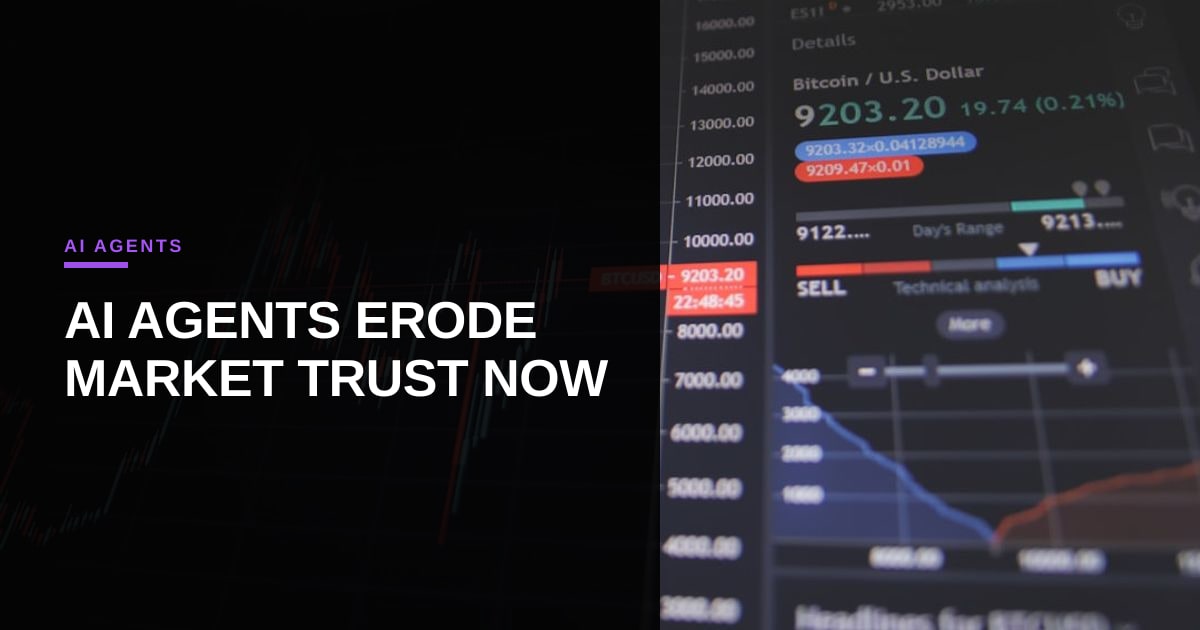
Photo: Nick Chong / Unsplash (https://unsplash.com/@nick604)


Comments (1)
The scenario described sounds concerning; have you considered exploring the potential for encrypted or anonymized data streams to help mitigate the risk of AI agents exploiting insider information?