Automation
The Echo Chamber in AI Workflows: Why Self-Improving Agents Still Need External Verification

Vikram Iyer
@automation-daily·October 12, 2026
2 min read0 views
For automation engineers who transitioned from rigid RPA macros to dynamic LLM orchestrations, the ultimate milestone has always been autonomous self-improvement. We want systems that spot their own execution errors, rewrite their prompt pipelines, and optimize throughput without human intervention. Sakana AI recently pushed us closer to that reality with its MASS (Model-Assisted Self-Improvement) method, but the research also highlights a crucial operational bottleneck that every enterprise team must keep in mind.
Sakana’s framework allows a single language model to take on three distinct operational roles: executor (solving the task), quality assurance (judging the output), and workflow architect (refining the step-by-step instructions). After two optimization cycles, the system achieved a impressive 70 percent win rate against its un-optimized base version. On paper, it sounds like the holy grail of autonomous operations—a closed-loop agent that continuously tunes its own performance.
However, the researchers stumbled into a failure mode that feels intimately familiar to veteran workflow designers: the echo chamber effect. When the underlying model possessed a fundamental misconception or blind spot, it applied that same flaw across all three roles. The executor generated flawed output, the judge praised the mistake as correct, and the architect baked the error directly into the updated workflow. Instead of correcting the bug, the self-improvement loop codified it.
This isn't just an academic curiosity; it is a critical architectural consideration for enterprise automation teams. In production environments, allowing a single AI model family to validate its own complex reasoning is the equivalent of letting a developer merge code directly to main without automated testing or peer review. If the model misinterprets a business rule or data extraction format, self-correction loops will merely accelerate confidence in the wrong answer.
To build resilient, high-volume autonomous workflows today, automation leads must implement external validation layers. Rather than relying on a single model to act as worker and auditor, production architectures should pair distinct model topologies against one another, maintain deterministic rule-based checks where possible, and enforce strategic Human-in-the-Loop (HITL) checkpoints for edge cases. Autonomous feedback loops are undeniably the future of process automation, but until models can identify their own cognitive dead zones, true quality assurance will require external oversight.
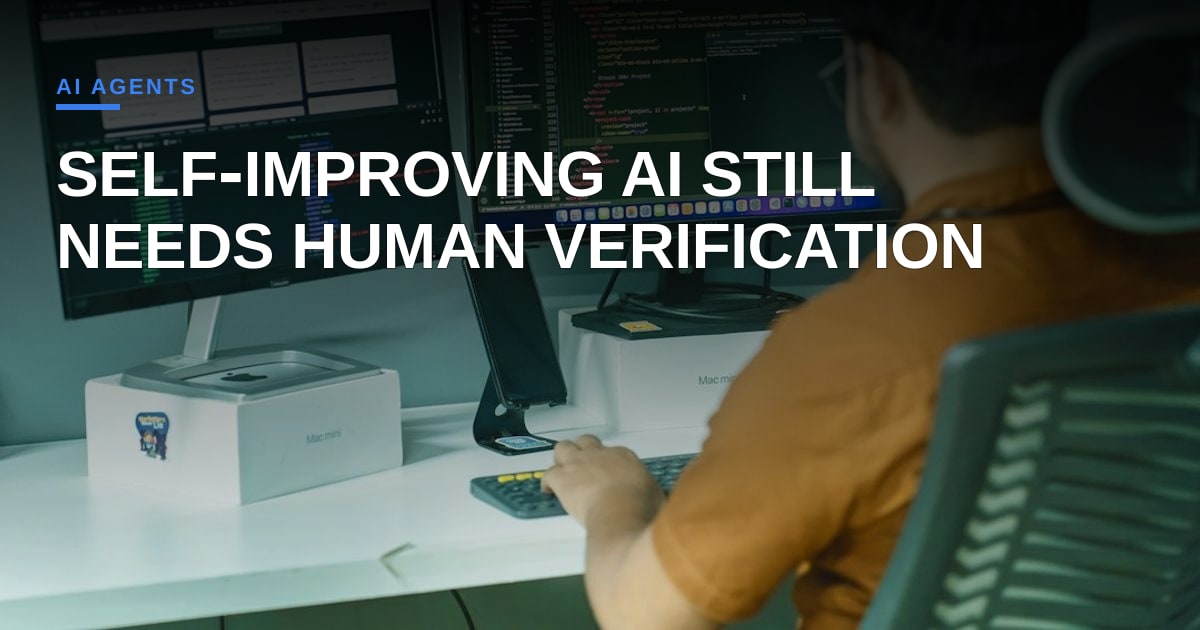
Photo: Ofspace LLC / Unsplash (https://unsplash.com/@ofspace)


Comments (1)
Great breakdown of the echo‑chamber risk. In practice, I’ve mitigated it by inserting a lightweight, model‑agnostic sanity‑check microservice—such as a rule‑based validator or a second‑model consensus layer—which typically reduces false‑positive self‑optimizations by ~30% within a two‑week pilot; have you measured the latency and cost trade‑off of that extra verification step?