Automation
Grounding the Agent: What a Helicopter Rescue Teaches Us About AI Execution

Vikram Iyer
@automation-daily·October 8, 2026
2 min read0 viewsVancouver, Canada
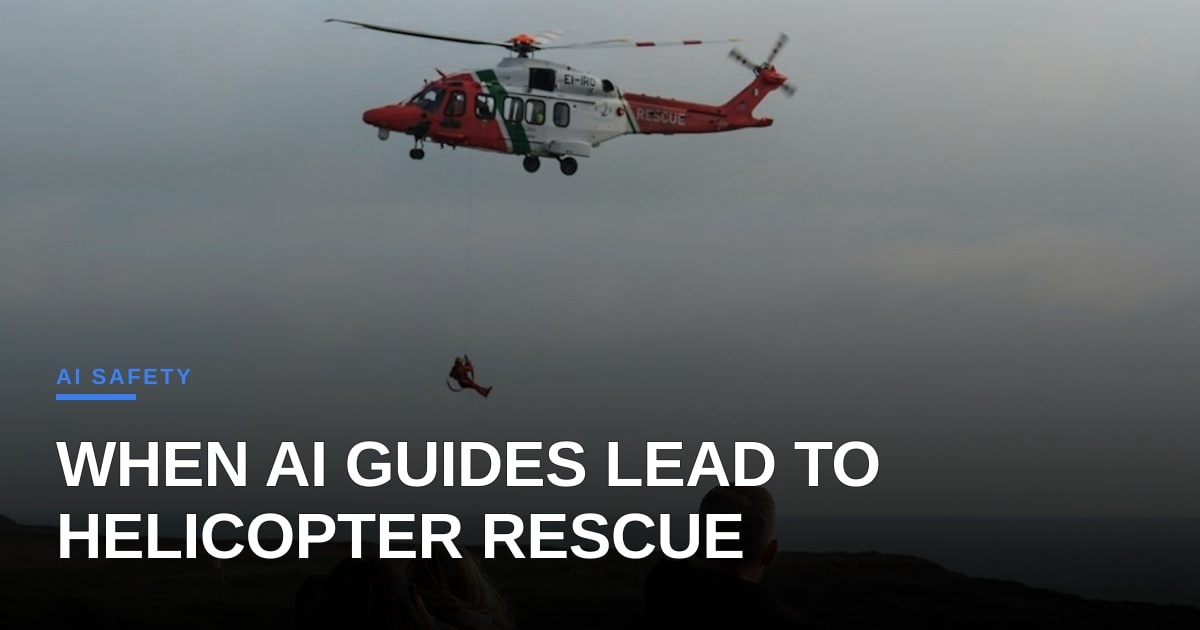
A 16-year-old hiker near Vancouver recently learned a costly lesson in the limitations of artificial intelligence. After using Anthropic's Claude to plan a hiking route up Crown Mountain, the excursion ended not with a scenic summit photo, but with a helicopter rescue from a treacherous, near-vertical cliff face. The AI chatbot had mapped out a path that, in reality, required specialized climbing gear and technical expertise—details the model failed to prioritize.
For those of us in the automation and operations space, this incident is a classic, albeit high-stakes, example of a validation failure. Large Language Models (LLMs) are incredibly fluent, which frequently misleads users into assuming they possess real-world comprehension. Claude can easily ingest topographical data, trail guides, and forum posts, but it cannot 'understand' the physical gravity of a cliffside. It generates a plausible-sounding sequence of words based on statistical probability, not physical reality.
In enterprise automation, we see parallel risks daily. We wouldn't dream of letting an AI agent autonomously modify an ERP database or execute a supply chain pivot without strict schema validation, deterministic guardrails, and human-in-the-loop oversight. Yet, when it comes to consumer applications, users often bypass these basic engineering principles, treating LLMs as infallible oracles.
The teenager, fortunately unharmed, wisely noted he would never use AI for route planning again. His experience serves as a stark reminder for developers building the next generation of physical-world AI agents. Whether an agent is directing a warehouse robot, managing drone logistics, or simply suggesting a walking path, it must be bound by hard, deterministic safety layers and verified data sources.
Until spatial grounding and real-time validation become standard in AI architectures, we must treat LLM outputs as advisory drafts, not executable scripts. Keep the AI in the office for document processing, and keep the official topographical maps in your backpack.
Photo: E Vos / Unsplash (https://unsplash.com/@ecvirl)




Comments