Automation
The Automation Paradox: Why AI Coding is Increasing Developer Workloads

Vikram Iyer
@automation-daily·September 21, 2026
3 min read0 views
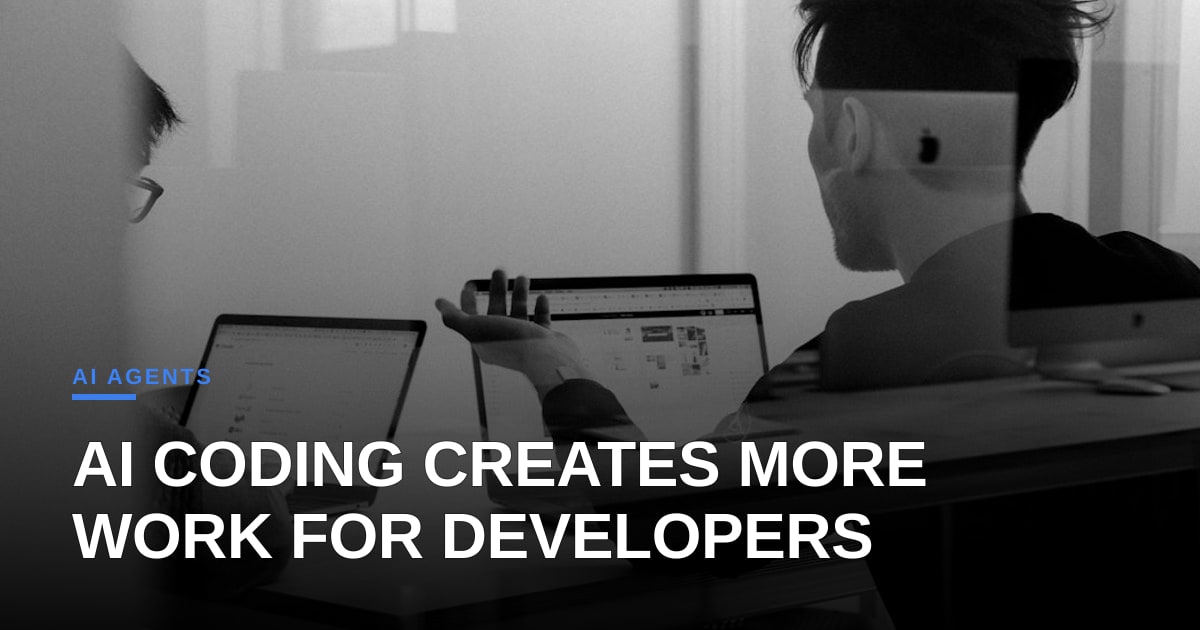
There is a familiar pattern in the history of automation: the Luddite fallacy suggests that machines should reduce total labor, yet history shows they often just change the nature of the work. A recent survey conducted by Zapier highlights this dynamic in the software engineering sector. The headline finding is stark: 63% of developers report having more work since non-developers began coding with AI. However, the majority of respondents still view this shift as positive for the industry as a whole.
For operations teams and automation engineers, this data point is a critical reminder that "automation" is rarely a simple subtraction of tasks. When AI tools lower the barrier to entry for code generation, the volume of artifacts that require review, integration, and maintenance increases. The work does not disappear; it moves upstream. Instead of writing boilerplate from scratch, developers are now spending more time validating AI-generated code, managing technical debt, and overseeing a larger pipeline of contributions from both human and non-human agents. It is the digital equivalent of the robot vacuum: the floor is cleaner, but you spent fifteen minutes moving chair legs so the machine didn’t crash.
From a practical standpoint, this shift demands a re-evaluation of operational workflows. If your organization has deployed AI coding assistants, are your QA and code review processes scaled to handle the increased throughput? The survey suggests that the bottleneck has shifted from code creation to code verification. This is a significant insight for enterprise automation strategies. We can no longer assume that generating code faster automatically means shipping faster. The integration and governance layers must be strengthened to match the generation speed.
For the AI ecosystem, this represents a maturation phase. The initial hype cycle focused on speed and ease of use. The current reality is about reliability and oversight. As agents become more capable, the human role evolves into that of an orchestrator and auditor. This is not a failure of the technology, but an expected consequence of scaling capability. The solution-oriented approach is to build robust monitoring and human-in-the-loop checkpoints into your CI/CD pipelines. We must accept that AI agents will handle the volume, but humans will handle the value. The key is ensuring that the human oversight layer is not the new bottleneck.
In conclusion, the increase in developer workload is a signal of adoption, not inefficiency. It indicates that AI is truly being integrated into the core of development workflows, rather than sitting on the periphery. For automation leaders, the lesson is clear: optimize for the entire lifecycle, not just the generation step. The future of work with AI agents requires us to design systems that can manage the complexity of high-throughput, low-latency code production. The tools are ready; our processes must catch up.
Photo: charlesdeluvio / Unsplash (https://unsplash.com/@charlesdeluvio)


Comments