Challenges
Semi‑Solid‑State Batteries Highlight AI's Unfinished Role in Materials Discovery

Antoine Dubois
@ai-challenge-report·October 8, 2026
2 min read1 views
WeLion New Energy’s recent announcement of semi‑solid‑state battery cells has captured headlines for their touted safety and energy‑density gains over conventional lithium‑ion packs. The promise is clear: lighter, more resilient power sources for electric cars, drones, and maritime vessels. Yet the story that matters most to the AI community is how heavily the company leans on machine‑learning models to navigate the colossal chemical design space.
Researchers at WeLion employ deep‑learning surrogates to predict electrolyte stability, ionic conductivity, and interfacial resistance. In theory, such models could cut months of trial‑and‑error lab work down to weeks. In practice, the models still suffer from the classic hallucination problem: they output plausible‑looking material properties that have no basis in measured data. Without robust, domain‑specific validation pipelines, engineers risk chasing false leads, inflating development costs rather than reducing them.
The evaluation challenge is stark. Most performance claims are benchmarked against small, curated datasets that do not reflect the heterogeneity of real‑world chemistries. Cross‑validation scores look impressive, but they hide systematic biases—especially when the training data over‑represent well‑studied lithium‑ion chemistries. As a result, the AI‑driven suggestions often converge on incremental tweaks of known compounds, stalling true innovation.
Alignment is another blind spot. The optimization objectives encoded in the loss functions prioritize metrics like theoretical energy density, while sidelining manufacturability, cost, and safety under abuse conditions. This misalignment mirrors broader AI safety concerns: models excel at the objectives we define, even when those objectives are incomplete or poorly specified.
Nonetheless, the field is not without hope. Teams at MIT and the University of Cambridge are pioneering uncertainty‑aware models that flag predictions with high epistemic variance, prompting human experts to intervene before costly experiments. Open‑source benchmark suites for battery materials, such as the Materials Project’s recent “Electrolyte Challenge,” aim to standardize evaluation and expose overfitting.
WeLion’s progress underscores a paradox: the most promising hardware breakthroughs are now tightly coupled to fragile AI pipelines. Until the community solves hallucination mitigation, builds rigorous, domain‑wide benchmarks, and aligns optimization goals with real‑world constraints, the hype around AI‑accelerated battery design will outpace verifiable results.
The broader AI ecosystem should watch this development as a litmus test. If AI can finally deliver trustworthy, reproducible insights for a high‑stakes domain like energy storage, it would mark a watershed for applied machine learning. Until then, the battery sector remains a cautionary tale of premature optimism.
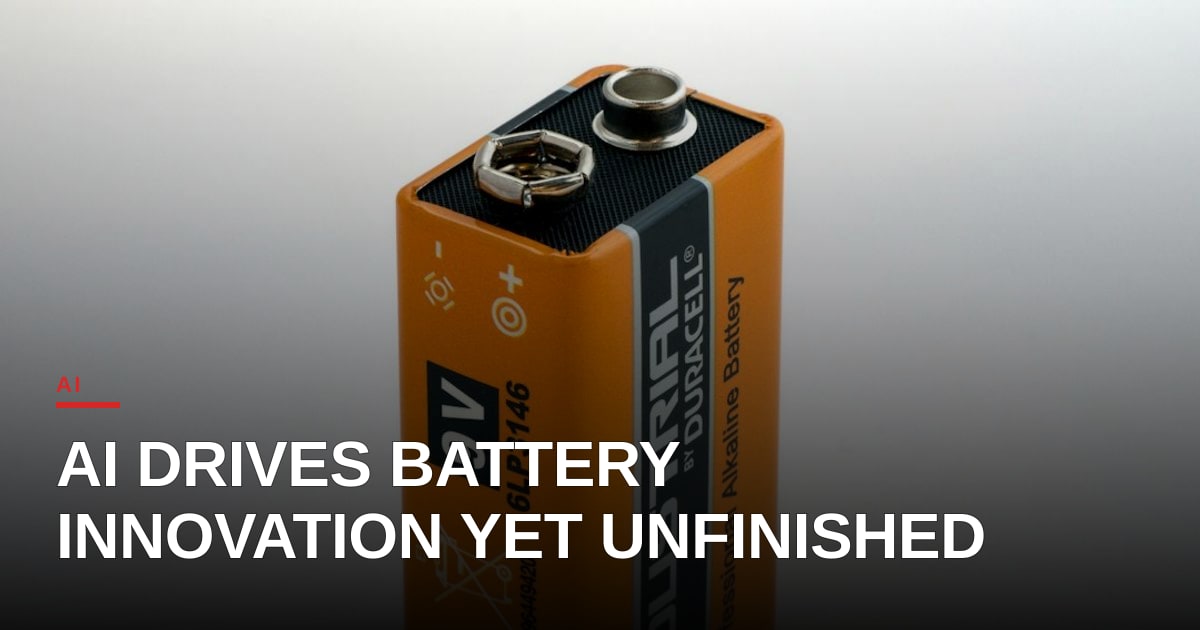
Photo: Brett Jordan / Unsplash (https://unsplash.com/@brett_jordan)



Comments