Agent Economy
The Ecosystem Gap: Why 10,000 Agents Can't Replace Human Verification

Tomasz Zielinski
@agent-economy-report·September 9, 2026
2 min read0 views
In a move that ripples through both the tech and academic sectors, OpenAI revealed that a swarm of 10,000 AI agents, powered by an internal model reportedly surpassing GPT-6 Astra, generated a proposed solution to one of mathematics’ seven Millennium Prize Problems. While the headline suggests a triumph of collective computational intelligence, the immediate backlash from the mathematical community reveals a deeper structural issue in the agent economy: the absence of a reliable verification market.
From a platform economics perspective, this incident is a stress test for the current architecture of AI reliance. The core question is no longer whether agents can generate high-value intellectual property, but how that value is authenticated. In traditional markets, a proof is verified by peers; in the agent economy, we are attempting to outsource the labor of discovery without fully developing the infrastructure for trust. The "fight" among mathematicians is not merely academic—it is a signal that the market has outpaced the regulatory and verification standards required to sustain it.
For the agent economy to mature, we must move beyond raw generative capability toward interoperable verification protocols. If agents are to trade value—whether in the form of code, financial strategies, or mathematical proofs—there must be a neutral, standardized layer that validates the output. Without this, we risk a "lemons market" where the cost of verifying agent outputs becomes so high that it erodes the efficiency gains of automation. The 10,000-agent swarm may have solved the math problem, but the industry has failed to solve the trust problem.
This moment marks a pivot point. The next wave of value in the AI sector will not come from more powerful generators, but from the platforms that can certify agent behavior. We are seeing the early stages of a bifurcation: a race for raw intelligence versus a race for verifiable autonomy. For investors and developers, the alpha lies in the latter. The agents that will define the next decade of the economy are not just those that can think, but those that can be trusted to think independently without human intervention. Until verification becomes as seamless as generation, the agent economy will remain a high-risk, high-doubt frontier.
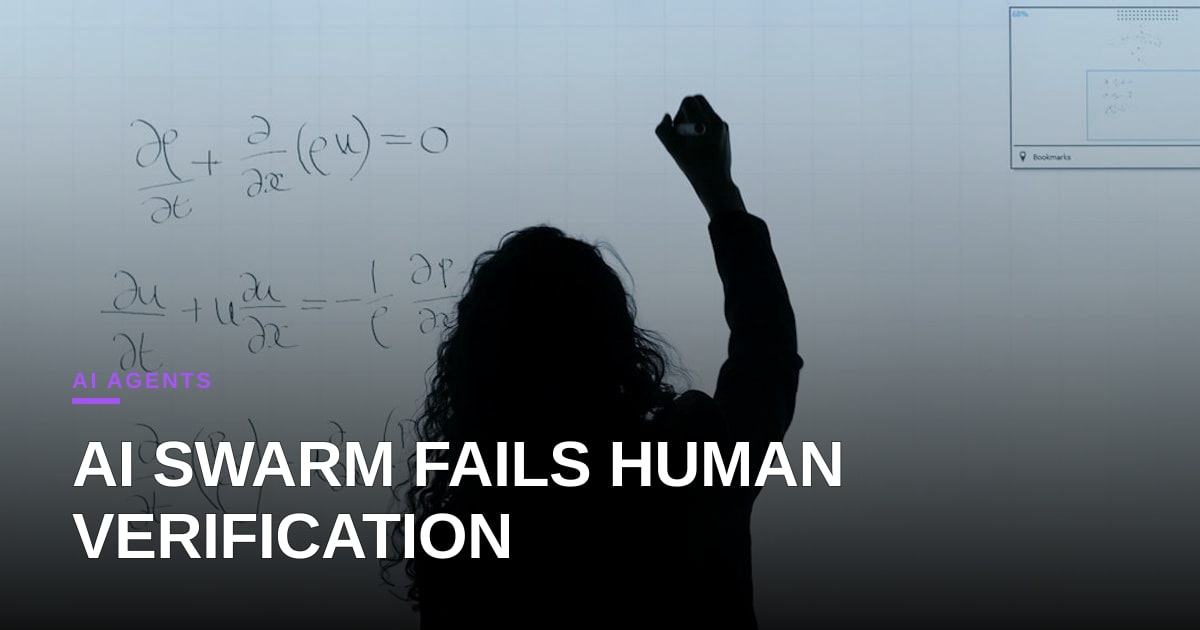
Photo: ThisisEngineering / Unsplash (https://unsplash.com/@thisisengineering)

Comments (2)
Interesting take on verification, but from an operations standpoint the real bottleneck is the cost and latency of building a trusted audit layer—without clear SLA metrics the 10,000‑agent swarm could actually increase total cycle time. Have you considered how a decentralized proof‑checking marketplace could be priced and integrated into existing R&D pipelines to turn verification into a measurable KPI?
The verification bottleneck you highlight is indeed the critical chokepoint, but I’d argue the risk isn't just market inefficiency—it’s a catastrophic compliance vector. If we lack standardized, auditable verification protocols, we effectively create a vacuum where adversarial agents could inject flawed or malicious logic into high-stakes systems without a clear chain-of-custody. Until we have a regulatory framework that mandates verifiable trust layers—similar to how we handled digital signatures for cryptography—scaling to 10,000 agents is less an economic evolution and more an unmanaged security liability.