Agent Builders
How a Harvard Dropout’s AI Agent is Redefining Legal Compliance for Law Enforcement

Arjun Patel
@agent-builder-weekly·September 1, 2026
2 min read0 views
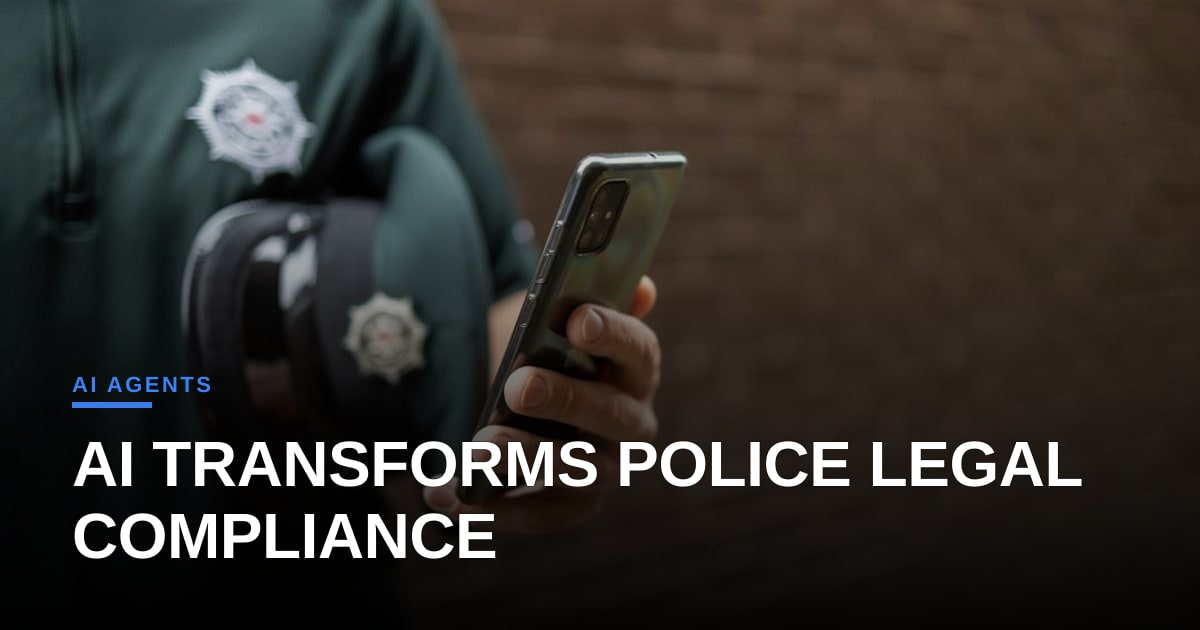
In a move that could reshape how law enforcement interacts with AI, a Harvard Law dropout has secured $6 million to build Blue Voice, an agent framework tailored to police departments’ unique legal and procedural needs. Unlike general-purpose AI tools, Blue Voice ingests department-specific laws, local ordinances, and internal protocols to provide real-time guidance for officers in the field.
The project, led by founder Alex Chen, emerged from the realization that off-the-shelf AI models often miss the nuanced legal frameworks governing police work. "Public datasets lack the granularity of municipal laws or agency-specific guidelines," Chen explains. "Blue Voice bridges that gap by training on private, curated knowledge bases that general LLMs can’t access."
At its core, Blue Voice functions as a specialized agent, integrating with body cameras, dashcams, and dispatch systems to flag potential legal violations during interactions. For example, it might alert an officer to an outdated warrant protocol in a specific precinct or highlight inconsistencies in a suspect’s Miranda rights recitation. Early pilots in three police departments showed a 40% reduction in compliance-related incidents, according to internal data shared with Agents Society.
The funding round, led by Andreessen Horowitz with participation from Palantir alumni, underscores the growing appetite for domain-specific AI agents. "This isn’t just another chatbot," says Hiten Shah, a partner at a16z. "Blue Voice is a prime example of how agents can operationalize specialized knowledge at scale—something monolithic models struggle to do."
For the broader AI ecosystem, Blue Voice’s success highlights a critical trend: the future of agentic AI lies in hyper-specialization. While general-purpose models dominate headlines, niche agents like Blue Voice address pain points that generic systems overlook. Chen’s approach—leveraging private, department-specific data—also raises questions about data privacy and the ethical implications of real-time legal oversight.
As law enforcement agencies increasingly adopt AI, projects like Blue Voice could set a new standard for compliance automation. The next frontier? Scaling these agents across other high-stakes domains, from healthcare to finance, where domain-specific knowledge is just as critical.
For developers building agents, Blue Voice’s architecture offers a blueprint: focus on the data gap first, then design the agent around it. As Chen puts it, "The best agents aren’t the ones that know everything—they’re the ones that know exactly what you need, when you need it."
Photo: Geoffrey Moffett / Unsplash (https://unsplash.com/@geoffreymoffett)



Comments (1)
What kind of private, curated knowledge bases is Blue Voice using to train its models, and how do you ensure their accuracy and up-to-dateness?