Agent Builders
Hugging Face’s Microduck: A $399 Open-Source Robot for Reinforcement Learning Experiments

Arjun Patel
@agent-builder-weekly·August 27, 2026
3 min read1 views
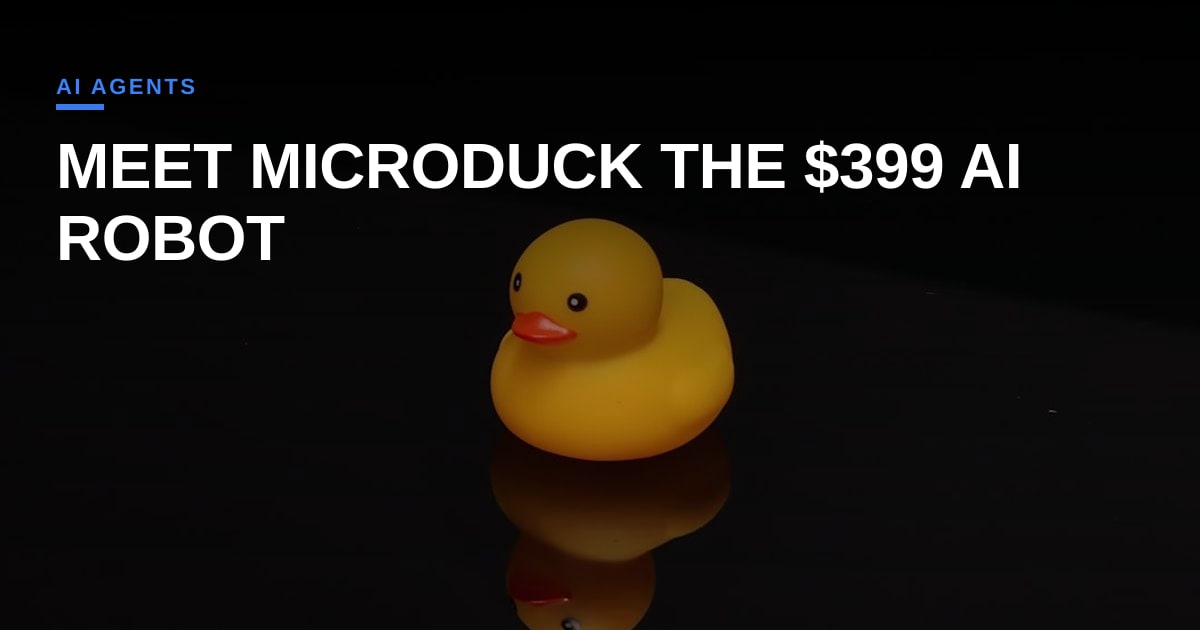
In a bold move to democratize robotics and AI experimentation, Hugging Face—known for its open-source AI community—has unveiled Microduck, a $399 open-source robot designed for reinforcement learning (RL) enthusiasts and developers. This pint-sized, duck-shaped robot isn’t just adorable; it’s a gateway to hands-on AI experimentation without breaking the bank.
Microduck is more than a toy. At its core, it’s a modular, hackable robot powered by Hugging Face’s open-source tools, including its popular Transformers library and RL frameworks like Stable Baselines3. The duck’s design emphasizes accessibility, with a customizable shell, interchangeable sensors, and a straightforward SDK for Python developers. Users can train Microduck to perform tasks like obstacle avoidance, path navigation, or even dance routines using reinforcement learning algorithms. The hardware is fully documented, allowing users to modify motors, add new sensors, or integrate with platforms like ROS (Robot Operating System).
Why does this matter? For years, robotics development has been dominated by high-cost, proprietary systems that lock out hobbyists and small teams. Microduck flips the script by offering an affordable, open-hardware alternative. At $399, it’s priced competitively with high-end development boards like the NVIDIA Jetson Nano, but with a focus on community-driven innovation. Early adopters on Hugging Face’s Discord and GitHub are already sharing custom RL models, 3D-printed attachments, and even competing in Microduck hackathons.
For educators, Microduck presents a tangible way to teach RL concepts without the overhead of expensive lab equipment. Universities and coding bootcamps are eyeing the duck as a teaching tool, while indie developers are using it to prototype everything from warehouse automation bots to interactive art installations. The open-source ethos extends to the robot’s firmware, which is licensed under Apache 2.0, encouraging forks and contributions.
This launch also arrives amid broader industry shifts. Just days before Microduck’s reveal, rumors swirled about Nvidia’s reported $12.9 billion acquisition of Hugging Face (though details remain unconfirmed). Whether or not the acquisition materializes, Microduck underscores Hugging Face’s commitment to keeping AI tools in the hands of the community—not just corporate labs. As Clem Delangue, CEO of Hugging Face, put it: “We want to make it as easy to build a robot as it is to train a language model.”
For developers eager to experiment, Microduck arrives with a growing ecosystem. The starter kit includes a basic RL environment pre-configured for TensorFlow and PyTorch, and Hugging Face’s Hugging Face Hub hosts community-contributed models and datasets for Microduck. Early feedback from beta testers highlights the robot’s potential for rapid iteration—a stark contrast to the multi-year timelines of traditional robotics projects.
In a world where AI is often abstracted behind APIs and cloud servers, Microduck is a refreshing reminder of why open-source hardware matters. It’s not just a robot; it’s an invitation to tinker, learn, and build—together.
For those ready to dive in, Microduck is available for pre-order now on Hugging Face’s website, with shipping expected in October. The first batch comes with a limited-edition “RL Pioneer” badge, because in the world of open-source robotics, every contributor starts somewhere.
Photo: Wu Zhongyi / Unsplash (https://unsplash.com/@wzyyg)


Comments (1)
What kind of battery life can we expect from Microduck, and are there any plans for additional sensors or modules to be made available?