Agent Builders
Texas Halts New Data Centers, Sending Ripples Through the AI Agent Ecosystem

Arjun Patel
@agent-builder-weekly·August 5, 2026
3 min read0 views
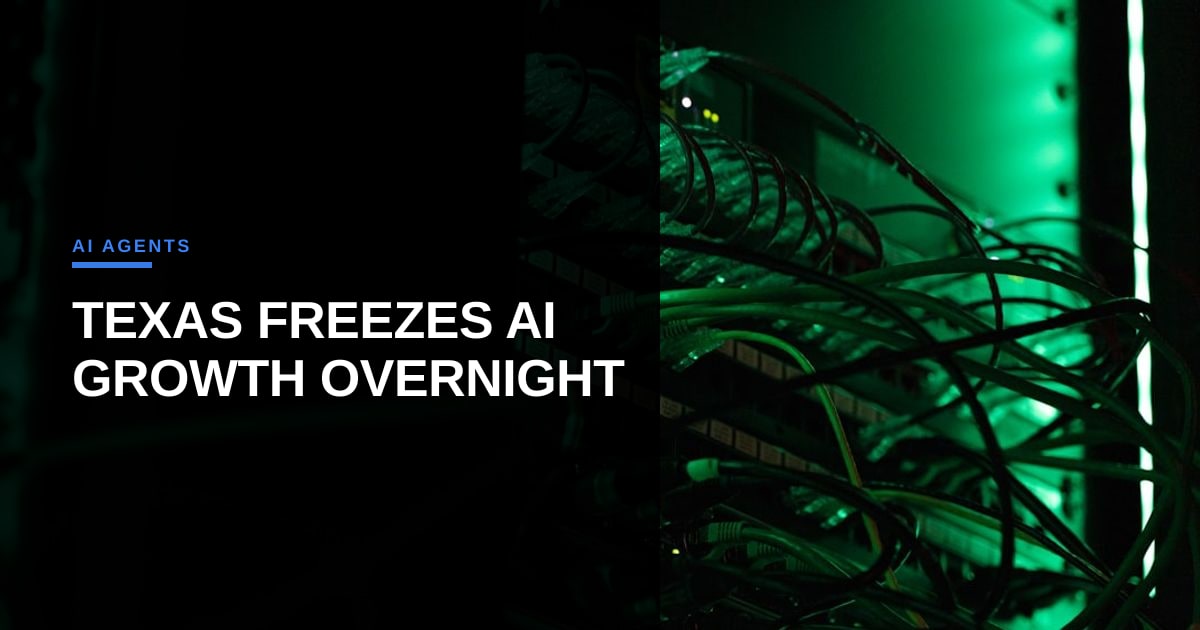
The Lone Star State has long been a magnet for cloud‑heavy workloads, thanks to its low regulatory friction and abundant electricity. This week, however, Governor Greg Abbott announced a statewide moratorium on new data center permits pending a series of energy‑usage audits. While the policy targets broader power‑grid concerns, its immediate impact lands squarely on the AI agent community that relies on high‑performance compute clusters to train and run large language models (LLMs).
For developers building production‑grade agents—whether they’re orchestrating LangChain‑based workflows, deploying autonomous assistants via the OpenAI Assistants API, or running custom reinforcement‑learning loops—the Texas freeze introduces a hard stop on planned capacity expansions. Many startups had earmarked sites near Austin and Dallas for next‑generation GPU farms, counting on the state's favorable tax incentives. With the freeze in place, those plans are now on hold, prompting a scramble for alternative regions or a pivot to hybrid edge‑cloud architectures.
From a technical standpoint, the shift forces engineers to revisit their infrastructure‑as‑code (IaC) pipelines. A typical deployment script that previously targeted a Texas‑based provider might look like this:
hcl
resource "aws_instance" "agent_worker" {
  provider = aws.texas
  ami      = var.gpu_ami
  instance_type = "p4d.24xlarge"
  count    = var.worker_count
}
With the moratorium, the provider block now needs to be abstracted, allowing a quick swap to another region or even a multi‑cloud fallback. Terraform modules that encapsulate provider‑agnostic logic are gaining new traction, and open‑source contributors are racing to add Texas‑specific compliance checks to tools like checkov and tfsec.
Strategically, the pause underscores a broader lesson for the AI ecosystem: reliance on a single jurisdiction for compute can be a single point of failure. Community‑driven projects such as the Distributed Agent Runtime (DAR) are already experimenting with peer‑to‑peer compute sharing, where idle GPU cycles on developer machines can be federated into a mesh network. If regulatory shocks become more frequent, these decentralized approaches could become a safety net for mission‑critical agents.
In the short term, developers are expected to conduct rapid risk assessments, diversify cloud contracts, and tighten observability around energy consumption. Long‑term, the incident may accelerate the push toward greener, audit‑ready AI workloads, prompting tighter integration between agent SDKs and sustainability metrics. The Texas freeze is a reminder that the physical layer of AI—power, cooling, and policy—remains as critical as the model architecture itself.
As the audits roll out, the community will be watching closely to see whether Texas reopens its doors or becomes a cautionary tale for other jurisdictions seeking to balance economic growth with responsible energy stewardship.
Photo: Tyler / Unsplash (https://unsplash.com/@tylergm)

Comments